Switch to seedless. Get 30% off with SWITCH30 till Oct 21
Is USDT Banned in Europe? What MiCA Means for Tether Users
USDT is not banned; it is only restricted on licensed exchanges. Your wallet is not an exchange.
This article is available in the following languages:
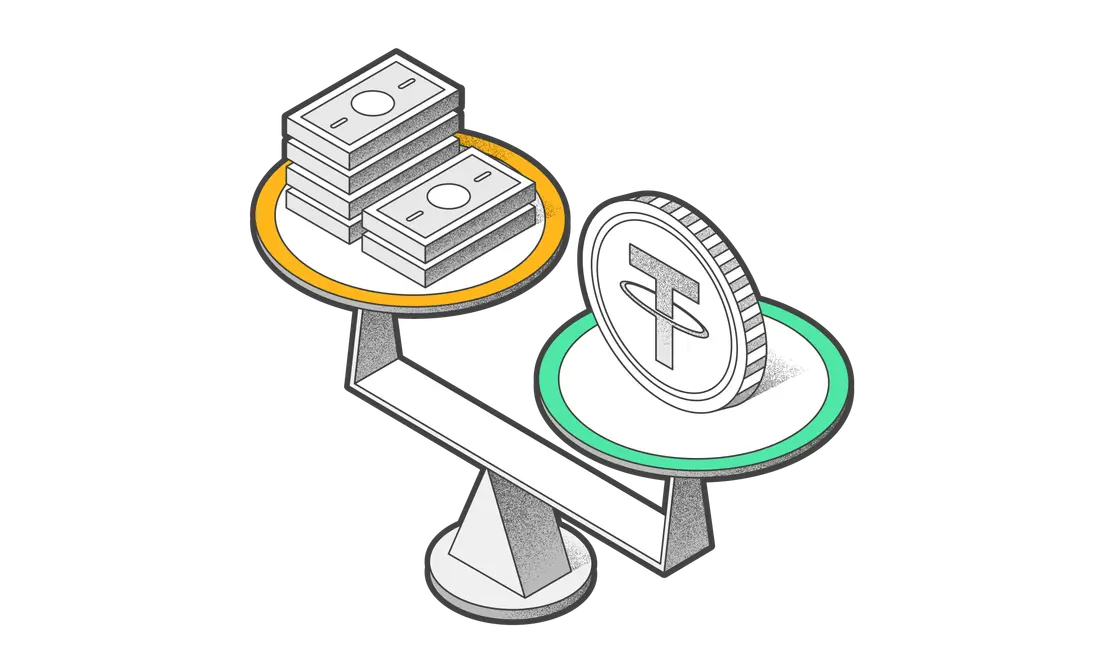
MiCA-licensed exchanges can no longer offer USDT to EU customers, because Tether chose not to get a MiCA license. A restriction on a regulated venue is not a ban on an asset. This guide explains what happened, what is still legal, and how to hold or swap your USDT without an exchange.
What Happened to USDT in Europe
MiCA sets rules for stablecoin issuers. To be listed on a licensed EU exchange, a stablecoin issuer needs its own authorization. Tether never applied for that e-money-token authorization, so USDT is not a compliant asset for any EU-regulated venue.
This was a deliberate choice. Tether CEO Paolo Ardoino said in April 2026 that MiCA's requirement to keep 60% of reserves in European bank deposits is incompatible with the company's business model, so it did not apply.
Tether's attestations show that about 80% of USDT's backing is in short-dated US Treasury bills, and those holdings are the company's main profit engine. Ardoino has called a MiCA license "very dangerous" for stablecoins, arguing that concentrating reserves in EU bank deposits adds its own risk.
Licensed exchanges then acted to protect their own licenses. Coinbase, Kraken, Binance's EU entity, and Crypto.com all removed USDT for European retail users, with most restrictions taking effect ahead of the 1 July 2026 deadline.
The scale is large, but the EU is not Tether's main market. USDT had a market value of about $184 billion in July 2026, far larger than USDC's about $73 billion. USDT remains dominant worldwide, even as it loses ground on Europe's licensed venues.
Is It Illegal to Hold USDT in Europe?
No. MiCA regulates service providers, not individuals. MiCA's Title V stops authorized exchanges from offering non-authorized stablecoins to the public, and that restriction applies to the venue, not the asset. You are not a venue.
This means you keep three clear rights. You can hold USDT in self-custody, and holding and self-custody remain legal. You can trade USDT on decentralized exchanges. You can send and receive USDT peer-to-peer. No EU law tells you to sell or convert the USDT you already own. The change only removes USDT from the order books of licensed exchanges.
Where Can You Still Use USDT in Europe?
You have three practical options. The first is the safest.
Self-Custody Wallets
A self-custody wallet holds your USDT with no exchange involved. You control the keys, so no venue can freeze or delist your balance.
Tangem supports USDT across 10+ networks, including Ethereum, Tron, and Solana. It needs no KYC to store your crypto, and it uses a seedless backup, so there is no seed phrase to lose.
Decentralized Exchanges (DEXs)
Decentralized exchanges still list USDT pairs. Uniswap, Curve, and PancakeSwap let you trade USDT directly from your wallet. MiCA does not apply to fully decentralized protocols, and DEX liquidity for USDT pairs has grown since the delistings. A DEX needs no KYC. Watch for gas costs and slippage before you trade.
Non-EU Exchanges
Some non-EU platforms still accept EU users and still list USDT. This route carries real risk. An unlicensed exchange gives you no MiCA consumer protections. If it freezes your account, no EU regulator can help you. Use self-custody instead, where you can.
MiCA-Compliant Stablecoin Alternatives
If you want a stablecoin that licensed EU exchanges accept, two options lead the market. Both come from Circle.
USDC (Circle)
USDC is the largest MiCA-compliant dollar stablecoin. Circle became the first global stablecoin issuer to comply with MiCA by obtaining an Electronic Money Institution license from France's ACPR. Of the top 10 stablecoins by market cap, only USDC complies with EU rules. It maintains a 1:1 peg to the US dollar and trades on all major licensed EU venues.
EURC and EURCV
EURC is Circle's euro stablecoin. It is issued under the same French EMI license, redeemable 1:1 for euros, and is the largest MiCA-compliant euro stablecoin by circulating supply. A euro stablecoin removes dollar FX risk for EU users. EURCV is a second option, issued by Société Générale-FORGE, which cleared MiCA's requirements through the banking-law channel. Both settle on major networks such as Ethereum and Solana.
Here is how the three stablecoins compare. See our USDC vs EURC guide for details.
Stablecoin | Issuer | Peg | MiCA status | Approx. market value | Networks |
|---|---|---|---|---|---|
USDT | Tether | US dollar | Not authorised | ~$184B | Ethereum, Tron, Solana, and more |
USDC | Circle | US dollar | Compliant (EMI, ACPR France) | ~$73B | Ethereum, Solana, Base, Avalanche |
EURC | Circle | Euro | Compliant (EMI, ACPR France) | ~€370M | Ethereum, Solana, Avalanche, Stellar |
For the full set of compliant tokens, read our list of MiCA-compliant stablecoins.
How to Swap USDT to USDC Without an Exchange
You do not need an exchange to move from USDT to a compliant stablecoin. You can swap inside your Tangem wallet. The in-app swap converts one token to another directly. It requires no exchange account or KYC. This is a feature that Ledger does not offer natively.
Follow these five steps.
- Open the Tangem app and tap your USDT balance.
- Tap Swap.
- Select USDC as the token to receive.
- Enter the amount, check the network, and the rate.
- Confirm the swap with your card.
The swap settles on-chain to your own wallet. Send a small test amount first if you are new to swapping. For a full walkthrough, read how to swap USDT to USDC on Tangem and our guide to swapping MiCA stablecoins.
What Happens to USDT on European Exchanges?
Each exchange handled delisting differently. Most removed USDT trading pairs and asked users to act before a set date.
Binance's EU entity restricted USDT ahead of the deadline, alongside Coinbase, Kraken, and Crypto.com. Revolut set 31 August 2026 as the end of USDT access for EU users, with balances that remain to be converted to fiat.
Some platforms convert leftover USDT to euros or to a compliant stablecoin. Others let the balance sit, but block new USDT trades. Withdrawals to self-custody stay open on most platforms. The safest move is to withdraw your USDT to a wallet like Tangem before any conversion date. For the Binance case, read USDT on Binance EU.
MiCA regulates platforms, not your wallet. With Tangem, you can hold USDT, swap it to USDC on-chain, and manage your stablecoins without an exchange or KYC. Your keys stay in your hands, and so does your choice.
FAQ
-
No. MiCA regulates exchanges and other service providers, not individuals. You can hold USDT in a self-custody wallet with no legal issues.
-
Not on a MiCA-licensed exchange. You can still acquire USDT on decentralized exchanges or by swapping another token for it inside a self-custody wallet.
-
Only if Tether decides to seek MiCA authorization and meet the reserve rules. As long as the company declines that path, USDT stays off compliant EU venues, whatever its global size.
-
USDC is the most widely accepted compliant dollar stablecoin. EURC is the leading compliant euro option, removing dollar FX risk for EU users.
-
Yes. A wallet with a built-in swap, such as Tangem, lets you convert USDT to USDC on-chain without an exchange account.
-
USDC is a fully reserved, MiCA-regulated e-money token. Its reserves back each token 1:1 and are held at regulated European banks under prudential supervision. No stablecoin is risk-free, so hold only what you need.
-
DAI is not authorized as a MiCA e-money token, so licensed EU exchanges generally do not list it. You can still hold DAI in self-custody and use it on decentralized exchanges.
-
MiCA treats a stablecoin as e-money. The issuer must hold strict reserves and accept supervision to protect users.