



What Is USDC and How Can You Use It?

USDC in One Sentence
USDC (USD Coin) is a dollar-pegged stablecoin issued by Circle, designed to track one US dollar rather than act as a speculative asset. That single sentence is doing a lot of work. USDC sits at the intersection of crypto infrastructure and everyday money: it lives on blockchains, moves like any other token, and yet its value is meant to stay at exactly $1. That design makes it useful for things Bitcoin and Ethereum aren't suited for, paying bills, holding savings between trades, or sending money across borders without worrying about the price swinging 20% overnight.
What Backs USDC's $1 Value
The $1 target isn't maintained by an algorithm or by market pressure alone. Each USDC is backed 1:1 by cash and short-term US Treasury bills held in segregated accounts. Circle, the issuer, publishes monthly independent reserve attestations so anyone can verify that the backing exists.
Here's why that matters: if you hold 500 USDC, there should be $500 worth of cash-equivalent assets sitting in reserve on the other side. The token represents a claim on those reserves. Reserve backing supports the $1 target. It cannot guarantee a permanent $1 price. In March 2023, USDC briefly traded at $0.87 after Circle disclosed that $3.3 billion of its reserves were held at Silicon Valley Bank, which failed. The peg recovered, but the event showed that issuer risk is real. A reserve-backed design is much more stable than a market-priced asset, yet it still depends on the financial institutions holding those reserves.
Circle's monthly attestation reports are public. Reading them takes five minutes and gives you a clearer picture of what's actually backing your tokens than any marketing copy will.
USDC vs. Bitcoin: Why the Price Doesn't Move
Bitcoin and Ethereum are market-priced assets. Their value is set by what buyers and sellers agree on at any given moment, and that number can swing 10-30% in a single day.
USDC is different by design. Its value is anchored to cash and Treasury reserves, not to speculation or network demand. When Bitcoin drops 15% in an afternoon, a USDC holder doesn't feel that move. That stability is the entire point: USDC is a tool for transacting and storing value in dollar terms, not a bet on future price appreciation.
You give up the upside of a volatile asset in exchange for predictability. Someone holding USDC isn't expecting to get rich from price appreciation. They're expecting $1 in, $1 out, with the ability to move that dollar quickly across blockchain networks.
A price-stability design also doesn't make USDC government-insured or remove issuer and counterparty risk. Those are separate questions, and the March 2023 de-peg is a useful reminder that stability is a design goal, not a legal guarantee.
What Blockchain Does USDC Run On?
USDC doesn't live on one chain. As of September 16, 2026, Circle supports native USDC on 38 blockchain networks, including Ethereum, Solana, Base, Polygon, Avalanche, and BNB Chain. This matters more than it might seem at first. The chain is part of the token's practical identity.
USDC on Solana and USDC on Ethereum are different tokens. Sending Solana-based USDC to an Ethereum ERC-20 address can result in permanent loss. Before you send or receive USDC, you need to confirm both the network you're sending from and the network the recipient expects.
Moving USDC between chains requires a bridge protocol. Third-party bridges can be faster, but they introduce additional smart-contract risk on top of the standard token transfer.
A bridge is another system involved in the transfer, so its smart contracts become part of the decision. Check the network on both sides before you approve anything. If you only need USDC on one chain, get the native version for that chain. It avoids an unnecessary bridge and keeps the route easier to follow.
One practical note: Tangem Pay, Tangem's non-custodial payment account, specifically uses native USDC on Polygon. If you're funding Tangem Pay, you need Polygon-native USDC, not the Ethereum version.
The Two Things People Actually Do With USDC
Most USDC holders are doing one of two things: holding it or spending it.
Holding USDC means keeping it in a wallet you control. In self-custody, you hold the private keys and sign transactions locally, without relying on an exchange or other intermediary. A hot wallet (connected to the internet) can suit a small active balance.
Picture $50 you expect to use for payments this week. A cold wallet keeps your keys offline, which may make more sense for $5,000 you plan to leave untouched for six months. Those figures are just examples. The real choice comes down to how often you need access and how much responsibility you are prepared to take for the keys. Separate the wallet choice from the token choice. USDC's issuer risk stays the same in either place. Before moving funds, you still need to check the network and protect the keys.
The key risk of holding USDC on a platform rather than in a self-custody wallet is that you're still exposed to that platform's counterparty risk, even though USDC itself is reserve-backed. If the exchange freezes withdrawals or fails, your USDC is caught in that failure regardless of Circle's reserves.
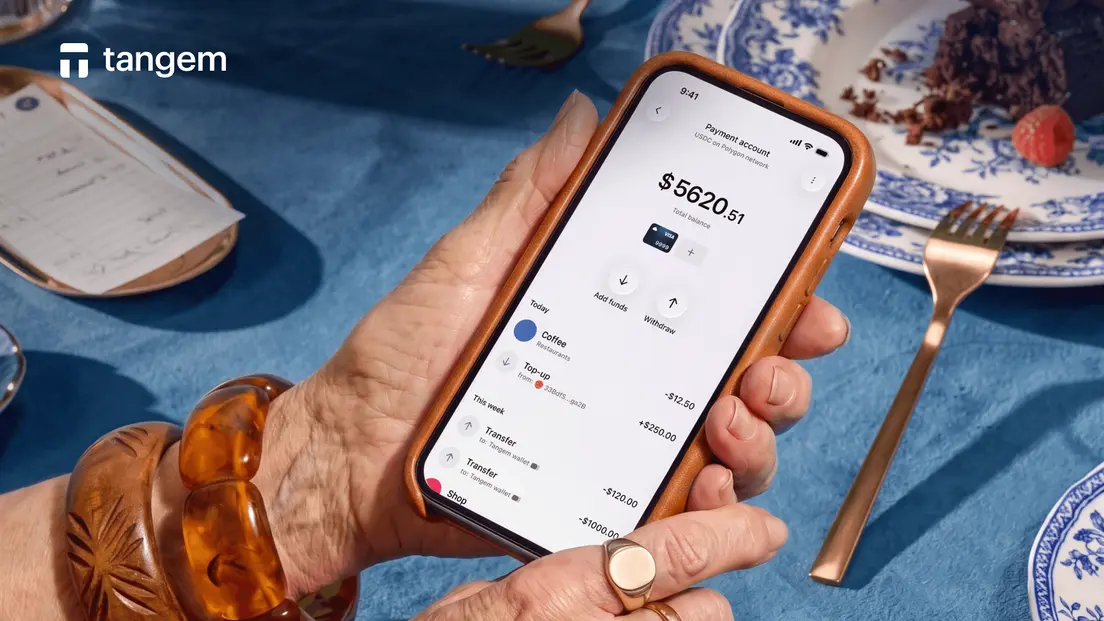
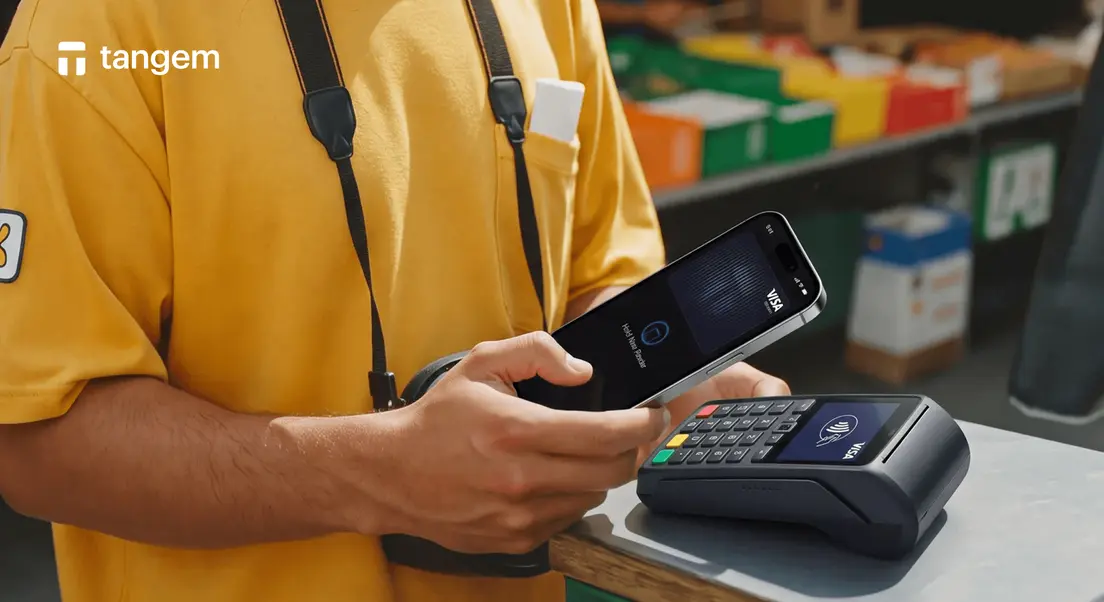
Spending USDC is increasingly practical. Tangem Pay, introduced in the Tangem app, is a non-custodial payment account. Top up the card with stablecoins and fiat. At purchase, USDC or USDT is converted 1:1 to USD, Visa processes the transaction, and the merchant receives USD. You can add the Tangem Pay card to Apple Pay or Google Pay.
Is USDC Safe to Hold?
The honest answer is: it depends on what risks you're weighing. USDC's reserve-backed structure makes it far more stable than market-priced cryptocurrencies. Circle publishes monthly attestations, and the token has maintained its peg through most market conditions. Holding it still involves issuer, platform, and key-management risks.
Two risks are worth understanding clearly. First, Circle has the technical ability to freeze USDC at a specific address for regulatory or compliance purposes. This is an issuer-level control that exists regardless of which wallet you use. Second, if you hold USDC on an exchange or custodial platform, you bear that platform's counterparty risk in addition to Circle's issuer risk.
Self-custody removes the exchange layer. It transfers the responsibility for private-key management entirely to you. Set it up carefully: lost keys have no recovery process. The March 2023 SVB event, when USDC briefly fell to $0.87, is a concrete example that even well-designed stablecoins can deviate from their target.
Поширені запитання
-
Yes. USDC is designed to track $1, but it can trade away from that price when people worry about its reserves or the institutions holding them. In March 2023, it briefly traded at $0.87 after Circle disclosed reserves held at Silicon Valley Bank. It later recovered.
-
USDC is a digital token that tracks the dollar's value 1:1. You hold it in a crypto wallet, while dollars in a bank account are held within the banking system. USDC doesn't carry FDIC insurance, and its value depends on Circle's reserve management and the health of the institutions holding those reserves.
-
Yes. Circle can freeze USDC at a particular address for regulatory or compliance reasons. That control comes from the issuer, not from the wallet, so storing the token in self-custody does not remove it. It remains part of USDC's issuer risk.
-
If an exchange halts withdrawals, you may not be able to access or move your USDC through that platform. The issue is the platform's counterparty risk, separate from Circle's reserves. Self-custody removes exchange custody risk, but you need to protect your private keys.


Не пропустіть 



Інші статті

