


 Switch to seedless. Get 30% off with SWITCH30 till Nov 02


Best Crypto Card for Travel in 2026
The best crypto card for travel overall is Tangem Pay: a non-custodial Visa card that integrates with Apple Pay or Google Pay and applies Visa's exchange rate to foreign purchases, with no separate provider FX markup
What matters most abroad: a low or zero FX fee on non-USD purchases, reasonable ATM withdrawal terms, wide Visa or Mastercard acceptance, Apple Pay or Google Pay compatibility, and travel perks that are actually available at your tier.
Quick comparison: best crypto travel cards
The table below reflects publicly available information as of October 2026. Fees, limits, and benefits vary by tier and region. Always verify current terms on the issuer's official site before applying.
| Card | FX fee | ATM fee & limit | Travel perks | Lounge access | Cashback abroad | Availability | Ideal for |
|---|---|---|---|---|---|---|---|
| Tangem Pay | Visa rate (no added provider fee documented) | 4% for Basic, 2% for Plus plan. 3 withdrawals/day ($250 max per withdrawal) | International Visa acceptance | Yes (depending on the tier) | Confirmed | Supported regions; check Tangem Pay | Self-custody advocates who pay by contactless and do need ATM access for cash withdrawal |
| ether.fi Cash | 0% on supported USD/EUR; margin on other currencies | Free withdrawals at Pinnacle/VIP | Visa Signature benefits, auto-rental insurance, travel cashback on ether.fi Travel | Yes (all membership levels) | 5% on ether.fi Travel | Region-dependent; eligibility required | DeFi users who want Visa Signature travel perks |
| KAST | 0.5%-1.75% | $3 + 2%; $250/withdrawal, $750/day | Visa Infinite (Premium/Private) | Not specified | 1.5%-3% | 170+ countries; check sign-up list | Cost-conscious travelers who want broad acceptance |
| Bybit Card | 0.5% (EEA/CH); 1.5%-7% elsewhere | 2% above monthly free allowance; €100 free (EEA/CH) | Mastercard acceptance | Not confirmed | 2%-10% (eligible tiers) | EEA, UK, UAE, Turkey, AU, LATAM; US unavailable | Active Bybit exchange users in supported regions |
| RedotPay | 1.2% | 2% up to $10,000/month; 3% above | Visa acceptance | Not confirmed | 3% (Pro, Apple/Google Pay; capped $18/month) | 100+ countries; restrictions apply | Travelers in Asia and emerging markets who use mobile payments |
| Crypto.com | 0%-2% depending on tier/region | 2% above monthly free; €200-€1,000 free by tier | Tier-dependent; higher tiers include lounge rebates | Yes (higher tiers) | Varies by tier | 90+ countries | Travelers who already use Crypto.com and qualify for a higher tier |
Fees, limits, and availability are subject to change. Check each provider's official page for current terms.
What makes a crypto card good for travel
Not every crypto card behaves the same when you cross a border. Here's what separates a good travel card from one that quietly drains your balance.
FX fee. When you pay in a currency other than your card's settlement currency, most providers apply a conversion markup on top of the base exchange rate. Even 1.5% compounds fast on a two-week trip.
ATM access. Physical cards with ATM access but charge 2-4% per withdrawal after a small monthly allowance. Know which category your card falls into before you need cash.
Acceptance network. Visa and Mastercard are accepted at hundreds of millions of merchants worldwide, but acceptance varies by country. A card that works across 150 million or 170 million merchant locations gives you real coverage.
Mobile wallet support. Apple Pay and Google Pay let you tap to pay without showing a physical card. Particularly useful when a physical card is lost or unavailable.
Travel perks. Lounge access, travel insurance, and hotel benefits are genuinely valuable, but only if your tier includes them and you use them often enough to justify any annual fee.
Custody model. A custodial card links to an exchange account where a third party holds your keys. A non-custodial card, such as Tangem Pay, keeps funds in a smart contract that you control.
Regional availability. Most crypto cards are not globally available. Eligibility depends on your country of residence, not where you're traveling.
Best crypto cards for travel in 2026
Tangem Pay
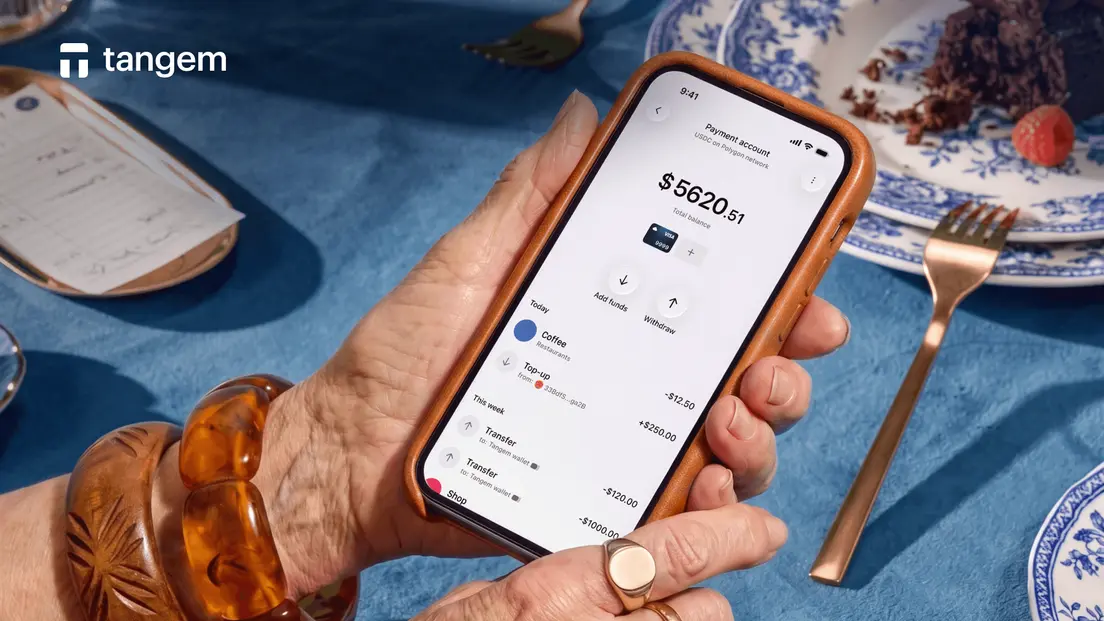
Tangem Pay is a non-custodial payment account built into the Tangem Wallet app. When you make a purchase, USDC converts 1:1 to USD, the transaction processes through Visa, the merchant receives USD, and the equivalent USDC is deducted from your account.
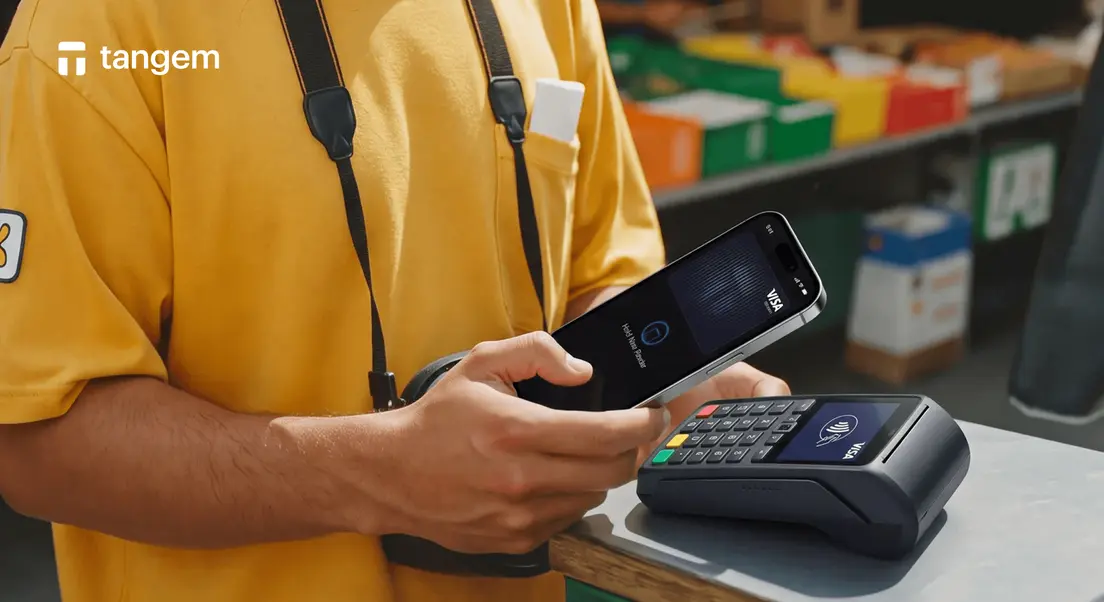
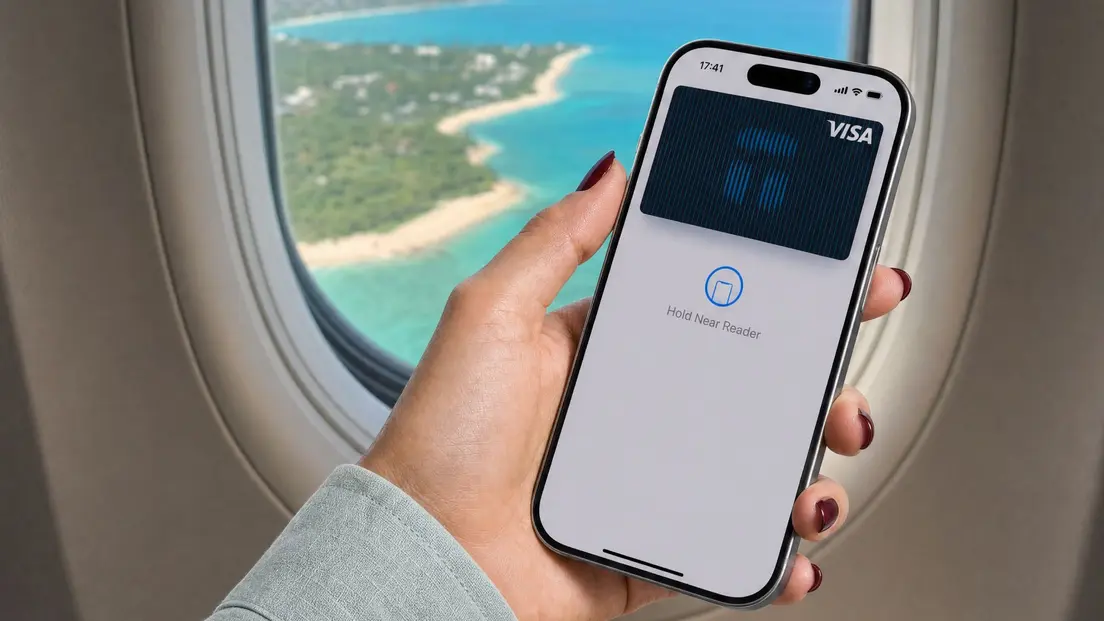
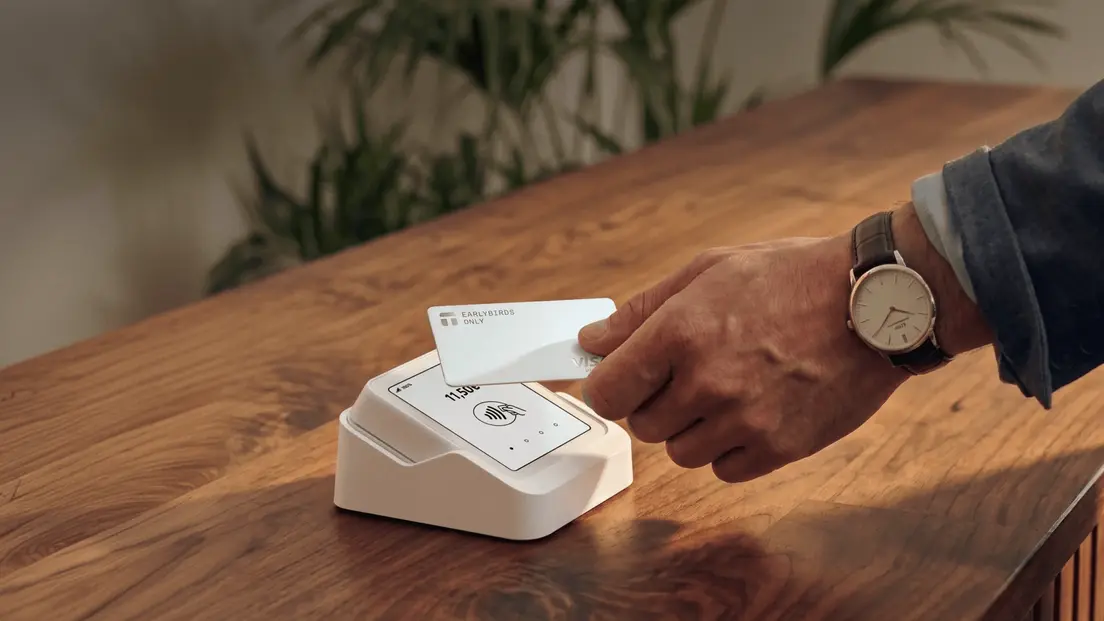
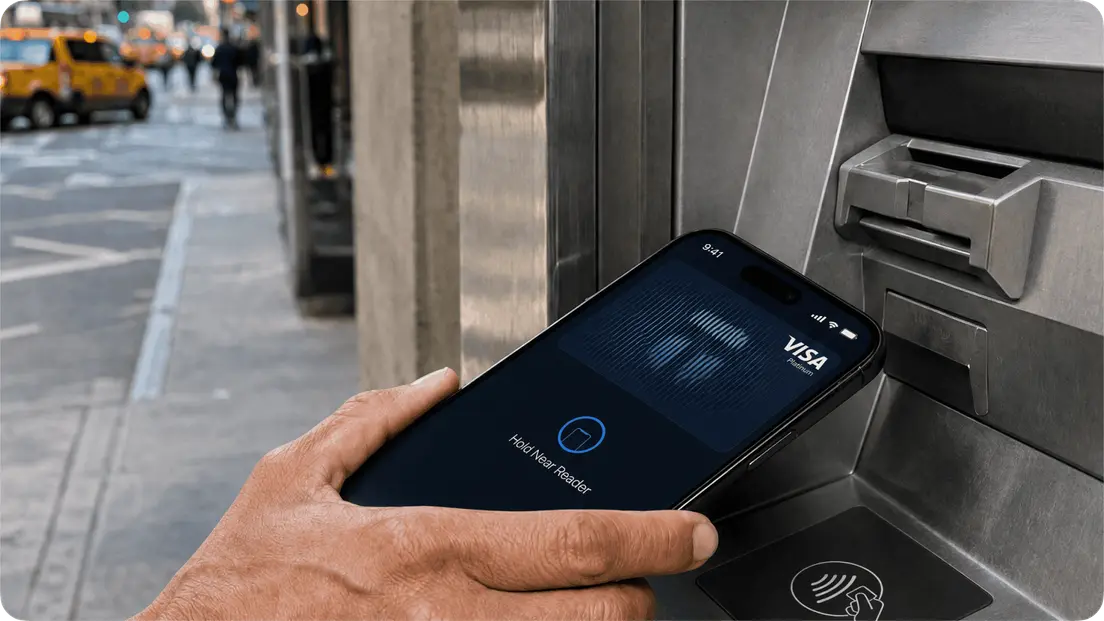
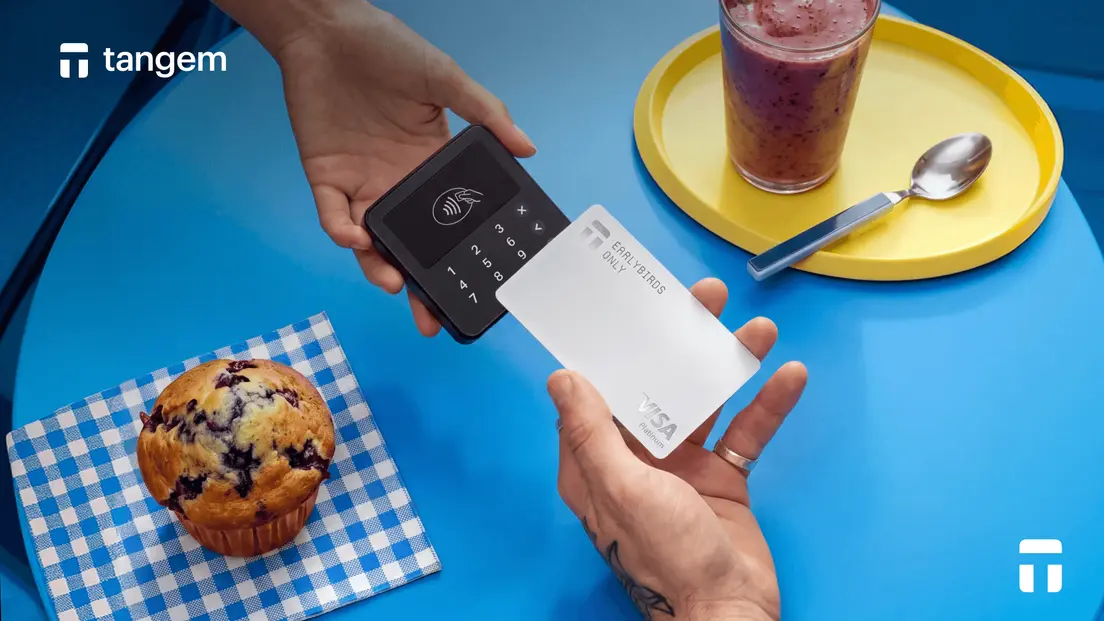
The Tangem Pay card can be added to Apple Pay or Google Pay, which covers most in-store contactless payments abroad. International transactions are supported, and Visa's foreign-exchange rates apply to non-USD purchases. No separate provider FX markup is documented in the current product materials. The Tangem Pay physical card is also available for POS payments (coffee shops, stores).
Best for: Self-custody advocates, Tangem hardware wallet users, and travelers who pay primarily with contactless and need access to ATMs.
ether.fi Cash
ether.fi Cash describes itself as a non-custodial account and issues Visa cards at multiple membership levels. All levels include Visa Signature benefits, auto-rental insurance, lounge benefits, and 5% cashback specifically on ether.fi Travel purchases.
ATM withdrawals are free at Pinnacle and VIP membership levels. FX fees are 0% on supported USD and EUR spending; other currencies incur an FX rate plus a membership-level margin, and the official FAQ does not state a single fixed total fee for all cases.
Pricing: Core costs $50 for a physical card, Luxe is $199/year (plus $100 for a physical card), and Pinnacle is $999/year (plus $100 for a physical card). The 5% cashback applies to ether.fi Travel, not all overseas spending. It's worth understanding before treating this as a general-purpose travel rewards card.
Best for: DeFi users who want Visa Signature travel perks and are comfortable with a membership fee.
KAST
KAST issues Visa Platinum (Standard) and Visa Infinite (Premium/Private) cards. Standard is free (physical card shipping costs $40); Premium is $1,000/year; Private is $10,000/year.
FX fees run 0.5%-1.75%. ATM withdrawals cost $3 plus 2% of the amount, with a $250 per-withdrawal cap and a $750 daily limit. Cards are accepted at 150 million+ merchants in 170+ countries, with support for Apple Pay and Google Pay. Cashback is 1.5% (Standard), 2% (Premium), and 3% (Private).
Best for: Cost-conscious travelers who want broad acceptance and cashback without a high annual fee.
Bybit Card
Bybit Card offers virtual and physical cards on Mastercard (and Visa, depending on region). FX fees are region-dependent: 0.5% in the EEA and Switzerland; 2% in Australia, Asia-Pacific, Georgia, Kazakhstan, and Mexico; 1.5% in Brazil; and 7% in Argentina. ATM withdrawals incur a 2% fee above the monthly free allowance; the EEA/Switzerland free allowance is €100.
Cashback runs 2%-10% under eligible rewards tiers. Apple Pay and Google Pay are supported. Bybit Card is available in the EEA, UK, UAE, Turkey, Australia, Argentina, Brazil, Kazakhstan, Asia-Pacific, Mexico, and Georgia. The United States, Canada, China, Japan, South Korea, and Singapore are listed as unavailable. No current authoritative source confirms coverage for travel insurance or airport lounge access. Bybit Card funds sit in a custodial exchange account. That is a meaningful difference from the non-custodial models above.
Best for: Active Bybit exchange users in supported regions who want cashback on everyday spending
RedotPay
RedotPay charges a 1.2% FX fee on non-USD purchases. ATM withdrawals cost 2% up to $10,000 monthly and 3% above that, with daily limits of $3,750 and monthly limits of $50,000. The card is accepted at more than 130 million merchants worldwide.
RedotPay Pro offers 3% cashback on Apple Pay and Google Pay purchases, capped at $18 monthly. No current authoritative source confirms coverage for travel insurance or airport lounge access. Card issuance is available in more than 100 countries, subject to jurisdictional restrictions.
Best for: Users in emerging markets who want broad acceptance and cashback on mobile payments.
Travel perks that matter: insurance, lounges, and hotels
Travel perks sound great in marketing copy. They're worth less if you don't understand the conditions attached.
Travel insurance on payment cards generally requires you to book some or all of the trip using the eligible card. Covered events, cancellations, delays, baggage loss, and medical expenses come with limits, documentation requirements, and exclusions for pre-existing conditions or voluntary changes. Read the benefit guide before your trip, not after something goes wrong.
Lounge access varies significantly by program. Enrollment, eligible flights, guest limits, capacity controls, participating locations, and per-visit fees can all apply. Among the cards reviewed here, Tangem Pay offers lounge access, depending on the tier. ether.fi Cash includes lounge benefits at all membership levels. Crypto.com offers lounge access at higher tiers. KAST does not specify lounge access in the current materials. Bybit and RedotPay have no confirmed lounge benefits.
- Hotel benefits on cards typically require booking through a specified channel or participating property. Credits, upgrades, late checkout, and elite status are only valuable if you'd use the included benefits at properties you'd actually stay at.
Here's the honest issue with travel perks on crypto cards: most key benefits are reserved for higher subscription tiers or for significant staking requirements.
A card that charges $999/year for lounge access and travel insurance only makes financial sense if you travel frequently enough to extract that value. For occasional travelers, a no-fee card with a reasonable FX rate often delivers better real-world value.
Fees to watch abroad
FX fees get the most attention, but they're not the only cost that matters when you pay abroad.
Dynamic currency conversion (DCC). A foreign merchant or ATM may offer to charge you in your home currency instead of local currency. This sounds convenient, but it typically uses a worse exchange rate than your card's own conversion rate. Always choose to pay in local currency.
ATM operator surcharges. Even if your card charges no ATM fee, the ATM owner can add its own usage fee. This is separate from your card's stated withdrawal rate and appears on the ATM screen before you confirm the transaction.
Cross-border charges. Some issuers add a network-level cross-border fee on top of their stated FX fee. Check whether the FX fee shown in your card's terms is the total cost or just one component.
- Merchant preauthorization holds. Hotels, car rental companies, and gas stations commonly place a temporary hold on your card for an amount larger than the final charge. This reduces your available balance until the hold is released, which can take several days. If your card balance is close to the hold amount, a transaction may be declined even though you have enough funds for the purchase.
For practical guidance on keeping conversion costs down, see how to avoid high fees when paying with crypto.
Which crypto travel card should you choose?
Choosing the best crypto card for travel comes down to three questions: how much you're paying to convert currencies, what perks you actually need, and who controls your funds. For travelers who want self-custody and a non-custodial Visa card with no documented FX markup, Tangem Pay is the clearest starting point.
If you're already a Tangem wallet user, Tangem Pay integrates directly with your existing setup. You don't need a new app or separate account, and your main wallet holdings stay private.
Not financial or tax advice. Tangem Pay availability, fees, and features depend on your country of residence and eligibility. Fees, limits, and availability are subject to change. Check the Tangem Pay page for current terms.
FAQ
-
Usually, yes, if your provider issued the card to residents of your country and the merchant accepts its payment network. Eligibility follows your country of residence, not your destination. Visa and Mastercard acceptance is broad, but a provider can still restrict issuance or service by region, so check its current terms before departure.
-
A virtual card you use through Apple Pay or Google Pay may be unavailable until you regain access to an approved device. Before you leave, confirm the issuer's documented lock-and-support procedure and carry a separate payment option for emergencies.
-
Check the provider's lock-and-support procedure before you leave. A custodial provider can restrict access to the card account. With Tangem Pay, a frozen card disconnects from the Visa network, while the on-chain USDC balance is unaffected.
-
Contactless payments require an approved device and a virtual card in its wallet. Carry a separate payment option, because a phone without access to that card can leave you unable to pay.
-
Most do, but the amounts vary significantly. Tangem Pay applies Visa's exchange rate with no separate provider FX markup documented in current materials. KAST charges 0.5%-1.75%. RedotPay charges 1.2%. Bybit charges 0.5% in the EEA and Switzerland but 2% in most other regions. Crypto.com's fee depends on tier and region. Always check the current fee schedule on the issuer's official site, as these terms change.
-
Tangem Pay includes access to an airport lounge, depending on the tier. ether.fi Cash includes lounge benefits at all membership levels. Crypto.com offers lounge access at higher tiers. Among the other cards reviewed here, KAST does not specify lounge access in its current materials, and no authoritative sources currently confirm lounge access for the Bybit Card or RedotPay. Lounge benefits typically require enrollment and may have guest limits, capacity restrictions, or location-specific requirements. Check the benefit guide for your specific card.
-
Reasonably safe, with some precautions. The main risks are the same as with any payment card: phishing, device compromise, and physical loss of the card. A documented best practice is to keep only a small active-use balance on your card and store the bulk of your holdings in cold storage, which limits the impact if the card account is compromised. Never share your seed phrase (if your wallet uses one) while traveling or otherwise. Anyone who has it controls those funds. With Tangem Pay, a frozen card disconnects from the Visa network, while the on-chain USDC balance is unaffected.
-
A custodial card links to an exchange or provider account where a third party holds your private keys. A non-custodial card connects to a wallet where you hold the keys. The practical difference for travelers: if a custodial provider freezes your account or goes offline, you can't access your funds. With Tangem Pay, for example, if the card is frozen, the documented effect is disconnection from the Visa network, but your on-chain USDC balance is unaffected. The trade-off is that non-custodial accounts place the responsibility for backups and key management on you.
-
No. Tangem Pay offers virtual and physical cards and supports Apple Pay and Google Pay for in-store contactless payments. KAST and ether.fi Cash also offers virtual cards. Physical cards are useful for ATM access and for merchants that don't accept contactless payments. For most urban travel, a virtual card on your phone covers most payment situations.


Don't miss these 


Other articles

