

 Switch to seedless. Get 30% off with SWITCH30 till Nov 02


Real-World Assets (RWAs): Bringing Securities, Gold, and More Onchain
This article is available in the following languages:
What are real-world assets?
Real-world assets (RWAs) are assets that exist outside crypto, such as company shares, gold, or government bonds, that are tokenized on a blockchain. A token is a digital receipt for the asset. You hold it in your wallet like any other crypto.
In this article
- How tokenized securities and gold work
- Tokenized stocks in Tangem
- What are yield-bearing stablecoins?
- Practical tips for holding and swapping RWAs
- Why swap with Tangem
How tokenized securities and gold work
- A company, the issuer, holds the real asset. For example, real shares or gold are kept in a reserve with a regulated custodian.
- The issuer creates the same amount in tokens. Each token is backed by the asset in reserve.
- The tokens live on a blockchain. You can hold, send, and swap them just like any other token.
- Tokens can be redeemed. When tokens are taken out of circulation, the issuer releases the matching asset from its reserve.
The token is a real blockchain token, but the underlying asset is held by the issuer. So you rely on the issuer to keep the reserve.
Tokenized stocks in Tangem
Tangem's xStocks integration brings traditional securities to the blockchain through a carefully structured framework:
- Price exposure, not ownership. An xStock follows the price of a real share or ETF. It is a tracker certificate, not the share itself. It gives no shareholder rights, such as voting.
- Backed 1:1. For every token, the issuer holds the matching share with a regulated custodian in a separate account. If the issuer fails, an independent security agent can take control of these assets and pay out the token holders.
- Dividends are added to your token amount. You do not get a cash payment. Dividends are reinvested in additional shares of the same stock after applicable taxes. Your balance grows, and stock splits adjust it accordingly. Your total value stays the same.
- Issuing and redeeming follow market hours. The issuer creates and redeems tokens on US business days. The tokens themselves can be traded on-chain at any time.
Real assets tab
Use this tab to find tokenized real-world assets. These are stocks, gold, and bonds that you swap and hold in your own wallet.
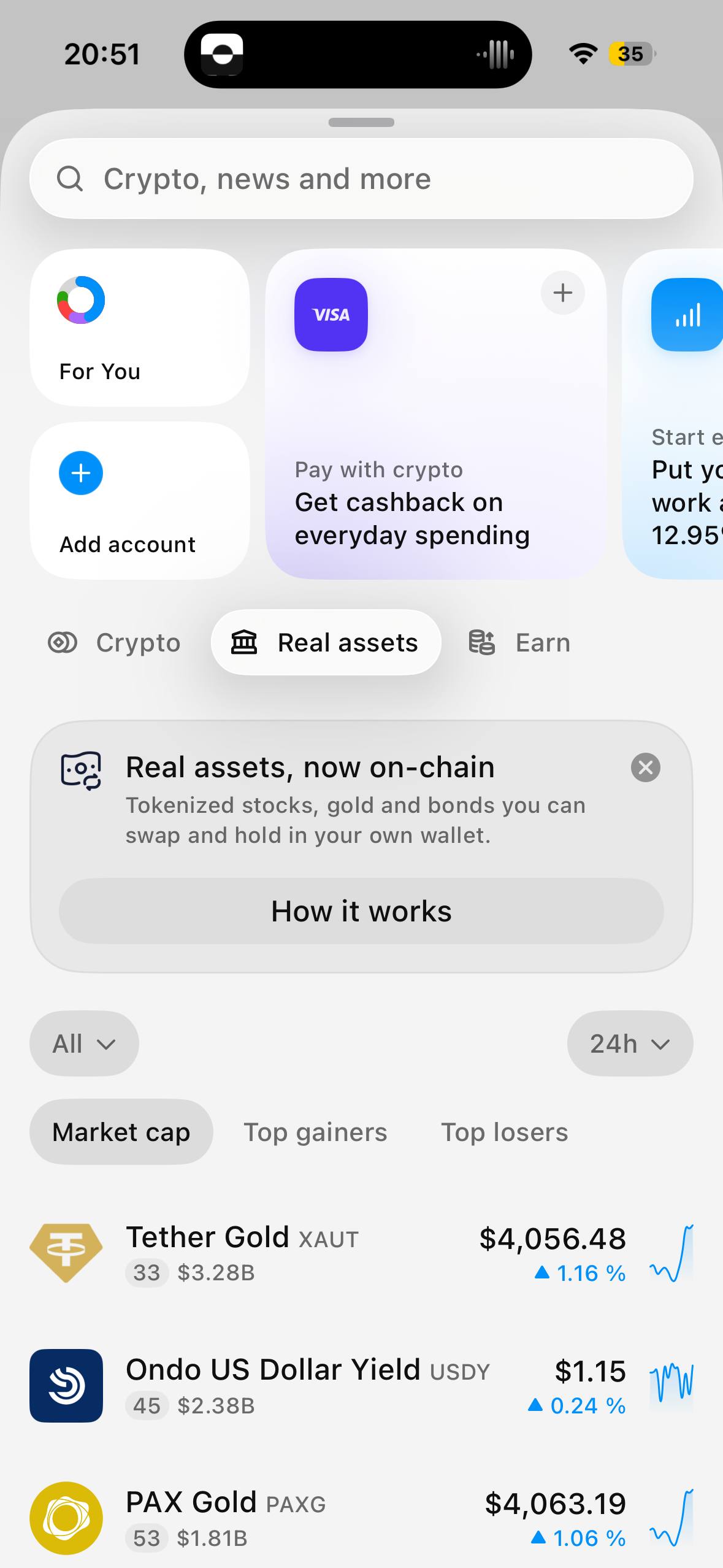
Each row shows the asset name, ticker, price, 24-hour change, and market cap. Blue means the price went up. Red means the price went down.
Sort the list by market cap, Top gainers, or Top losers. Change the period with the 24h filter.
Filter by category
Tap the All filter. The Category sheet opens.
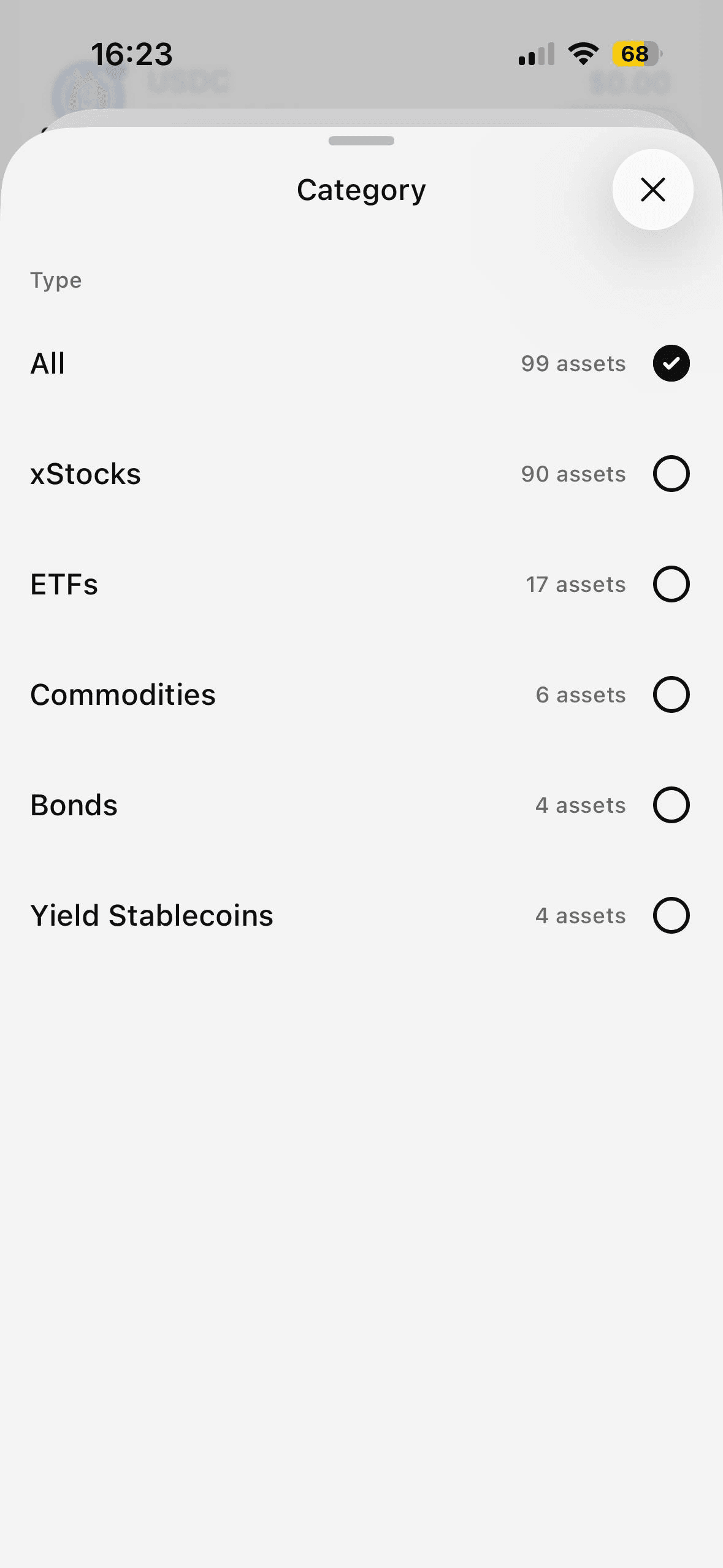
Choose one type:
- xStocks: Tokenized versions of real company shares that you hold and swap in your own wallet.
- ETFs: Tokenized funds that track a basket of assets, such as an index, in a single token.
- Commodities: Tokens that represent physical goods, such as gold, and follow their market price.
- Bonds: Tokens that represent debt instruments, such as government treasury bills, that pay interest over time.
- Yield Stablecoins: Tokens pegged to a stable currency, such as the US dollar, that pass yield from underlying assets to the holder.
What are yield-bearing stablecoins?
A regular stablecoin aims to maintain a value of $1. A yield-bearing stablecoin does too, but its issuer also invests the reserves—for example, in short-term government bonds or through lending. The profits go to holders, either as a growing balance or as a gradually rising token price. Yield can vary over time and isn’t guaranteed.
Practical tips for holding and swapping RWAs
- Use Ethereum or Solana: Choose swap providers that have the deepest liquidity on these two networks, so you get better rates.
- Pick the right pair. For xStocks, liquidity is best against USDC. Tokenized gold can be swapped for both USDC and USDT.
- Mind the market hours. RWA tokens are regular tokens, but the issuer links them to the traditional market by creating and redeeming them at the current market price.
On weekends and holidays, the main market is closed, so the issuer cannot do this. Onchain liquidity gets thin, and rates can be worse. If you can, swap while the market is open.
- Check availability in your country. xStocks are not offered in the following countries:
Afghanistan, Belarus, Canada, Central African Republic, Congo (Democratic Republic of the), Cuba, Ethiopia, Haiti, Iran, Iraq, Korea (Democratic People’s Republic of), Lebanon, Libya, Mali, Mozambique, Myanmar, Nicaragua, Nigeria, Philippines, Russian Federation, Somalia, South Sudan, Sudan, Syrian Arab Republic, Ukraine, United Kingdom, United States of America, Venezuela, Yemen and Zimbabwe.
Why swap RWAs with Tangem?
Swap one stablecoin for another with no provider fee. USDT to USDC, USDC to DAI, any supported pair. Most exchanges and aggregators take 0.1% to 0.5% on stablecoin pairs that should trade at par. Tangem charges zero on these swaps because a dollar should stay a dollar when you change the label.
Bridge the same token between networks with no provider fee. Move your USDC between Ethereum and Solana with one tap. Cross-chain bridges often charge a flat fee or a spread on top of gas. Tangem absorbs the provider cost, so you only pay the network fee.
Both routes get your stablecoins to where RWA liquidity is deepest. More RWA protocols are deployed on Ethereum and Solana than on any other networks. Your capital arrives there without a haircut.


Don't miss these 
Other articles

