



Leveraged eETH wallet
The most secure hardware wallet for your Leveraged eETH
Protect your Leveraged eETH with Tangem, the leading choice for thousands of savvy investors worldwide!
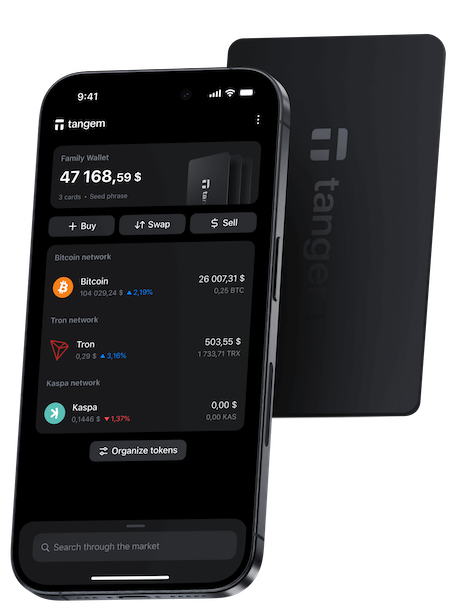

How to secure your Leveraged eETH with Tangem?
When you buy or hold Leveraged eETH in Tangem, it secures your private keys in many ways:
- With Tangem's seedless setup and multi-card backup, your Leveraged eETH stays in your hands only.
- IP69K water/dust protection keeps the cards safe from heat, cold, shocks, and X-rays.
- Access code + biometric lock inside Tangem Mobile prevent unauthorized use.
- Private keys are generated and stored inside the EAL6+ secure element — never leaving the card.
How to get a Leveraged eETH Crypto Wallet?
Tangem products are for everyone, from beginners to experts. They keep your crypto safe and easy to manage. With cutting-edge technology, Tangem lets you control and protect your digital assets.
Buy TangemWhy choose Leveraged eETH wallet with Tangem.
Privacy
No registration and KYC required to use the app. We don't track your data.

Security
Your private keys are encrypted and never leave your device. Only you have control over your funds.

Convenient designs
Choose from a variety of elegant designs, including unique co-branded editions and our innovative ring-form factor wallet, ensuring both style and functionality.

24/7 Customer care
Fast support for your needs. Live chat and email support for customers from all over the globe.

What is Leveraged eETH (XEETH)?
Think of xeETH as the volatile half of a pair. A reserve of eETH, ether.fi's liquid restaking token, backs two claims at once: a dollar-stable token that is held at one dollar of value, and xeETH, which absorbs everything else. Because the stable half never moves, the whole swing of the reserve lands on the volatile half, and a move in ETH shows up here magnified.
What makes this one particular is the collateral. eETH is ETH that has been staked and then restaked, so xeETH is exposure to ETH stacked on top of a restaking receipt: the accrual inside eETH flows into the reserve, and the operator and restaking risk of eETH sits underneath your position too. There is no borrowed money in the structure, so there is no funding charge and the risk of liquidation is low, and xeETH can be redeemed for its share of the reserve at any time.
Holders confuse xeETH with eETH more often than you would expect. They are not interchangeable: eETH is a one-to-one style claim on staked ETH, xeETH is the leveraged remainder after the stable side is covered.
This is a position people take for a long ETH view, and long positions do badly with key rotation. In Tangem the private key is generated inside the card's secure element and never leaves it, a second identical card serves as the backup, and a recovery phrase exists only if you deliberately choose to add one. Supported networks in Tangem (1): Ethereum. Storage that asks nothing of you between the mint and the redemption is what a position held this long actually needs.
Leveraged eETH XEETH


Tangem supports other cryptocurrencies
Reliability and convenience at your fingertips. Manage thousands of cryptocurrencies with peace of mind anywhere and anytime
See all supported cryptosLeveraged eETH FAQ
- A reliable wallet for XEETH should prioritize robust security and user-friendly access. Tangem offers offline protection coupled with straightforward mobile management.
- Software wallets for Leveraged eETH are often free, but hardware wallets usually require a one-time purchase. Sending transactions may involve network fees.
- The safest Leveraged eETH wallet keeps your private keys offline and protected from unauthorized access. Hardware wallets, such as Tangem, offer the highest level of protection because they isolate keys from online risks.
- A Leveraged eETH wallet is a tool that lets you store, send, and receive your digital assets. It manages your private keys, which prove ownership of your XEETH.
- A reserve of eETH, the liquid restaking token from ether.fi. That reserve backs both a dollar-stable token and xeETH, and xeETH takes the entire price movement because the stable side is fixed at a dollar of value.
- No. eETH tracks staked and restaked ETH roughly one to one, while xeETH is the leveraged residual claim on an eETH reserve after the stable token's dollar value is covered.
- The structure has no borrowing behind it, so there is no periodic funding charge and the risk of liquidation is low; redemption is against the reserve itself.
Related articles
Learn more



Something went wrong
Please
Don’t miss! 🚀 We drop prices for 20%
Flash sale expires soon! Stakes with BTC Reward Tap & Get

00:00:00

