


US Crypto Tax Deadline 2027: How to Report 2026 Transactions

- When is the US crypto tax deadline for 2026 transactions?
- What are the penalties for filing or paying late?
- Which crypto transactions do you have to report for 2026?
- Which forms do you use to report crypto on your 2026 return?
- What does Form 1099-DA show for 2026 transactions?
- How are crypto gains taxed for 2026?
- How do you report your 2026 crypto transactions step by step?
- How do you prepare your 2026 crypto tax report in the US?
You traded crypto in 2026. Now you're staring at a calendar wondering exactly when the IRS expects you to deal with it, and what "dealing with it" actually means in practice. The deadline, the forms, the broker statements that may or may not show your cost basis: it's a lot to untangle.
When is the US crypto tax deadline for 2026 transactions?
15 April 2027. That's the derived federal deadline for filing Form 1040 and paying any tax owed for tax year 2026. The IRS's standing rule places the due date on the 15th day of the fourth month after the tax year ends. When this guide was verified on 22 November 2026, the IRS had not yet published a 2027-specific filing date, so the date is derived from that standing rule rather than a confirmed IRS announcement. DC Emancipation Day falls on Friday, 16 April 2027, after the deadline, not on it, so it does not push the date forward.
Need more time to file? Form 4868 gives you an automatic six-month extension, moving the filing deadline to a derived 15 October 2027. File it by 15 April 2027. The IRS is clear on one point: an extension of time to file is not an extension of time to pay. Whatever you owe is still due on 15 April 2027.
Here's the full calendar:
| Date | What is due | Status and source |
|---|---|---|
| 15 January 2027 | Fourth 2026 estimated tax payment, Form 1040-ES | Confirmed on the 2026 Form 1040-ES |
| 1 February 2027 | File the 2026 return and pay in full to skip the 15 January payment | Confirmed on the 2026 Form 1040-ES |
| 15 April 2027 | Form 1040 filing and payment of tax owed | Derived from the IRS standing rule; not yet published by the IRS |
| 15 April 2027 | Form 4868 extension request | Derived; due by the original due date |
| 15 April 2027 | FBAR, FinCEN Form 114, where required | Derived from the 15 April rule in IRS IRM 4.26.16 |
| 15 October 2027 | Extended Form 1040 and automatic FBAR extension | Derived from the six-month extension rules |
Whichever date applies to you, the figures on Form 8949 come from a complete record of every exchange account and self-custody wallet you used in 2026. You can turn your wallet history into Form 8949 using the method described later in this guide.
What are the penalties for filing or paying late?
- The failure-to-file penalty is 5% of unpaid tax for each month or part of a month the return is late, capped at 25%. For returns due after 31 December 2025, a return filed more than 60 days late carries a minimum penalty of $525. When both the failure-to-file and failure-to-pay penalties apply in the same month, the failure-to-file penalty is reduced by the failure-to-pay amount.
- The failure-to-pay penalty is 0.5% of unpaid tax per month or part of a month, capped at 25%. It drops to 0.25% during an approved installment plan if the return was filed on time, and rises to 1% if tax remains unpaid 10 days after a notice of intent to levy. Interest accrues on top of all of this.
Filing on time, even if you can't pay in full, significantly limits the damage.
Which crypto transactions do you have to report for 2026?
The IRS treats digital assets as property, not currency. That single classification drives everything. Selling, exchanging, or otherwise disposing of crypto can trigger a reportable capital gain or loss. Receiving crypto as income is reported as income.
Every Form 1040 filer must answer the digital asset question, a Yes/No box near the top of the form. It asks whether at any time during the tax year you received a digital asset as a reward, award, or payment for property or services, or sold, exchanged, or otherwise disposed of a digital asset or a financial interest in one.
The IRS gives specific examples that require a Yes:
- Mining, staking, or similar activities
- Receiving a hard-fork airdrop
And one example that does not, by itself, require Yes: having purchased only digital assets with US or other real currency, or having held them only in a wallet or account.
Staking rewards follow Rev. Rul. 2023-14: a cash-method taxpayer includes them in gross income at fair market value in the year the taxpayer gains dominion and control over the rewards, including rewards received through an exchange. The IRS Digital Assets page also references Rev. Rul. 2019-24 on hard forks and airdrops, and TC Memo 2026-46, which holds that staking rewards are income.
One thing that does not constitute a taxable disposal is transferring crypto between wallets, addresses, or accounts you own. That transfer alone is a No for the Form 1040 question. Any crypto used or withheld to pay the transfer fee is treated differently.
Which forms do you use to report crypto on your 2026 return?
Disposals go on Form 8949, with totals carried to Schedule D. Crypto income goes on Schedule 1 or Schedule C. Here's the full map from the IRS Digital assets page:
| Transaction type | Form |
|---|---|
| Sales, exchanges, and other dispositions of capital-asset digital assets | Form 8949 → Schedule D |
| Forks, staking, mining, and other ordinary income | Schedule 1 |
| Independent-contractor payments and customer sales in a business | Schedule C |
| Digital-asset wages | Form 1040 |
| Gifts of digital assets | Form 709 |
For Form 8949 specifically, digital asset disposals use boxes G through L in the 2025 instructions. Digital assets must not use boxes C or F.
| Holding period | Form 1099-DA with basis reported to the IRS | Form 1099-DA with no basis or basis not reported | No Form 1099-DA received |
|---|---|---|---|
| Short-term, one year or less | Box G | Box H | Box I |
| Long-term, more than one year | Box J | Box K | Box L |
There's a Schedule D shortcut worth knowing: you can enter totals directly on line 1a or 8a only when the 1099-DA shows the basis reported to the IRS, and you have no adjustments.
FBAR note: FinCEN Form 114 is due 15 April with an automatic extension to 15 October if foreign accounts totaled more than $10,000 at any point in the year, per IRS IRM 4.26.16 (transmittal 26 August 2025). FinCEN Notice 2020-2, as reported by TaxesForExpats (updated 23 September 2026), states that a foreign account holding only virtual currency is not currently reportable, while an account that also holds fiat or securities is.
What does Form 1099-DA show for 2026 transactions?
Form 1099-DA is the broker information return for digital-asset transactions. Brokers report gross proceeds for transactions from 1 January 2025. For 2026, they also report cost basis, but only for covered securities: digital assets acquired after 2025 for cash and held in a custodial account through the broker's sale. Assets acquired before 2026 or transferred into the broker are noncovered, so basis reporting is not required for them.
The 2026 Form 1099-DA instructions include de minimis rules. Under the optional reporting method:
- Qualifying stablecoin sales are not reported individually if aggregate annual gross proceeds are $10,000 or less
- Specified NFTs have a $600 threshold
- Processor digital-asset payments of $600 or less a year are not reported
Notice 2024-57 temporarily exempts several transaction types from 1099-DA reporting: wrapping, liquidity-provider transactions, staking, lending, short sales, and notional principal contracts.
Here's the key point: you must report all digital asset income, gains, and losses on your federal return, whether or not you receive a Form 1099-DA. The form doesn't determine your obligation. It is just a starting point. Non-custodial, decentralized brokers that do not take possession of assets are outside the final regulations for custodial brokers. The separate DeFi broker rule was overturned by H.J. Res. 25, signed on 10 April 2025.
How are crypto gains taxed for 2026?
The holding period determines the rate. Crypto held for more than one year produces long-term gains, taxed at 0%, 15%, or 20% depending on your income. Short-term net gains, assets held one year or less, are taxed as ordinary income. Net capital losses can offset other income by up to $3,000 per year ($1,500 if married filing separately). Unused losses carry forward to future years.
The 2026 long-term capital-gains thresholds, from Rev. Proc. 2025-32 (IR-2025-103, 9 October 2025):
| Filing status | 0% rate applies up to | 15% rate applies up to |
|---|---|---|
| Married filing jointly | $98,900 | $613,700 |
| Head of household | $66,200 | $579,600 |
| Single | $49,450 | $545,500 |
| Married filing separately | $49,450 | $306,850 |
The 2026 standard deduction from the same Rev. Proc. is $16,100 for single filers and $32,200 for married filing jointly.
Cost basis is tracked on a wallet-by-wallet basis. Since 1 January 2025, Treas. Reg. §1.1012-1(j) requires that the basis be tracked wallet by wallet or account by account. Within a single unhosted wallet, you may specifically identify which units you sold, as long as the identification is recorded by the sale date and time and your records confirm those units left that wallet. Without a valid identification, the earliest-acquired units in that wallet are treated as sold first (FIFO within the wallet).
Notice 2025-7, which allows taxpayers to make specific identification of assets held with brokers through their own records or standing orders, covered only the period from 1 January to 31 December 2025. It does not extend to 2026 sales.
On wash sales: the statutory wash-sale rule applies to stock or securities. H.R. 10357 would extend the wash-sale rules to digital assets traded, but it is proposed legislation, not law.
How do you report your 2026 crypto transactions step by step?
- List every exchange account and self-custody wallet you used in 2026. Basis is tracked wallet by wallet, so the list needs to be complete.
- Collect each Form 1099-DA your brokers send for 2026. Check the filer, asset, proceeds, basis, and whether the asset is marked as noncovered.
- Build a full transaction record for each self-custody wallet from its public addresses. A broker can use customer-provided acquisition information for lot selection but cannot report the basis of transferred-in units. Your own records fill that gap.
- Work out cost basis, proceeds, and holding period for every disposal. For each sale with missing basis, trace the units to the wallet they came from, the purchase date, dollar cost, and fees, then apply the identification method for that wallet.
- Enter each disposal on Form 8949 in box G, H, I, J, K, or L and carry the totals to Schedule D.
- Report staking, mining, and other crypto income on Schedule 1, or Schedule C if it's business income.
- Answer the digital asset question on Form 1040.
- File and pay by 15 April 2027, or file Form 4868 by that date and pay what you owe.
The tax obligation rests with you wherever your coins are held, including in self-custody. This page covers the federal rules for tax year 2026 as verified on 22 November 2026. Rules change, so confirm current requirements with the IRS or a qualified tax professional.
How do you prepare your 2026 crypto tax report in the US?
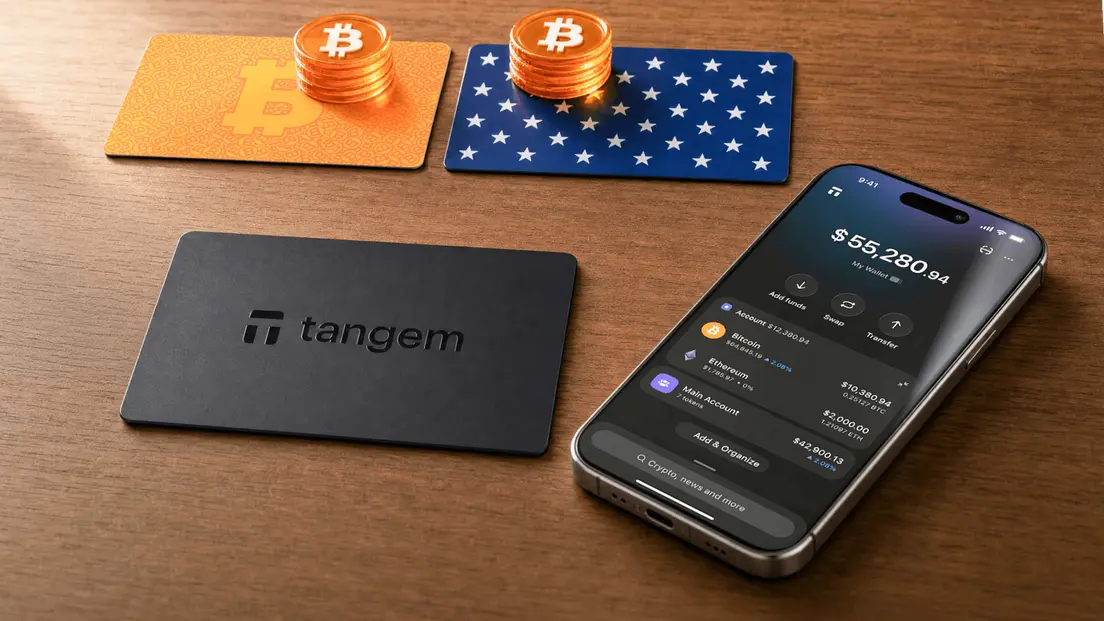
Tangem Wallet doesn't have a built-in tax report, and the app doesn't export transaction history. Because it's a self-custody wallet, your transactions live on the blockchain, so a tax tool can pull them from your public addresses instead.
Tangem's guide, Filing Crypto Taxes with Tangem Wallet via CoinLedger, walks through the process:
- In Tangem Wallet, open the token, tap Receive, and copy the address.
- In CoinLedger, select Connect Wallet, paste the address, and choose the blockchain.
- Sync the transactions, repeat for each wallet and network you use, then generate your report.
For Bitcoin and other UTXO coins, you can generate an xPub in the app instead (token page → three dots → Generate XPUB), so the tool picks up every address in that wallet. CoinLedger and Koinly both accept xPubs.
CoinLedger only reads public blockchain data. You never share your private keys or seed phrase, and your keys stay on your Tangem card. For background on how gains are taxed and which IRS forms apply, including Form 8949, see Capital Gains Taxes on Crypto Explained.
FAQ About US Crypto Tax Deadline 2027
-
Build a full transaction record from the wallet's public addresses. For each sale with missing basis, trace the units to the wallet they came from, the purchase date, dollar cost, and fees, then apply that wallet's identification method. A broker can use customer-provided acquisition information for lot selection, but it cannot report the basis of transferred-in units.
-
Assets acquired before 2026 or transferred into the broker are noncovered, so basis reporting is not required for them. Use your own records to work out the basis, proceeds, and holding period for each disposal. You still report all digital-asset income, gains, and losses on your federal return.
-
A transfer between wallets, addresses, or accounts you own does not, by itself, create a taxable disposal. The exception is crypto used or withheld to pay the transfer fee, which is treated differently. Keep the transfer and fee in your records when you work out each disposal.
-
It asks whether, at any time during the tax year, you received a digital asset as a reward, award, or payment for property or services, or sold, exchanged, or otherwise disposed of a digital asset or a financial interest in one. Mining, staking, and hard-fork airdrops require a Yes. Simply buying crypto with dollars or holding it in a wallet does not, by itself, require a Yes.
-
It depends on the holding period. For short-term disposals (one year or less) with no Form 1099-DA, use Box I. Long-term disposals (more than one year) with no Form 1099-DA use Box L. These boxes come from the 2025 Form 8949 instructions; the 2026 instructions had not been published as of this guide's research date. Digital assets must not use boxes C or F.
-
Yes. The IRS treats digital assets as property, so exchanging one cryptocurrency for another is a disposal of the first asset. You recognize a gain or loss based on the fair market value of what you received versus your cost basis in what you gave up. Each swap is a separate line on Form 8949.
-
Not under current law. IRC §1091 applies to stock and securities, and KPMG's analysis in the Journal of Taxation of Financial Products (Vol. 23 No. 2, 2026) notes general agreement among commentators that digital assets are not subject to the wash-sale rule as currently written. H.R. 10357 would change this, but it passed the Ways and Means Committee on 16 September 2026 and is not yet law.
-
Request a corrected form from the broker who issued it. The IRS cannot correct a third-party information return, and you should not delay filing your return while the correction is pending. Use the correct figures from your own records on Form 8949 and document the discrepancy.
-
The tax obligation rests with you wherever your coins are held. Self-custody doesn't exempt you from reporting disposals, income, or the digital asset question.


Don't miss these 





Other articles

