


How to Stake Stablecoins Without Giving Up Your Keys
This article is available in the following languages:
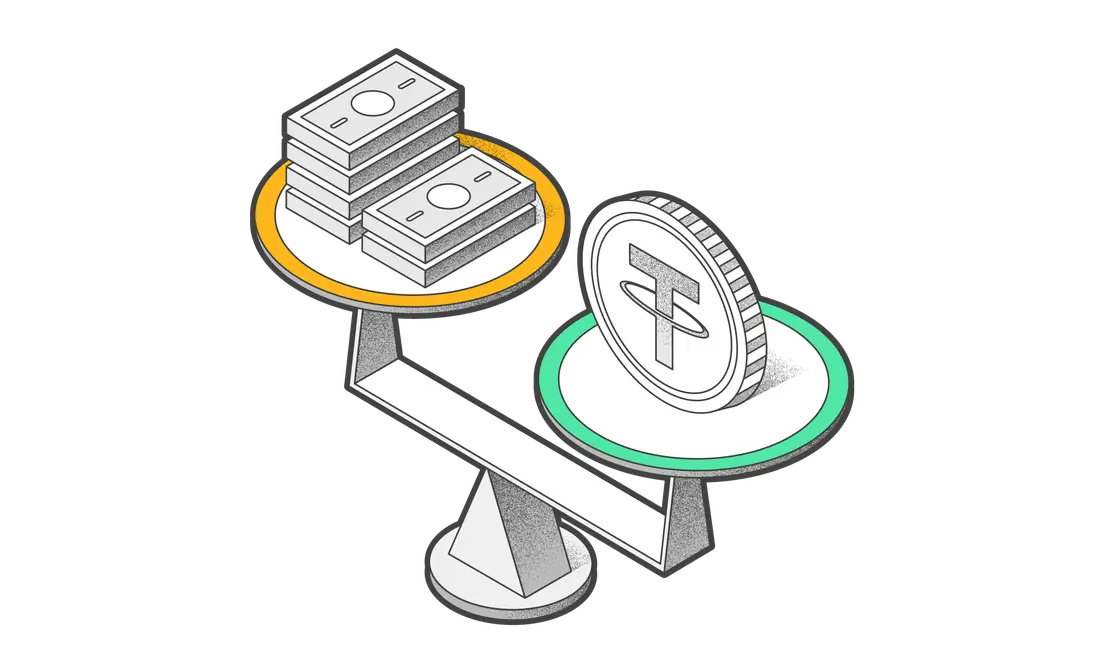
Stablecoins sitting in your wallet don't grow. A dollar in USDT today is still a dollar in USDT next year, while inflation quietly takes its cut. For a long time, there were two ways to put them to work. You could send them to an exchange and let it pay you at a rate, or you could go into DeFi yourself and handle wallet connections, token approvals, and gas.
The first means trusting someone else with your money. The second means a lot of clicking and a lot of room for mistakes. There's now a third option. You can earn yield on your stablecoins straight from the Tangem app, while your keys stay with you. This guide explains what "staking stablecoins" really means, compares the main ways to do it, and shows you how to start with Tangem Yield Mode.
What does "staking stablecoins" actually mean?
Most people say "staking stablecoins," but in most cases that isn't staking in the strict sense. True staking means locking coins like ETH or SOL to help secure a proof-of-stake network. Stablecoins don't secure any network, so when you "stake" them, you're usually doing one of these:
- Lending. You supply stablecoins to a lending pool, borrowers pay interest, and you get a share. This is how Aave and Compound work, and it's how Tangem Yield Mode works as well.
- Providing liquidity. You add stablecoins to a trading pool on a DEX like Curve or Uniswap and earn a cut of the trading fees.
- Exchange "earn" products. You hand your stablecoins to a centralized platform, which decides what to do with them and how much to pay you.
The name matters less than one question: who holds your coins while they earn? That's the main difference between the options below.
Three ways to earn yield on stablecoins
1. Centralized platforms
Exchanges and lending apps like Binance, Coinbase, Nexo, and Crypto.com all offer some kind of stablecoin "earn" product. You deposit, and they pay you a rate.
They're easy to use, but there's a big trade-off: once your coins are on the platform, they're no longer yours to control. The platform holds the keys. It can change rates, add lockups, require you to hold its own token for better tiers, or pause withdrawals. That last one isn't theoretical. In 2022, Celsius froze withdrawals, and BlockFi and FTX went bankrupt. Users who had parked stablecoins there to earn a few percentage points ended up waiting for years to get back part of their money.
2. Using DeFi protocols directly
You can skip the intermediary and supply stablecoins to a protocol like Aave or Compound yourself. Your coins stay under your own wallet's control, and the rates are set openly by supply and demand. The catch is the effort. You connect your wallet to a dApp, approve token spending, pick the right network, pay gas in that network's native coin, and keep an eye on everything. Each step is a chance to click a fake site or sign something you shouldn't. For most people, it's too much work for a stablecoin savings balance.
3. Tangem Yield Mode
Tangem Yield Mode gives you the second option without the hassle. It supplies your stablecoins to Aave, the largest DeFi lending protocol, right from the Tangem app. There's no dApp to connect and no separate platform to sign up for. Your keys stay in your Tangem wallet, and every transaction still needs your approval. You get on-chain yield with the same security you already use to store your crypto.
How Tangem Yield Mode works
When you turn on Yield Mode for a token, the Tangem app supplies it to Aave's lending pool. Borrowers on Aave pay interest, and a portion of that interest accrues to you.
Here's what that looks like in practice:
- Your balance earns every second. Your supplied tokens appear as aTokens (like aUSDT or aUSDC), and interest is continuously added to your balance. You can watch it grow in the app.
- New deposits go to work automatically. Once Yield Mode is enabled for a token, incoming transfers of that token on the same network are routed to Aave on your behalf. There's no need to repeat the setup.
- No lockups. You can send, swap, or sell your tokens while Yield Mode is on, or turn it off whenever you want.
- Your keys stay with you. Everything runs on-chain. Tangem doesn't take custody of your funds, and every transaction needs your approval in your wallet.
- Works with both wallets. Yield Mode is available in the Tangem hardware wallet and in the Tangem Mobile wallet. All you need is a supported token on a supported network.
- Wide support. Yield Mode covers 49 tokens across 7 networks, including USDT, USDC, and DAI on Ethereum, Base, Arbitrum One, Optimism, Polygon, BNB Chain, and Avalanche. You'll find the full list in the app under Earn, with the Yield Mode filter.
- Audited and open. Pessimistic audited the Yield Mode smart contracts, and the source code is public on GitHub.
There's also an extra layer of protection. If a vulnerability is identified in Aave, Tangem can start an emergency withdrawal of your funds from Aave back to your wallet. This is not a guarantee against losses, and you can always turn off Yield Mode in the app to withdraw your assets yourself. Aave has also published its own case study on Tangem's integration.
How to stake stablecoins in the Tangem app
Setting up Yield Mode takes a couple of minutes.
Turn on Yield Mode
- Open the Tangem app and tap a supported token on the main screen, such as USDT, USDC, or DAI.
- Tap Learn more to open Yield Mode.
- Check the current APY and tap Continue.
- Review the network fee. If you don't hold the network's native coin for gas, you can pay the fee in the token you're supplying.
- Tap Supply assets, then confirm and sign the transaction. If you use a Tangem card, tap it to your phone.
That's it. Your balance starts earning right away, and new deposits of that token on the same network are supplied automatically.
Turn off Yield Mode
- Tap the token on the main screen, then tap Yield Mode.
- Tap Disable Yield Mode, then Confirm.
- Sign the transaction. Your funds go back to your regular Tangem balance right away.
Tangem Yield Mode vs exchanges vs DIY DeFi
Here's how the three options stack up on the things that matter most.
Tangem Yield Mode | Centralized platforms | Using DeFi directly | |
Who holds your keys? | You | The platform | You |
Where the yield comes from | Aave lending, on-chain | Decided by the platform, often not disclosed | The protocol you choose, on-chain |
Lockups | None | Common on higher-rate products | Depends on the protocol |
Setup effort | A few taps in one app | Account, KYC, deposit | dApp connections, approvals, gas management |
Can a company freeze withdrawals? | No (pool liquidity can delay withdrawals) | Yes | No (same liquidity limits apply) |
Transparency | Audited, open-source contracts | Limited | Depends on the protocol |
Fees | Network fees + 15% of yield earned | Built into the rate | Network fees |
If you want an exchange-like experience without handing your money to an exchange, Yield Mode sits in the middle: the self-custody of DeFi with the simplicity of an app.
Fees and APY, explained simply
1. How much can you earn?
The APY in Yield Mode is variable. Aave sets it in real time based on how much people supply and borrow. When borrowing demand is high, rates go up. When it's low, they drop. In addition to the base rate, some tokens also earn extra incentive rewards distributed via Merkl. These are paid in a separate token, run for a limited time, and their value depends on that token's price. Tangem claims small or expiring rewards for you automatically and covers the fee. The 15% service fee on earned incentives still applies. You can always see the current rate for each token in the Earn tab of the Tangem app.
2. What does it cost?
- Service fee: Tangem takes 15% of the yield and incentives you earn. It's only taken from earnings, never from your deposited funds. For example, if the APY is 5%, you keep about 4.25%.
- Network fees: turning Yield Mode on or off is a regular blockchain transaction, so you pay the network fee. You can pay it in the token you're supplying.
- Top-up fees: when new tokens arrive and are supplied automatically, the network fee is deducted from the amount supplied.
3. Why some deposits don't get supplied right away
To keep fees from eating your yield, Yield Mode has two safeguards:
- Minimum top-up. Small deposits stay in your wallet if the network fee would be too large a share of the amount. The minimum is calculated to keep fees at or below about 4% of the transaction.
- Max fee limit. If the network fee exceeds your limit, the deposit waits in your wallet instead of being sent at a worse price.
This is expected behavior. It's there to protect your earnings, especially on networks like Ethereum where fees can skyrocket.
Risks to know before you start
Stablecoin yields are lower-risk than most of crypto, but they aren't risk-free. Whichever option you choose, keep these in mind:
- Variable rates. APY changes with market demand. The rate you see today isn't locked in.
- Smart contract risk. Aave and Tangem's Yield Mode contracts are audited, but no code is completely free of bugs.
- Liquidity limits. Aave lends out supplied funds. When most of a pool is borrowed, withdrawals can be delayed until liquidity comes back. This is how lending protocols work, and it applies to anyone using Aave, not only Tangem users.
- Depeg risk. A stablecoin can lose its peg to the dollar. Yield doesn't protect you from that, so stick to stablecoins you trust.
- Swap options. While Yield Mode is on, some DEX routes may not be available for that token. Exchange routes and other DEX routes still work.
- Platform risk (for centralized options). If you use an exchange instead, you also take on the risk that the company freezes withdrawals or fails. Self-custody removes that one.
A sensible approach is to put in only what you're comfortable exposing to these risks, and to keep some stablecoins outside Yield Mode if you need instant access.
Start earning on your stablecoins
You don't have to choose between earning yield and keeping control of your money. With Tangem Yield Mode, your stablecoins earn on Aave while your keys stay in your wallet, with no lockups and no exchange in the middle.
Already have Tangem? Open the app, tap USDT, USDC, or DAI, and turn on Yield Mode. New to Tangem? Get Tangem Wallet and start earning in a few taps.
Stablecoin staking FAQ: methods and risks
-
Yes, though it's usually lending rather than staking in the strict sense. You supply stablecoins to a lending protocol or platform and earn interest from borrowers. In the Tangem app, you can do this with Yield Mode.
-
Staking stable coins involves locking up your stablecoin holdings in a smart contract or protocol to support the stability and operations of a blockchain network. In return, you typically earn rewards or interest for your contribution. 2.
-
It's lower risk than holding volatile coins, but there are still risks: smart contract bugs, liquidity limits, depegs, and variable rates. Keeping your keys in a self-custody wallet removes the risk of an exchange freezing or losing your funds.
-
Yield Mode supports USDT, USDC, DAI, and other Aave-compatible tokens- 49 in total across 7 networks. See the full list in the app under Earn, with the Yield Mode filter.
-
Yes. There are no lockups in Yield Mode. You can turn it off whenever you want, or send, swap, and sell while it's on. In rare cases, when an Aave pool is heavily borrowed, withdrawals can be delayed until liquidity improves.
-
Not necessarily. When you turn Yield Mode on or off, you can pay the network fee in the stablecoin you're supplying.
-
Yes. Yield Mode works in both the Tangem Mobile wallet and the Tangem hardware wallet, as long as the token and network are supported.
-
If a deposit is below the minimum top-up amount, or the network fee exceeds your max fee limit, it stays in your wallet instead of being supplied. This protects your yield from high fees.
-
Staking stable coins can provide a source of passive income, as you earn rewards or interest on your holdings. Additionally, by staking stable coins, you contribute to the liquidity and stability of the network, which is crucial for its functioning. 3.
-
While staking stable coins can offer rewards, it also comes with certain risks. These may include smart contract vulnerabilities, market fluctuations affecting the value of rewards, and potential loss of funds in case of protocol failures or exploits. It's essential to conduct thorough research and understand the risks before staking.
-
Tax regulations regarding staking rewards can vary depending on your jurisdiction. Often, staking rewards are taxable income and should be reported accordingly. It's advisable to consult with a tax professional or accountant to understand the tax implications of staking stable coins in your specific circumstances.
-
Interest is added to your balance every second. Incentive rewards, when available, are paid in a separate token and can be claimed in the app.


Don't miss these 




Other articles

