
 Grab EXTRA 10% OFF


Staking on an Exchange vs a Self-Custody Wallet: Which Is Safer
If you're holding crypto for the long term and can protect your keys, self-custody staking is generally the safer choice. Exchange staking is simpler for active traders who accept counterparty risk. The decision between exchange staking and self-custody staking comes down to a single question: who holds the keys while your coins are locked? The answer shapes every other risk you carry. Both routes can earn you staking rewards, but the custody model underneath them is fundamentally different, and that difference matters far more than the yield gap between platforms.
How Exchange Staking Works
When you stake through a centralized exchange, you are not staking directly on the blockchain yourself. You are depositing assets with the exchange, and the exchange stakes on your behalf. The private keys that control those assets belong to the exchange, not to you.
Exchanges handle validator selection, technical uptime, and the mechanics of claiming rewards. For users who want exposure to staking yields without having to run infrastructure or manage keys, the convenience is genuine. Binance, for example, offers Soft Staking across a range of assets, including BNB, SOL, ADA, SUI, TON, NEAR, POL, ALGO, S, and AXS, with rewards paid daily and no additional fee charged to users. Binance ETH Staking sets a 0.0001 ETH minimum and applies a 10% fee to staking rewards.
The tradeoff is structural. A custodial wallet delegates control of the private key to a third party. You hold a claim on the provider, not the underlying asset directly. If the provider experiences a hack, insolvency, regulatory freeze, or withdrawal restriction, your staked position is exposed to that outcome.
How Self-Custody Wallet Staking Works
Self-custody staking keeps the private keys with you throughout the process. In Proof-of-Stake networks, this typically means delegating your stake to an existing validator rather than operating one yourself. The delegation transaction is signed by your private key and broadcast to the network. The exchange never enters the picture.
In a self-custodial setup, the wallet generates a public-private key pair, signs transactions locally with the private key, and broadcasts them to the network. With a hardware wallet like Tangem, the signing step happens inside a secure element chip, entirely isolated from the internet.
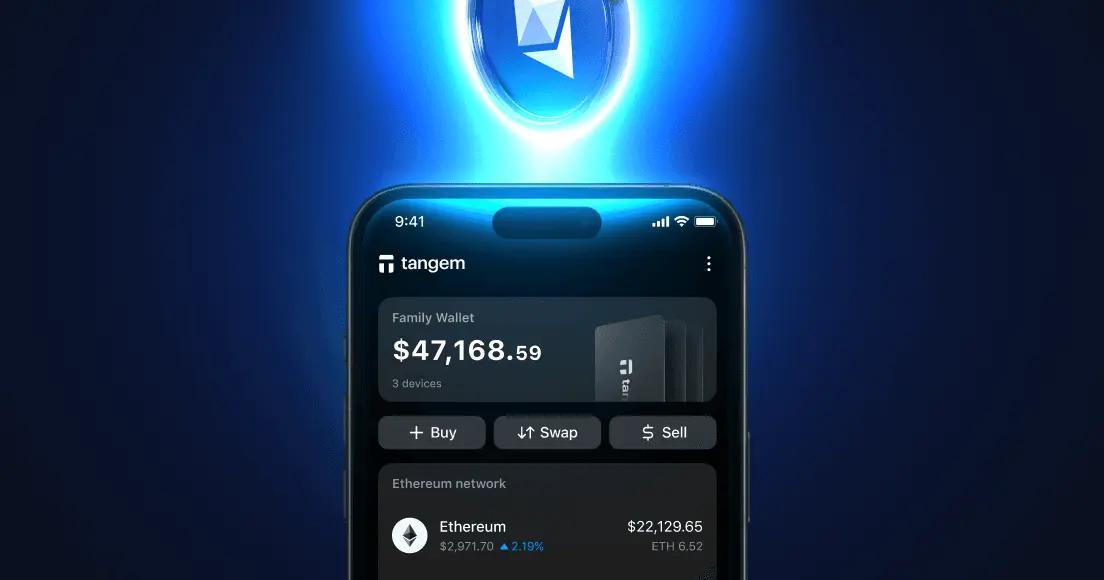
You can stake ATOM, BNB, GRAM (previously TON), POL on Ethereum, SOL, TRX, ETH, and ADA directly in the Tangem app. Users choose from a curated list of validators, view APR/APY for each validator, track and claim rewards, and see the unbonding period before committing. The infrastructure behind this runs through Yield.xyz and P2P.org, and Yield.xyz provides slashing-protection coverage. For chains not on the native list, Tangem users can connect to external staking platforms through WalletConnect, including liquid-staking protocols such as BENQI and Lido.
The responsibility that comes with this model is real. A non-custodial wallet gives only the holder access to and control of the private keys. That means the holder is responsible for key management and backups. There is no exchange support desk to call if something goes wrong.
Who Actually Controls Your Staked Assets?
This is the axis that matters most. Custodial wallets place private-key control in the hands of a third party. Non-custodial wallets place it with the user.
The ownership model is the key distinction: a person using custodial storage holds a claim on a provider that controls the keys, rather than directly controlling them. On an exchange, that means the exchange can freeze withdrawals, restrict access by jurisdiction, or become insolvent before you can exit your staked position. Self-custody gives the user full control. But a lost private key or seed phrase has no recovery process. That is not a theoretical risk. It is the design.
Tangem's multi-card backup model uses 2- or 3-card sets, with each card providing full wallet access. Losing all cards without a seed phrase makes funds permanently inaccessible. A seed phrase is optional and BIP39-compatible for users who want wallet portability. The choice of whether to enable a seed phrase carries its own tradeoff: a seed phrase creates a single point of failure if someone finds or photographs your written words.
Security Risks Compared
The risk profiles here are genuinely different, not just differently weighted versions of the same concern.
Exchange staking risks are counterparty risks. Custodial storage exposes users to provider hacks, bankruptcy, regulatory freezes, and exit fraud. In the first half of 2025, crypto platforms lost $2.47 billion to theft, exceeding the total for all of 2024. That figure covers platforms broadly, not exchanges alone, but it illustrates the scale of what concentrated custody attracts.
Self-custody staking risks shift inward. The primary loss vectors become user error, lost keys, and device compromise. Custody does not remove the underlying risks of staking or the asset itself. Staking carries market, inflation, slashing, and liquidity risk. An unbonding period is the interval after unstaking when funds are unavailable, and no rewards accrue during it. Staked assets cannot be transferred or sold until they are unstaked and the unbonding period completes.
Slashing is worth naming specifically. A validator can be penalized for malicious behavior or downtime, potentially reducing the amount of staked funds. Yield.xyz provides slashing-protection coverage for supported networks on Tangem, which reduces, but does not eliminate, this exposure.
The Tangem Cold Wallet uses a Samsung S3D350A secure element certified at Common Criteria EAL6+. The private key is generated entirely within the secure element, never leaves the chip, and transaction signing happens on-chip. The NFC channel between the card and the phone is AES-256-encrypted, with a stated range of 0-5 cm. That architecture removes the remote attack surface associated with software wallets and exchange accounts. Tangem's interface is mobile-only. There is no desktop or web app. And NFC-based signing requires physical proximity to the card, so remote signing is not possible.
Rewards and Flexibility Compared
APR is the expected yearly return from staking, not a fixed or guaranteed outcome. Staking reward behavior, claiming, compounding, minimums, and unstaking terms all vary by network and further depending on whether you stake through an exchange or directly.
Exchanges sometimes offer simplified reward structures, but they typically take a cut. Binance ETH Staking charges a 10% fee on staking rewards, for instance. Self-custody staking routes rewards directly to the user without an intermediary fee, though network transaction costs still apply when claiming.
Flexibility is where the comparison gets more nuanced. Binance Soft Staking keeps assets tradable and withdrawable while staked, which is a meaningful convenience for active traders. On-chain staking through a self-custody wallet involves real unbonding periods. TRON (TRX) through Tangem has a 14-day unbonding period. BNB Smart Chain has a minimum of 1 BNB. Cardano has a 0-day unbonding period through P2P.org. TON has a 10.2 TON minimum.
Holding some funds back from staking can preserve liquidity because staked tokens cannot be transferred until the required unstaking and unbonding processes complete. That applies whether you stake through an exchange or a wallet.
Tangem also offers Yield Mode, a native Aave integration that lets you earn variable yield on supported assets without leaving the app. Yield Mode supports assets, including USDC, USDT, WETH, and DAI, across Ethereum, Base, BSC, Polygon, Arbitrum One, Avalanche, and Optimism. To see the complete current list, open the Earn tab in the Tangem app and set the All types filter to Yield Mode.
Unlike staking, Yield Mode is fully liquid: users can withdraw, send, receive, or swap at any time, with no unbonding period or exit penalty. No third party holds user funds, and the smart contracts are independently audited and verifiable on-chain.
Which Should You Choose?
The custody decision is a tradeoff between recovery and convenience on one side, and full control with personal security responsibility on the other. Neither model is universally superior. The right choice depends on what you are optimizing for.
Choose exchange staking if you are actively trading the same assets, you want a simpler interface without managing keys or validator selection, and you are comfortable with the counterparty risk that comes with custodial custody. Binance Soft Staking's daily rewards and no-additional-fee structure make it genuinely accessible for this profile.
- Choose self-custody staking if you are holding assets for the medium or long term, want to eliminate counterparty risk, and are willing to take responsibility for key management and backups. The Tangem hardware wallet is a practical option here: native staking for seven networks, slashing-protection coverage through Yield.xyz, and a secure element that keeps keys off any internet-connected device.
For users who want yield without unbonding constraints, Tangem's Yield Mode offers a self-custodial alternative to staking entirely, with full liquidity and no intermediary holding funds.
The vault's own framing is direct: choose delegated storage for people who prefer it while trading, or non-custodial control for people who want direct control of their assets. The amount you're staking matters too. The larger the position, the more the counterparty risk of exchange custody weighs against its convenience.
FAQ
-
Exchange staking is operationally convenient but carries counterparty risk. Your staked assets are controlled by the exchange's private keys, not yours. If the exchange is hacked, becomes insolvent, or freezes withdrawals, your position is exposed. In the first half of 2025, crypto platforms lost $2.47 billion to theft, illustrating the scale of risk that concentrated custody carries. Whether that risk is acceptable depends on the size of your position and your tolerance for platform dependency.
-
Self-custody gives you full control, but if a private key or seed phrase is lost, there is no way to recover it. With Tangem's multi-card model, losing all cards without a seed phrase makes funds permanently inaccessible. This is intentional. The design prevents any third party from accessing your assets. Keeping at least two cards in separate, secure locations substantially reduces this risk.
-
Slashing is a penalty mechanism built into some Proof-of-Stake networks. A validator can be penalized for malicious behavior or downtime, potentially reducing the amount of staked funds. Custody does not remove the underlying risks of staking or the asset itself. In self-custody staking, Yield.xyz provides slashing-protection coverage for supported networks on Tangem.
-
Staking rewards may be taxable income depending on your jurisdiction. The tax treatment varies by country and sometimes by the structure of the staking arrangement. You should seek advice from a tax professional for your specific circumstances before staking significant amounts.
-
Yes. Tangem's default setup is seedless: the private key is generated and stored inside the secure element chip, and no seed phrase is written down. A seed phrase is optional and BIP39-compatible for users who want portability to other wallets. The seedless model eliminates the seed-phrase attack surface but means that losing all cards without a seed phrase makes funds permanently inaccessible. Users who enable a seed phrase gain portability at the cost of introducing a written backup that someone else could find.
-
Native staking in Tangem involves delegating your tokens to a validator on a supported Proof-of-Stake network, with network-specific unbonding periods before you can access funds after unstaking. Yield Mode is Tangem's native Aave integration for earning variable yield on supported assets. It is fully liquid: no unbonding period, no exit penalty, and users can withdraw at any time. The two features serve different use cases: staking for long-term PoS participation, Yield Mode for flexible yield on stablecoins and other supported assets.


Don't miss these 
Other articles

