Switch to seedless. Get 30% off with SWITCH30 till Oct 21
Seed Phrase Theft: Risks From Screen Implants
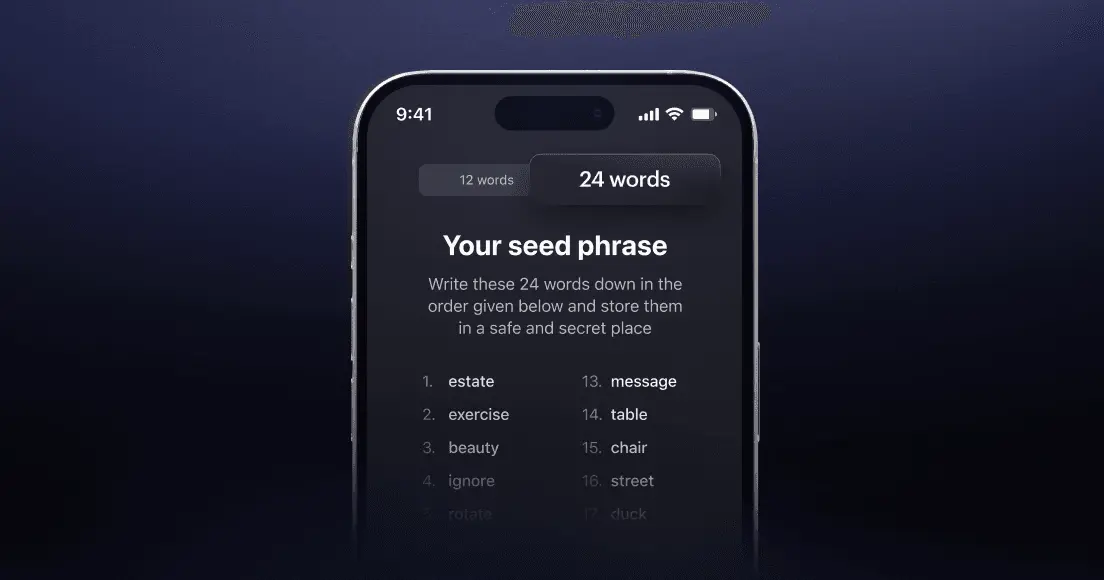
Your seed phrase is a 12- or 24-word backup that can regenerate your entire wallet. Anyone who has those words controls your funds. No device, no password, or additional step is required. That single fact is the starting point for every threat discussed here.
Understand the Threat Model
Not all crypto theft looks the same. The risks cluster into distinct categories, and treating them as one blurred problem leads to mismatched defenses.
Self-custody means you hold the private keys rather than an exchange or intermediary. That removes counterparty risk, but it shifts full responsibility for key and backup protection to you personally. There is no support ticket that recovers a lost seed.
Hardware wallets generate and store private keys offline, then sign transactions internally so the private key never enters an internet-connected environment. That design eliminates a wide class of remote attacks. It does not eliminate physical or social ones.
Here's how the risks break down:
- Supply-chain tampering: A device modified before or during delivery could behave differently from its factory specification.
- Phishing and social engineering: Fake websites, fake support staff, and fake recovery services are the most common vectors for theft by volume.
- Malware: Hot wallets running on internet-connected devices are vulnerable to keystroke capture, clipboard monitoring, and wallet file theft.
- Malicious approvals: Signing a deceptive transaction or approving a token can drain a wallet even when the private key remains safe.
- Physical access: Someone with your written seed phrase, or your unlocked device, can take everything.
- Recovery-backup failure: A single seed backup at a single location is a single point of failure. Loss, damage, or theft of that copy results in loss of access to the funds.
Each category calls for a different control. Knowing which one you face is step one.
How the Attack Path Works
A hardware wallet converts generated entropy into a 12- or 24-word mnemonic that the user writes down for recovery. That moment of display and transcription is the exposure window.
In a suspected screen-implant attack, a circuit board concealed beneath the device's display could passively monitor what appears on screen, recognize the recovery phrase as it's shown, and transmit it externally. Independently reported evidence from a single incident describes a suspected board containing a microcontroller, an antenna, an LTE component, and an eSIM. The proposed mechanism involves passive display monitoring and cellular exfiltration of the captured phrase.
That said, no current authoritative source independently verifies specific affected device models or confirms that the alleged screen-reading and cellular-exfiltration mechanism operated in the incident. One manufacturer confirmed an unauthorized circuit board in at least one device linked to a reseller, but has not publicly confirmed the implant's exact operation. Treat the mechanism as a credible hypothesis, not a confirmed technical fact.
What is confirmed: possession of the seed phrase is sufficient to control the wallet's funds. Whether the phrase is captured by a hardware implant, a hidden camera, a photograph, or a shoulder-surfing observer, the outcome is identical. The phrase functions as the master key.
Hot-wallet malware follows a different path: it captures keystrokes, clipboard data, or wallet files on an infected device. The attack surface is different, but the end result, phrase or key exposure, is the same.
Here's what that means practically: the seed phrase is the highest-value target in any self-custody setup. Any path that exposes it is a critical risk, regardless of the technical method.
Controls That Reduce Exposure
Proportionate protection starts with knowing where your recovery material actually exists right now.
Before anything else: map where your keys and seed backup live, how you access them, and the realistic ways an attacker could reach them. Then apply controls to the highest-impact paths first.
For the recovery phrase itself:
- Never store it digitally. No cloud storage, no phone photos, no email drafts.
- Keep physical backups in at least two separate locations on durable media.
- Test your recovery procedure before committing significant funds. A backup you've never tested is not a backup.
For the device and accounts:
- Buy hardware wallets directly from the manufacturer or a verified official reseller. A device that arrives already set up or with a pre-written seed phrase should be discarded immediately.
- Use strong, unique passwords and two-factor authentication for wallet apps and related accounts.
- Verify website addresses before entering credentials. Phishing sites that mimic official wallet interfaces are common.
- Keep the wallet app, operating system, and browser updated.
If you suspect your phrase has been exposed, act immediately. Stop entering, sharing, or digitally storing the phrase. Create a new wallet on a trusted device, record its seed offline, verify the receiving addresses, and transfer a small test amount before moving the remainder. Review and revoke old wallet permissions. Retire all addresses derived from the exposed seed. Escalate only through independently verified official security channels. Never use unsolicited "support" contacts.
Separating a small active balance in a hot wallet from longer-term holdings in cold storage also limits the damage from any single compromise.
Limits and Trade-offs
Hardware wallets reduce remote private-key theft. They cannot determine whether a transaction or message is actually safe. Phishing and malicious approvals remain effective when users authorize deceptive or opaque requests because the hardware device signs whatever it's asked to.
On-device confirmation helps only when the full transaction is clearly displayed and verified. Blind signing, approving a transaction without reading what it does, can leave users authorizing malicious payloads, including token approvals and contract actions.
Hardware wallets also cannot prevent coercion, exposure of recovery phrases, compromise of companion software, or supply chain tampering before delivery. Buying from an official source and generating the seed during first setup address some of these risks. Not all.
Cold-storage choices involve real trade-offs: hardware wallets cost money, paper backups are vulnerable to loss and damage, and deep cold storage can delay access when you need it quickly. Self-custody has no recovery process if the private key or seed phrase is permanently lost. That's the honest baseline.
How Tangem's Design Reduces Specific Attack Vectors
Tangem's default setup is seedless. No seed phrase is generated, displayed, or stored during setup, which removes the recovery-phrase display window entirely. That eliminates the specific exposure path a screen-implant attack would target.
The card itself has no screen, no battery, no USB port, and no Bluetooth radio. There is nothing to implant a secondary circuit into that could read display output, because there is no display. Firmware is factory-installed and non-updatable, which eliminates remote exploit vectors that rely on malicious firmware updates.
The Tangem app performs a cryptographic authenticity check on the card before any operation, providing anti-counterfeit protection. Access requires the physical card, the Tangem app on a phone, an access code or biometric, and NFC proximity within 0-5 cm.
What Tangem does not prevent: phishing, malicious transaction approvals, coercion, user error, or loss of all cards when no seed phrase exists. If you lose all the cards in a seedless setup, the funds become permanently inaccessible. The security architecture also notes that physical theft, combined with knowledge of the access code, is the primary remaining attack vector against the card itself.
Using a seed phrase remains optional in Tangem's setup. Users can generate or import a 12- or 24-word BIP39 phrase if portability across other wallets is important. Doing so introduces seed-phrase vulnerability. That trade-off is yours to make with full awareness of what it means.
FAQ
-
No. A hardware wallet can reduce exposure of private keys to an internet-connected device, but it cannot prevent phishing, malicious approvals, unsafe recovery backups, coercion, or any supply chain or physical attack. The device signs what it's asked to sign. Verifying what you're signing is still your responsibility.
-
Map what you protect, how you use it, and the realistic ways an attacker could reach your keys, recovery material, or transaction approval. Then apply controls to the highest-impact paths. A backup stored in one location and never tested is a common, fixable gap.
-
Seek trusted, independently verified help when assets may be actively at risk or a device appears compromised. If losses are significant, funds have reached an exchange, or tracing and recovery actions exceed your expertise, a qualified crypto-forensics professional and, where appropriate, a lawyer can assist. Never share a seed phrase or private key with support staff or anyone offering recovery. Preserve transaction hashes, wallet addresses, timestamps, and any messages as evidence before reaching out.
-
Tangem does not hold custody of your funds, and your cards will continue to work. If you generated a seed phrase, you can import it into any BIP39 wallet.
-
Treat it as fully compromised. Create a new wallet on a trusted device, record the new seed offline, and first transfer a small test transaction. Review and revoke old wallet permissions, retire all addresses from the exposed seed, and contact any receiving exchanges through their independently verified official support channels.