
 Grab EXTRA 10% OFF


Why Some Blockchains Hide What You Sign
Why chains like Ethereum and Solana force you to sign a blank check, and how the industry is trying to fix it.
This article is available in the following languages:
- Blind signing vs clear signing
- Why some blockchains hide what you sign
- Where your protection actually comes from
- How Tangem Wallet handles signing
- Security behind the signature
- A safe-signing checklist for every chain
- Sign what you understand; keep your keys out of reach
- Resources and Further Reading
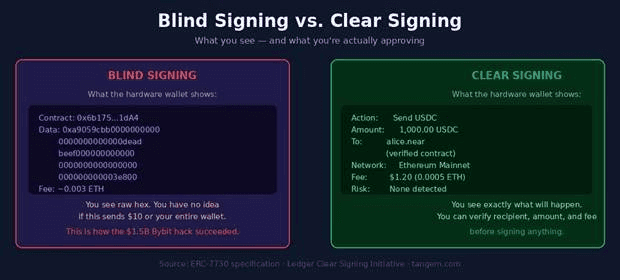
When you approve a crypto transaction on a hardware wallet, you're doing one of two things: either you're reading a plain-English summary of exactly what's about to happen, or you're signing off on a wall of raw hexadecimal code and hoping for the best. Blind signing is the act of approving a digital transaction without being able to verify its full details in a human-readable format.
In February 2025, attackers walked away with about $1.5 billion from the exchange Bybit. They didn't break any encryption. They got the people approving a transaction to sign something they couldn't actually read. On their screens, it looked like a routine transfer. In reality, it handed over control of a wallet.
Here's the uncomfortable part. On some blockchains, blind signing isn't a wallet bug you can patch. It's built into how the chain encodes transactions. So the question isn't only "which wallet do I use?" It's "what can I actually see before I approve, and what protects me when I can't see everything?" This article explains the difference between blind and clear signing, which blockchains make clear signing easy, where your protection really comes from, how Tangem Wallet handles signing, and a simple checklist to sign safely on any chain.
Blind signing vs clear signing
Every crypto transaction is a set of instructions. Before your wallet's private key signs it, someone has to turn those instructions into something a human can check.
Clear signing means you can read the important details before you approve: who gets the funds, how much, on which network, the fee, and what action the transaction takes.
Blind signing means you're approving data you can't meaningfully check. You might see a long string of hex characters, a contract address, or a vague label like "Contract interaction."
Clear signing | Blind signing | |
What you see | Recipient, amount, network, fee, action | Raw data, a hash, or a generic label |
What you can verify | That the transaction matches what you meant to do | Very little |
Typical cases | Simple sends, well-known transaction types | Complex smart contracts, DeFi, unfamiliar dApps |
Main risk | Low, as long as you actually read it | Approving something malicious without knowing |
Why some blockchains hide what you sign
How readable a transaction is depends mostly on how the blockchain was designed. Some chains clearly label every transaction type. Others pack instructions into raw bytes that only make sense if you already know the smart contract behind them.
Think of it in three tiers. This isn't about good chains and bad chains. Every design makes trade-offs, and flexibility often comes at the expense of readability.
Tier 1: Built for Transparency
These blockchains make clear that signing is a natural outcome of their design. The core reason: they use a finite set of typed transaction structures where every field has a name, a type, and a defined schema. A hardware wallet doesn't need any external information to parse them; the transaction tells you what it is.
The XRP Ledger offers perhaps the strongest, clearest signing story of any major chain. Its binary format includes a TransactionType field that ensures deterministic parsing across 50+ enumerated transaction types: Payment, OfferCreate, TrustSet, EscrowCreate, and more. Every field has a defined schema. A hardware wallet can display the recipient, amount, fee, memo, and every type-specific parameter without needing to look anything up externally. Close to 100 percent of current mainnet transactions can be fully clear-signed.
Polkadot developed the most technically sophisticated clear signing solution in the industry through its runtime metadata system (MetadataV14/V15). Every transaction references pallet and call indices, and the metadata tells you exactly what those indices mean and how to decode the arguments. The challenge is that full metadata exceeds 200KB, too large for hardware wallets with limited memory.
The solution, RFC-0078 (Merkleized Metadata), builds a cryptographic tree from the metadata, transmits only the relevant subset, and verifies the inclusion proof on-chain. The result is a single Ledger application that works across all Polkadot parachains without per-chain updates.
Cosmos uses a typed message architecture and the SIGN_MODE_TEXTUAL standard (ADR-050), introduced in Cosmos SDK v0.50, which renders transactions as human-readable screens sized for small displays. Coin amounts display as "2 ATOM" instead of "2000000uatom." NEAR Protocol takes readability even further with human-readable account names like "alice.near" and JSON-serialized function arguments that a wallet can display as plain text.
Tier 2: Works for Basics, Breaks Under Pressure
Six ecosystems provide solid, clear signing for their native operations, but degrade significantly when smart contracts are introduced. Bitcoin is the instructive case. The UTXO model means that raw transactions don't include input amounts; a hardware wallet can't calculate your fee without additional information about those prior outputs. PSBT (BIP 174) solves this for standard payments, covering roughly 90 percent of typical transactions, but Taproot script-path spends and complex multisig setups still create opacity.
Stellar shows the tier-2 split most clearly. Its 26 classic operation types (Payment, ManageSellOffer, ChangeTrust) have fixed schemas and display beautifully on hardware wallets. But Soroban smart contracts, launched in 2024, reintroduce EVM-style opacity: parameters arrive as encoded binary types that require contract-specific knowledge to decode, dropping coverage from roughly 95 percent for classic operations to near-zero for raw Soroban interactions. Algorand, Cardano, Aptos, and Tezos each follow similar patterns: strong native-op coverage and significant gaps in complex programmable logic.
Tier 3: Opaque by design
Three ecosystems have architectural choices that make clear signing an uphill battle, regardless of how good the wallet software is. Understanding why helps explain the existence of blind signing warnings on almost every major DeFi interface.
Ethereum and all EVM-compatible chains share the core problem: ABI encoding is not self-describing. When you interact with a smart contract, the transaction data field contains a 4-byte function selector, the first four bytes of a hash of the function name, followed by parameters encoded in 32-byte chunks. Without the contract's ABI JSON, this is pure hexadecimal noise. That ABI is not stored on-chain. A hardware wallet has no way to know that 0xa9059cbb... means "transfer 1,000 USDC to 0xABC..." unless it has external metadata.
Proxy contracts, which route execution to implementation contracts whose addresses can change, compound the problem, which is exactly how the Bybit hack was executed. The industry's response to this is ERC-7730, a metadata standard created in 2024 that provides JSON files describing how to decode and display specific contract interactions. It works, but it requires someone to write and maintain that metadata for every contract you might ever interact with. It is, fundamentally, a patch applied to an architecture that wasn't built for transparency.
Solana is arguably more challenging. Transaction instructions contain a program ID and an opaque byte array of instruction data with no standardized ABI; each program defines its own serialization format. The Anchor framework provides a semi-standard approach using 8-byte discriminators, but many programs don't use Anchor and don't publish their interface definitions publicly. For DeFi interactions, the majority of Solana's transaction volume requires blind signing.
TON adds further complexity through asynchronous execution: you sign only the initial message, and everything that happens downstream across subsequent blocks is invisible at the time of signing.
The takeaway: on Tier 3 chains, where most DeFi lives, no wallet can guarantee clear signing for every transaction. What matters is what else protects you.
Where your protection actually comes from
Many articles reduce safe signing to a single feature: a small screen on a hardware device. That screen is useful, but it can only show what the device can decode. On a Tier 3 chain, a device screen can still show a hash or a generic contract call.
In practice, safe signing rests on three layers:
- The protocol. How much the blockchain itself lets any wallet decode. You can't change this, but you can know your chain's tier.
- Checks before you sign. What your wallet does before asking for approval: decoding what it can, simulating the result, and flagging known scams.
- Key isolation. Where the private key lives and whether anything can reach it. If your key can't be copied, a malicious app or an infected phone can't steal it and later drain your wallet.
No single layer is enough on its own. A clear screen doesn't help if your seed phrase is sitting in a notes app. A secure chip doesn't help if you approve a malicious transaction. Good security covers all three, and so does a good signing habit.
How Tangem Wallet handles signing
Tangem was designed around all three layers. Your review happens in the app, where there's room to show real details. The signing happens on a certified chip that never lets your key out.
What a Tangem signature looks like
- You review on your phone. The Tangem app displays the transaction in a readable format before you sign.
- You tap your card. The app sends the unsigned transaction to the card over NFC. The card has no battery. Your phone's NFC powers it.
- The chip signs. The secure element signs the transaction internally and sends back only the signed result.
- Your key stays put. The private key was generated on the card, stays on the card, and is used only on the card.
What you see before you tap
- Standard sends: the recipient address, the amount, and the network.
- dApp transactions through WalletConnect: the dApp you're connected to, the tokens you'll send and receive, the network, and the gas fee.
- Scam and risk checks: WalletConnect requests go through transaction simulation and Blockaid scam detection, so known malicious sites and suspicious requests get flagged before you approve.
- A deliberate confirm step: you long-press to confirm signing, which makes an accidental approval much less likely.
What about the card having no screen?
This is a fair question, so let's answer it directly. Tangem cards don't have a display. You review transactions in the Tangem app, not on the card.
A phone screen can show far more than a tiny device display: full addresses, token amounts in and out, dApp names, fees, and risk warnings. The part that has to be untouchable, your private key, stays locked in an EAL6+ certified chip that has no way to export it.
To be fully transparent: no wallet can reliably decode every smart contract request on Tier 3 chains. Some complex contract calls don't expose every effect in a form the app can explain. Tangem supports EIP-712 typed-data signing through WalletConnect, but not every field in every request is guaranteed to appear in a readable form. When something isn't clear, treat it as blind signing and don't approve until you understand it.
Security behind the signature
What | Detail |
Chip | EAL6+ certified secure element |
Key generation | Created on the chip by a hardware true random number generator |
Key access | Stays on the card; Tangem has no way to extract or rebuild it |
Backup | 2 or 3 cards holding the same wallet, linked with end-to-end encryption. A seed phrase is optional |
Protection | Access code against unauthorized use and brute-force attempts |
Audits | Cure53 (mobile app, 2026), Riscure (hardware and firmware, 2023), Kudelski, 2018 |
App | Open source on GitHub |
Track record | Zero out of 6,000,000 cards hacked since launch in 2017 |
Coverage | 90+ networks, and 16,000+ tokens |
The seedless backup matters here too. Many losses never involve a bad signature at all. They start with a seed phrase that got photographed, typed into a fake site, or stored in the cloud. With Tangem's card backup, there's no seed phrase to leak unless you choose to create one.
A safe-signing checklist for every chain
Every transaction
- Check the recipient address against the source, not just the first and last few characters.
- Confirm that the amount, network, and fee match what you intended.
- If something doesn't add up, stop. You can always cancel and try again. You can't undo a signature.
Tier 1 chains (XRP Ledger, Polkadot, Cosmos, NEAR)
- Details usually read clearly. Your task is actually to read them.
Tier 2 chains (Bitcoin, Stellar, Cardano, and similar)
- Simple sends are easy to check.
- For multisig, advanced scripts, or newer smart contracts, understand the transaction before you sign, or test with a small amount first.
Tier 3 chains (Ethereum, EVM networks, Solana, TON)
- Connect only to dApps you've found through official links, not ads or DMs.
- In the Tangem app, check the dApp name, tokens in and out, network, and gas fee before you tap.
- Take scam warnings seriously. If the app flags a request, don't sign it.
- Be extra careful with token approvals and "permit" signatures. They can let a contract move your tokens later.
- If the details look incomplete or you only see raw data, treat it as blind signing and don't approve.
- Keep a separate wallet with a small balance for new or experimental dApps.
Sign what you understand; keep your keys out of reach
Blind signing isn't going away soon, especially on Ethereum and Solana. You can't change how a blockchain encodes transactions, but you can choose how well protected you are around them.
Tangem Wallet gives you readable transaction details and scam checks on your phone, a deliberate tap-and-confirm step, and a private key locked in a certified chip that never leaves your phone. Pair that with one simple habit: if you can't read it, don't sign it, and you've covered the risks that cost people the most. Get Tangem Wallet and sign with confidence.
Resources and Further Reading
The following resources provide technical depth on the protocols and standards discussed in this article.
EVM clear signing metadata standard | |
Bitcoin partial transaction signing | |
Polkadot trustless clear signing | |
Cosmos human-readable signing | |
Human-readable account identifiers | |
XRP typed transaction schemas | |
Off-chain typed data signing standard | |
Polkadot/Substrate metadata system | |
Community metadata submissions | |
Algorand smart contract ABI |
Transaction signing FAQ: clear vs blind
-
With clear signing, you can read the key details before approving: recipient, amount, network, fee, and action. With blind signing, you approve data you can't meaningfully verify, such as raw hex or a generic "contract interaction" label.
-
Not always, but the risk is real. Simple ETH and token transfers are usually easy to read. The risk comes mainly from smart-contract calls, token approvals, and permit signatures, where the encoded data doesn't explain itself.
-
Protocol design involves tradeoffs. Ethereum's flexible ABI system enables the rich ecosystem of DeFi applications that couldn't exist on a more constrained chain like XRP Ledger. That flexibility comes at the cost of self-describing transactions. Changing this retroactively would break backward compatibility across thousands of deployed smart contracts. The ERC-7730 metadata approach and efforts like EIP-712 represent pragmatic improvements within the existing architecture rather than a full protocol redesign.
-
ERC-7730 is a JSON metadata standard created in 2024 that tells hardware wallets how to decode and display specific smart contract interactions. A protocol team can submit a metadata file that maps the raw ABI encoding of their contract functions to human-readable labels and formats.
-
Yes, meaningfully so. Even when a hardware wallet displays encoded data rather than a clear summary, the private key never leaves the secure element, and the signing decision happens on isolated hardware. A compromised computer cannot extract your key. The risk with hardware wallet blind signing is that you might approve a transaction you wouldn't have approved if you'd understood it, but your key stays safe either way. Software wallets that blind-sign expose both your approval decision and, if the software is compromised, your key.
-
The Tangem app shows human-readable details before you sign. For standard sends, you see the recipient, amount, and network. For dApp transactions, you see the dApp, tokens sent and received, network and gas fee, plus simulation and Blockaid scam checks. Some complex smart-contract requests can't be fully decoded by any wallet, so always read what the app shows and don't approve anything you don't understand.
-
The card handles the part that must be untouchable: generating, storing, and using your private key inside an EAL6+ certified chip. Your phone handles the review, where a larger screen can show more details and scam warnings. Your key never leaves the card, so even a compromised phone can't copy it.
-
Yes, through WalletConnect. Not every field of every typed-data request is guaranteed to display in a readable form, so review what the app shows before you confirm.


Don't miss these 


Other articles

