 Switch to seedless. Get 30% off with SWITCH30 till Nov 04


What Self-Custody Really Means in 2026
This article is available in the following languages:
Binance suffered a record-breaking $6.3 billion security breach on October 29, 2026, marking the largest cryptocurrency heist in history. The hack, which the FBI attributed to North Korea's state-sponsored TraderTraitor group, targeted the platform's online "hot wallets" after an internal system was compromised.
Although stablecoin issuers quickly froze roughly $3 billion in assets and Binance committed its corporate treasury to fully absorb user losses, the exchange was forced to suspend all deposits and withdrawals for days. The massive exploit shook market confidence, triggering over $3.6 billion in panic outflows as soon as withdrawals resumed.
This incident highlights why self-custody matters: it helps remove corporate counterparty risk by putting full ownership of your assets back in your hands.
What is self-custody?
Bitcoin educator Andreas Antonopoulos popularized the phrase “Not your keys, not your coins.” It separates direct ownership of crypto from a claim against a company that holds it for you.
Crypto on a centralized exchange is an entry in that exchange’s internal records. Move it to a self-custody wallet, and you control the keys that authorize spending from your address.
For years, the industry treated self-custody as the final step. You bought coins on an exchange, moved them to a hardware wallet, and locked that wallet away.
This idea is outdated; self-custody wallets now connect to decentralized exchanges, staking protocols, lending markets, and payment services, and the hardware keeps private keys isolated from internet-connected devices.
3 things self-custody was never supposed to mean
Locked-away money. Cold storage describes how you protect private keys, and you can authorize a transaction from a hardware wallet whenever you need to.
No yield. Many self-custody wallets allow you to earn yield while retaining control of your private keys. DeFi protocols also offer ways to earn, with smart-contract, market, and other risks.
Technical expertise. Modern wallets offer tap-to-sign transactions, simple backups, and seedless setups. Using a wallet no longer feels like configuring a computer in 1998.
Tangem’s Self-Custody Report found that self-custody users trade 1.83 times as actively as exchange users. That finding challenges a common assumption that people who move crypto into private wallets become passive holders.
Direct control removes friction. Self-custody users move between decentralized apps without exchange withdrawal requests, withdrawal queues, platform limits, or repeated custodial transfers. The broader point stands. Ownership makes participation easier.
The arguments against self-custody
Self-custody has many advocates and some critics with legitimate concerns. Here are the four strongest objections.
Most people will lose access
Lose your private keys and every recovery method, and your crypto is gone, because Bitcoin has no password-reset button. James Howells spent years trying to recover a discarded hard drive that held keys to thousands of Bitcoin. Programmer Stefan Thomas lost the password to an encrypted device that held a Bitcoin fortune.
Wallet recovery has improved. Users now choose from seed phrases, multi-device backups, hardware wallets with redundant credentials, social recovery, and passkey-based approaches.
Tangem uses a seedless backup in which multiple cards hold the credentials for the same wallet. Lose one card, and another working card restores access.
It’s too complicated for normal people
Historically, this was fair. Early users dealt with unfamiliar software, long hexadecimal addresses, manual fee calculations, and unforgiving recovery procedures.
Technology goes mainstream when the interface improves. Most smartphone users cannot explain how a cellular network authenticates their device, and they do not need to. Crypto wallets are following the same path. Tap-to-sign hardware, biometric authentication, readable transaction previews, and guided backups all reduce the technical burden.
Good design does not remove the need to verify recipients, understand approvals, and recognize scams. Still, the claim that self-custody is too complicated gets weaker every year.
Regulators will restrict it anyway
Governments have legitimate interests in stopping money laundering, sanctions evasion, fraud, and terrorist financing. Criminals abuse crypto infrastructure, just as they abuse traditional finance. Regulators face a hard question. How do you enforce rules built around intermediaries when people transact directly on decentralized networks?
The EU’s Markets in Crypto-Assets Regulation (MiCA) sets rules for crypto-asset service providers. Its transfer-of-funds framework adds obligations for regulated providers that handle transfers to and from self-hosted addresses, and it does not ban private wallets.
In the United States, the Tornado Cash sanctions and the prosecution of developer Roman Storm raised hard questions about software, privacy, and enforcement. Regulators want enforceable safeguards, and privacy advocates warn that excessive controls threaten financial autonomy and open-source innovation.
Governments regulate exchanges, payment providers, and other businesses, and they pursue individuals through legal processes. Controlling an intermediary and controlling someone’s private keys are technically different. Self-custody places nobody above the law. It changes the infrastructure through which people exercise ownership.
What self-custody enables in 2026
The case for self-custody rests on independence. You can build a useful financial life without making any single institution indispensable, and that opens four possibilities.
Hold: keep ownership independent of a company
With self-custody, your access does not depend on the survival of an exchange or wallet company. Your Bitcoin lives on the blockchain, and your private keys authorize its movement. Apply the Disappearing Company Test. If the company behind your wallet vanished overnight, could you still recover and move your funds?
With a strong setup, you can. Control your keys, use a wallet built on compatible, recoverable standards, and another wallet restores access to the same assets.
Earn: Put your assets to work without handing them to an exchange
For years, earning yield meant depositing crypto on a centralized platform. Now, DeFi lending protocols let you supply assets through transactions your own wallet authorizes.
Although self-custody doesn’t eliminate risk. Smart-contract exploits, liquidations, oracle failures, stablecoin depegs, and governance decisions can all affect your funds. The benefit is choice. You decide which risks to take and which intermediaries to trust.
Spend: Make crypto useful beyond the wallet
The claim that crypto buyers only watch prices and never use it is losing force. Stablecoins move dollar value across compatible blockchains at any hour, with fewer intermediaries than international banking. That matters for cross-border payments.
World Bank data puts the global average cost of sending remittances at roughly 6%. Blockchain transfers cost far less at the network level, and the total depends on the chain, exchange rates, conversion fees, liquidity, and the recipient’s cash-out options.
Crypto-linked payment cards on networks such as Visa let you spend at merchants worldwide. Some of these cards move funds from self-custody into a regulated payment account before you spend, so know where custody changes hands.
Own: Take part in an expanding digital economy
Bitcoin introduced a scarce digital asset with no central account provider. Wallets now hold digital collectibles, tokenized securities where legally available, blockchain-native assets, and tokens tied to real-world value.
Tokenization does not guarantee legal ownership of the underlying asset. A tokenized share often represents a contractual claim, and the issuer, custodian, and legal framework still matter. As assets become programmable and transferable, the self-custody wallet becomes the interface for managing them.
People deserve more ways to own, transfer, and use assets without relying on a single platform. Self-custody gives that idea a practical foundation.
Risks self-custody users face
Scams bypass good technology by persuading people to approve malicious transactions. A hardware wallet protects private keys from extraction, and it cannot make every smart contract safe or every decision sensible.
Some services require custody by design, e.g., card payments. Using it does not break a commitment to self-custody. Your goal is to avoid unnecessary dependence on intermediaries.
How to start with self-custody
You need neither a large portfolio nor advanced technical knowledge.
- Choose a wallet. Pick one whose security and recovery model you understand. For long-term holdings, hardware-backed key storage protects against threats to internet-connected devices, so check the manufacturer’s security architecture, audits, transparency, and recovery options.
- Set up your wallet first. If your wallet uses a recovery phrase, record it securely offline and never enter it on an unfamiliar website or share it with “support.” If it uses seedless multi-device backup, learn how the devices are set up, how many you need, and what happens if you lose or damage them.
- Make a small test transfer. Verify the receiving address, confirm the funds arrive, and learn how your wallet authorizes transactions. Test your recovery procedure without exposing credentials or significant funds.
- Plan for inheritance. A wallet you can access alone also locks out your family if something happens to you. A good plan balances security, clear instructions, and a recovery method your beneficiaries can actually use. Start small, build confidence, and increase your exposure as your understanding grows.
The question that matters
For most of financial history, people depended on institutions to hold their money, keep their records, and authorize access. Those institutions provide valuable services, and many will continue to. Crypto introduced another option. You hold an asset directly and authorize its movement with no company maintaining your account. The industry first treated that option as a security feature: keep your keys, protect your coins, guard your backup. Those principles still matter, and they no longer capture the full opportunity.
In 2026, self-custody is the starting point for a broader financial life. It lets you hold assets independently, use decentralized protocols, move money across borders, and explore new forms of digital ownership. The most important question is whether you should have to depend on your exchange, your bank, or your wallet provider tomorrow.
Self-custody FAQ: first Tangem setup questions
-
Self-custody means you control the private keys or signing credentials that authorize transactions with your crypto. In a custodial exchange, the company controls the keys, whereas with a self-custody wallet, you hold direct authority over your assets and are responsible for your backups.
-
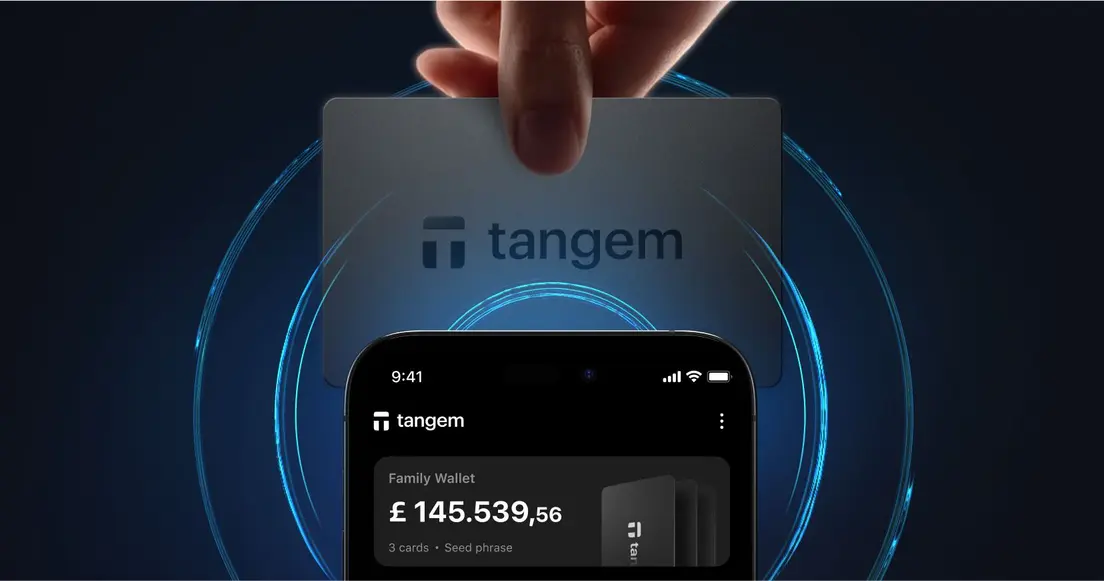
No. The card communicates over NFC with a range of 0 to 5 cm, and the channel is encrypted with AES-256. But the bigger protection is the access code: without it, a found card cannot authorize any transaction. The app itself also locks after 5 minutes of inactivity. Physical possession of the card alone is not enough.
-
Your funds stay on the blockchain regardless. The private keys reside on the cards, not on Tangem's servers. Official documentation states that blockchain access does not depend on Tangem. If you generated a BIP39 seed phrase during setup, you can import it into any compatible wallet. If you used the default seedless setup, your cards remain functional independent of Tangem's continued operation, since the keys are stored entirely on the secure element.
-
Yes. Because the private keys live on the cards rather than on any phone, you can install the Tangem app on as many phones as you like. On each new phone, open the app, tap "Scan card," hold any card from your set to the NFC reader, and enter the access code. The wallet appears and can sign transactions whenever a card from that set is tapped.
-
The Tangem app supports 16,000+ cryptocurrencies and tokens across 91+ blockchain networks. Supported networks include Bitcoin, Ethereum, Solana, Cardano, Arbitrum, Optimism, Base, BSC, Avalanche, TON, Sui, Aptos, and many others. Custom tokens can be added by contract address on 60+ networks. There is no practical limit on the number of different assets you can hold on one card set.
-
Self-custody is legal in the EU. MiCA's Recital 83 explicitly states that hardware or software providers of non-custodial wallets fall outside the regulation's scope. Holding and transferring your own crypto via self-custodial wallets remains fully permitted. The rules that do apply, such as the Travel Rule under Regulation (EU) 2023/1113, target regulated crypto service providers (CASPs), not individual users holding their own keys. Peer-to-peer transfers between self-custodial addresses are unaffected.

Don't miss these 


Other articles

