


 Switch to seedless. Get 30% off with SWITCH30 till Oct 26
15 Reasons Why You Should Use Tangem
This article is available in the following languages:

Cryptocurrency operates on absolute self-sovereignty. You alone are responsible, and if your crypto management method is unreliable, your funds can disappear instantly with zero legal recourse. A reliable management tool ensures that the private key, a cryptographic password that provides access, is kept completely safe away from malware, phishing links, and device failures.
However, the entire industry operates on the assumption that if you want security, you sacrifice usability. If you want usability, you move to a custodial platform and accept the risks that come with it.
Tangem has spent almost a decade dismantling this through engineering decisions, certifications, and products you can trust. Here are several reasons why we’re simply a top choice for crypto management.
Real ironclad security
1. Seedless backups
Back in 2021, Stefan Thomas made news for losing access to 7,002 Bitcoin on an IronKey hard drive after forgetting his password. With only ten attempts before permanent erasure, he had two left, leaving over $220 million trapped. Similarly, in 2013, James Howells discarded a hard drive containing 8,000 Bitcoin. Despite a decade of petitioning the Newport City Council to excavate the landfill, his requests have been rejected, leaving hundreds of millions of dollars locked beneath municipal waste.
Chainalysis estimates that up to 4 million Bitcoins are permanently lost due to a single point of failure in the backup system—the seed phrase.
We replaced this model with a multi-card backup. During setup, every card in the set receives the same private key—two or three cards, each an independent hardware copy, stored in separate locations. The seed phrase can still exist as a final fallback, but it is no longer your only line of defense.
2. One chip. Fewer attack vectors.
Most hardware wallets are assembled from multiple components. A secure element stores the private key. A separate microcontroller runs the user interface. A display driver powers the screen. A radio module or USB controller handles connectivity.
Tangem's card contains one component: a Samsung S3B512C secure element, certified EAL6+ under Common Criteria. The chip handles key generation, key storage, and transaction signing. The NFC antenna connects it to your phone. Nothing else.
3. Buy anywhere, Verify in the app
Billions of chip payment cards move through postal systems and retail shelves every year. Banks trust the format because tampering with a laminated card leaves visible evidence.
A Tangem card uses the same construction: a secure chip and an NFC antenna sealed between plastic layers 0.76 mm thick. It cannot be opened; there's no battery cavity or empty space.
The Tangem app also verifies each card’s authenticity with a cryptographic check at first use and warns you if someone has already activated it.
4. Independent audits & immutable firmware
In 1970, the U.S. Air Force hired a team of scientists to track down relentlessly every possible source of failure in a spacecraft subsystem or simulation. The project was called Tiger Team testing. The idea was radical for its time: pay smart people to attack your own infrastructure before your enemies do. The concept evolved into what the security industry now calls penetration testing and independent auditing.
Tangem's card firmware has been independently audited by two firms: Kudelski Security and Riscure.
Kudelski Security, the cybersecurity division of Switzerland’s Kudelski Group (est. 1951), specializes in embedded systems, IoT hardware, and cryptographic security.
Riscure specializes in hardware security evaluation and testing chips, secure elements, and embedded devices against physical attacks such as side-channel analysis, fault injection, electromagnetic probing, and tampering.
Both firms evaluated the Tangem card firmware independently, and it passed. Tangem's firmware is also immutable. It cannot be updated after manufacturing. So the code that Kudelski and Riscure evaluated is the code that runs on every card or ring shipped.
5. Proven security record
Tangem Wallet has been around since 2017, nine full years with zero security breaches, zero funds lost to hacks, and zero private keys compromised in the real world. Very few crypto wallet companies can claim a track record like that over the same period. By the end of this article, you’ll find out why.
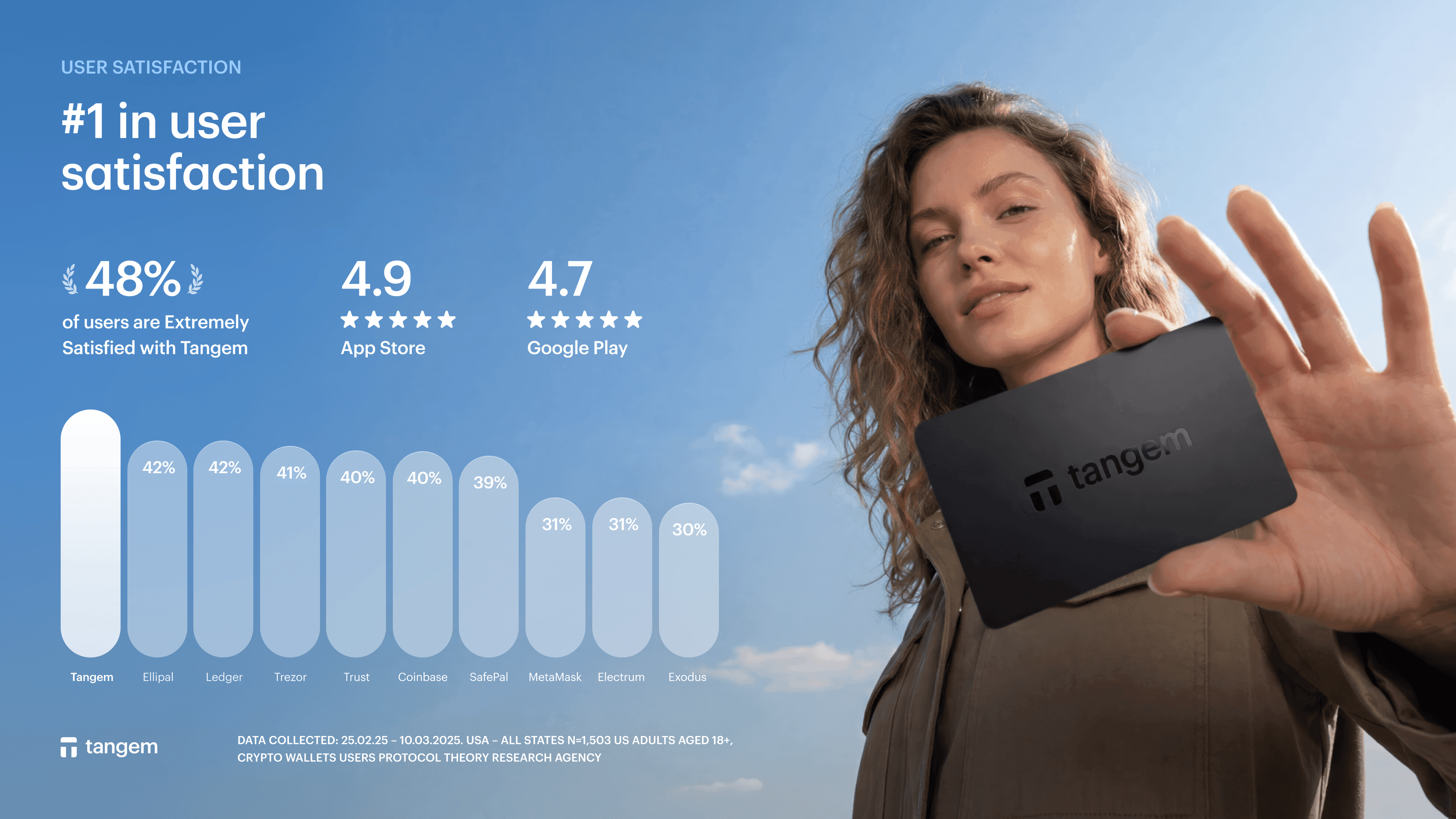
6. Maximum protection at minimum cost
In 1965, NASA engineers faced a problem with the Gemini spacecraft guidance computer. A single failure in the system could kill the crew. Their solution was triple modular redundancy: three identical computers running the same calculations simultaneously. If one failed, the other two outvoted it, and the mission continued. NASA accepted the added weight, cost, and complexity to avoid a single point of failure on a machine carrying human lives.
Most hardware wallets ship as a single device for up to to $349. You get one point of failure and a piece of paper for your seed phrase. Tangem starts at just $54.90 pre-discount for a set of two or three cards that contain the same private keys. You get multiple independent backups straight out of the box.
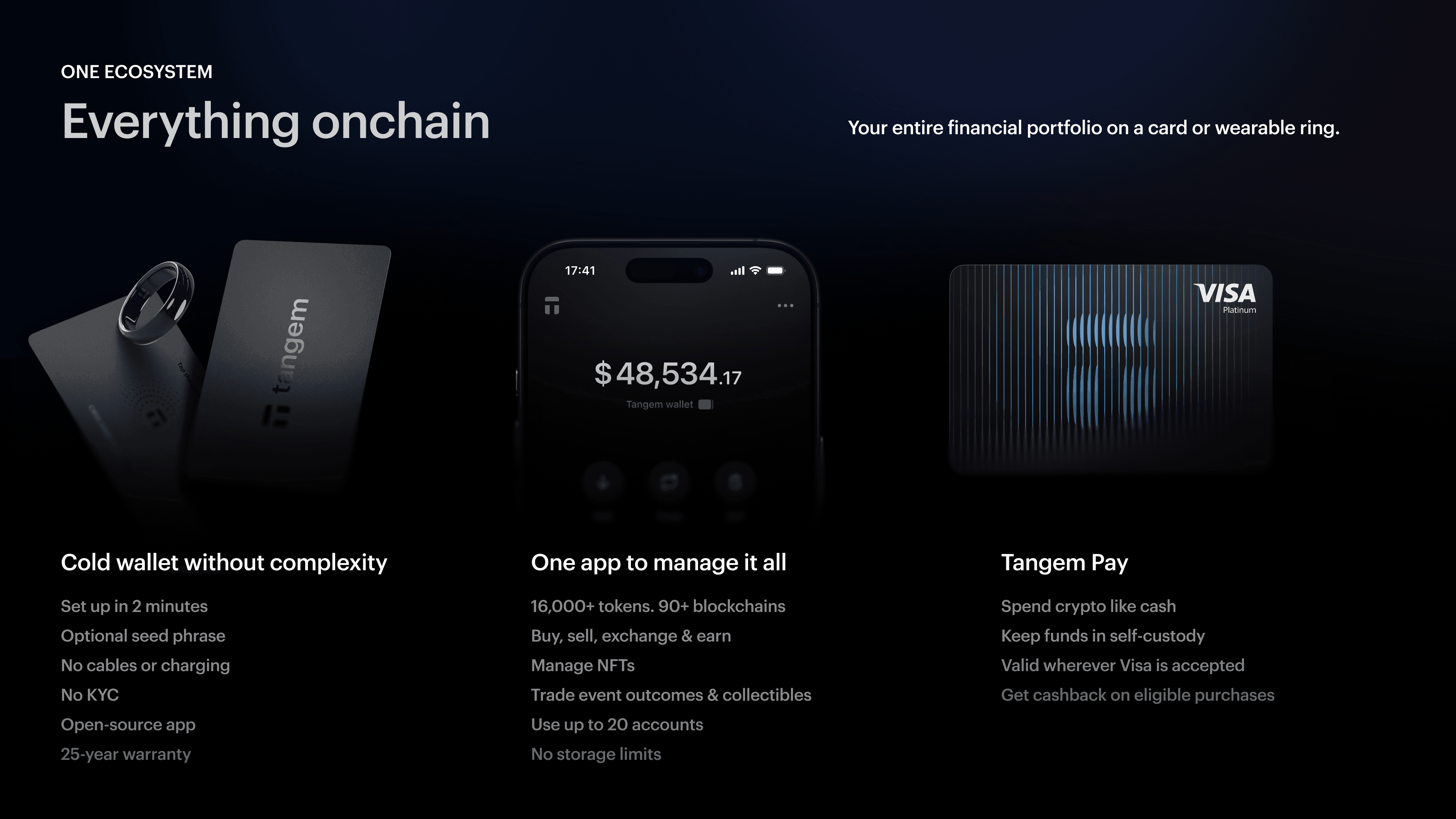
7. Set up in 1 minute
Complexity used to be a feature in self-custody. But it is an adoption barrier. The harder the setup, the smaller the user base. The smaller the user base, the less useful the technology. Some wallets still ask you to roll a physical casino-grade die 99 times and type each result into the device to generate your private keys.
Tangem has reduced the wallet setup to under 60 seconds. Download the app and create a wallet in just 2 button taps. No KYC, account creation, password, or email verification required at first. You get to back up your private key later.
It’s officially easier and faster to create a Tangem Wallet than to set up an Instagram account.
8. Built for an adventurous life
In 1962, the U.S. military published MIL-STD-810, a set of environmental testing standards for equipment intended for use in the field; in mud, rain, sand, extreme heat, and freezing cold. The logic was simple: if a soldier carries it, the equipment must survive everything the soldier survives.
IP ratings descend from the same logic. The Ingress Protection scale, maintained by the International Electrotechnical Commission (IEC), measures how well a device resists dust and water. The iPhone 15 carries an IP68 rating: full dust protection and submersion in fresh water up to 6 meters for 30 minutes.
IP69K is a different category entirely. It originated in the German standard DIN 40050-9, developed for equipment used in food processing plants and agricultural machinery, where hardware is subjected to high-pressure steam jets at close range.
The Tangem card and ring carry an IP69K rating.
Think about what this means in the context of daily life. You leave Tangem hardware in your jeans and run them through the washing machine. It survives. You spill hot coffee across your desk, drop it in the snow, carry it through monsoon rain. It still survives.
There is no battery to degrade, no moving parts to wear out, or screen to crack. Your bank will merge, rebrand, or fail in the next 25 years. Your exchange will change its terms, freeze withdrawals, or shut down. Your phone will be replaced eight to ten times. Your Tangem card and ring will still be there, signing transactions.
9. Access independent of Tangem
In 312 BC, the Roman censor Appius Claudius Caecus commissioned a road from Rome to Capua. It was built from volcanic rock, with drainage layers engineered to require no maintenance. The republic that built it fell. The empire that inherited it fell. The road is still there, and you can walk on it today.
Even if Tangem, the company, disappears, the website goes offline, and the app is removed from the stores, anyone can build it. Private keys stay on the card forever, transactions go straight to the blockchain with no company servers involved, and the open-source app code lives on GitHub.
The hardware needs no batteries, updates, or ongoing support. Your crypto remains accessible long after the company is gone, exactly how self-custody should work.
10. Wear your crypto: Tangem Ring
To truly take advantage of the crypto market and its upsides, you need your private key close at hand at all times. The Tangem Ring is crafted from premium zirconia ceramic, turning your wallet into a hypoallergenic, scratch-resistant accessory.
You can wear it continuously during daily activities, workouts, or travel. Inside the ring offers uncompromising security just like the Tangem cards. It represents a massive leap forward for crypto portability, moving your digital wallet out of your pocket and directly on your finger.
11. Mobile-first experience
Tangem puts the full wallet experience in the phone that you already carry. A tap of the card or ring on the phone signs a transaction while the secure element keeps the private key inside the card/ring.
The app offers a modern interface for swaps, yield farming, staking, and dApp integrations. A mobile-first model also lowers the barrier for new users through our seedless setup and multi-card backup.
Earn in your wallet.
12. Multiple networks, more opportunities
The early internet had a fragmentation problem. CompuServe users could not email AOL users. Prodigy had its own content library. Every online service was its own island. The networks could not talk to each other. TCP/IP unified them.
Crypto faces the same fragmentation challenge today. Bitcoin, Ethereum, Solana, Tron, Polygon, Avalanche, and dozens of other chains each operate independently. Most wallets support a handful of chains well and ignore the rest. You end up needing a different wallet for each ecosystem.
Tangem supports over 90 blockchain networks and more than 16,000 tokens. These include Real-World Assets, Non-fungible tokens, and soon Collectibles. Anything you want, we’ll give it to you while you hold your keys.
13. Safer access to DeFi
Decentralized finance recreated most of what traditional banks do: lending, borrowing, trading, and providing liquidity. It did this through smart contracts, which are self-executing code deployed on a blockchain.
The problem is access. Most people interact with DeFi through browser extensions. You visit a website, connect your wallet, and approve a transaction. The problem is that you often have no way to verify whether the website is legitimate before you sign.
Between 2022 and 2024, wallet-drainer operations like Inferno Drainer and Angel Drainer exploited this gap on an industrial scale.
KYDA in Tangem protects users at three layers. First, when you scan a WalletConnect QR code or tap a deep link, it checks the dApp URL and contract addresses against Blockaid’s current database of malicious and phishing domains, warning you of matches before any onchain interaction.
Second, before you tap your card to sign, the app simulates the transaction off-chain and previews token movements and permissions in plain language. This reveals balance changes, unlimited approvals, hidden NFT transfers, and suspicious operator permissions before you commit.
Third, Verified Transactions (VTX) cryptographically ensure the executed transaction matches the preview, preventing man-in-the-middle attacks between simulation and signing.
This is what separates Tangem's DeFi access from others. Tangem gives you the same protocol access with three additional verification steps and uncompromised self-custody.
14. Grow with staking and Yield Mode
For most of financial history, earning yield on your assets required giving them to someone else. You deposited cash in a bank. The bank lent it out and earned interest. You received a fraction of that interest.
Crypto staking works on a fundamentally different model. You lock assets (staking) to support a blockchain network's consensus mechanism and earn rewards for doing so. Or you lend assets to earn yields far greater than what banks offer.
On most wallets, staking still requires depositing your assets on a custodial exchange. You give up custody to earn yield, reintroducing the same counterparty risk that self-custody was designed to eliminate.
In the Tangem app, native staking is live for ETH, SOL, ADA, ATOM, BNB, TRX, POL, and GRAM on Ethereum. Two infrastructure providers handle the validator operations: Yield.xyz supports ATOM, BNB, GRAM, POL, SOL, and TRX. P2P.org supports ETH. ADA uses both.
Yield Mode in Tangem also supplies your stablecoins to Aave, one of the largest and most audited DeFi lending protocols on Ethereum. When you enable Yield Mode for a supported token, your assets are supplied to Aave's lending pools. Borrowers pay interest, and that interest flows back to you.
You earn yield on your crypto without transferring it to an exchange, without surrendering your keys, and without trusting a company to stay solvent. Staking secures networks. Yield Mode supplies lending markets. Both operate from self-custody.
The trade-off between security and yield earnings was a limitation of older products. Tangem engineered it out.
Spend as you go
15. Spend with Tangem Pay
Today, Visa processes over 200 billion transactions per year across more than 100 million merchant locations in over 200 countries. It is the largest payment network on earth. Payment networks win through ubiquity, and Tangem Pay is connected to it.
You tap your card at any Visa-accepting terminal. You pay in crypto. The merchant receives fiat. The settlement runs through Visa's infrastructure. You spend from self-custody at the same locations where you use your bank card. You don't need a separate app or off-ramp to an exchange. Cashbacks are also available, with 1% back on the Basic tier and 2% on Plus tiers.
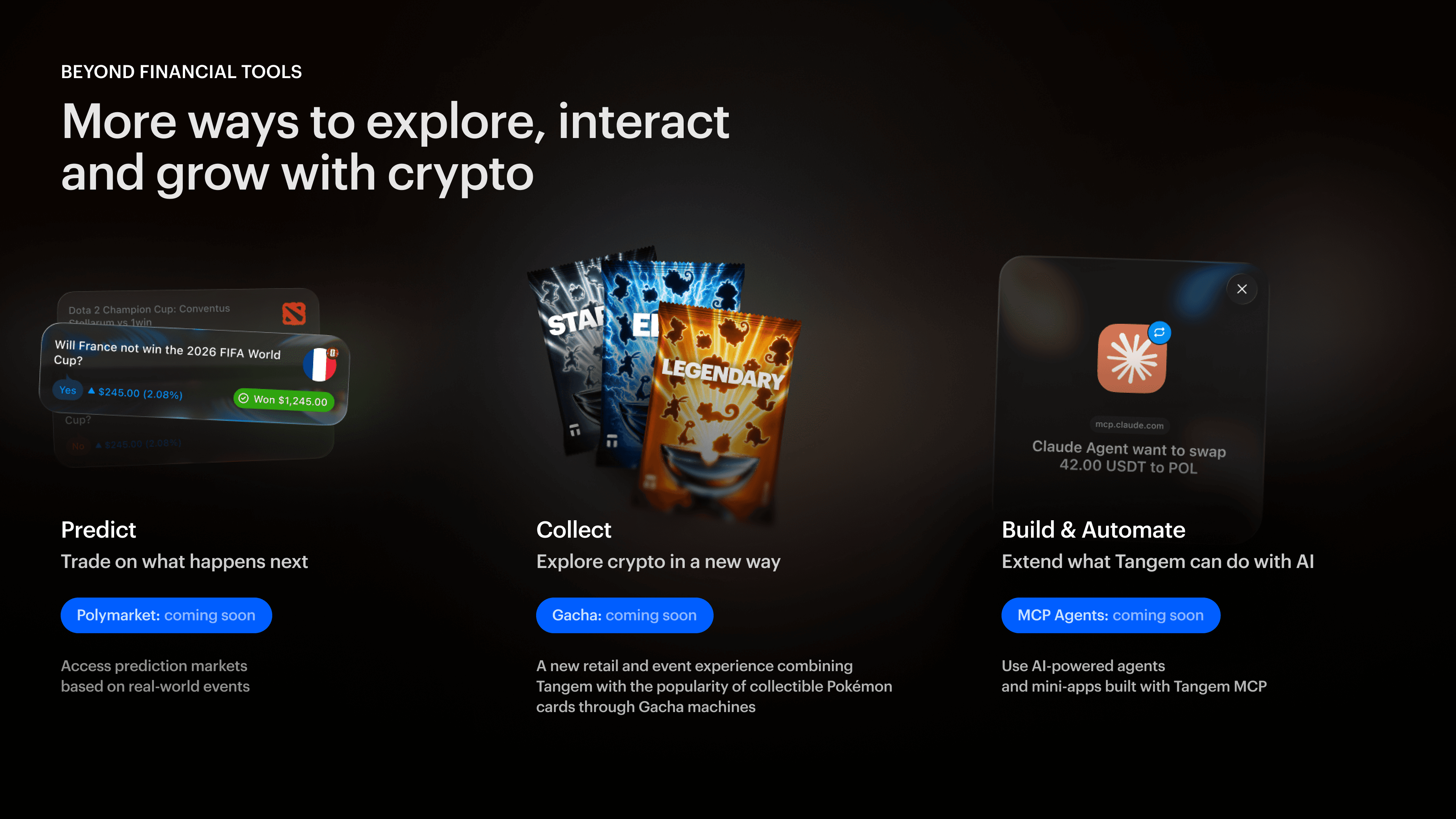
Store it. Earn on it. Spend it. Three actions that used to require three different platforms, three different custody models, and three different risk profiles. Tangem runs all three from a single app and a single set of private keys that never leaves your hand.
The technology is sophisticated, but the experience is not. It’s simply Tangem.