Switch to seedless. 30% off with SWITCH30 until 19 Oct
How People Actually Lose Their Crypto in 2026
After 3 years using a seedless wallet, here’s what I’ve learnt about how people actually lose their crypto.
This article is available in the following languages:
I have been creating content about hardware wallets on YouTube for about 6 years. In that time, I’ve reviewed many wallets, run many comparisons, and spoken to many people through comments, emails, and my community groups. And there is one pattern that keeps recurring.
Most people who lose their crypto do not lose it because of a sophisticated hack or a broken secure element chip. They lose it due to a mistake with their seed phrase.
The repeating pattern I’ve seen for years
I frequently receive emails, comments, and messages from people seeking assistance after losing access to their crypto wallets. While their stories vary, the common thread is almost always a mistake related to their seed phrase.
Some have lost the physical paper where they wrote down their seed phrase. Others were deceived into entering their seed phrase on a malicious fake website.
Many stored their seed phrase in their notes app, only for their phone to be stolen or hacked, leading to a compromise.
Several have reported mistakenly sharing their seed phrase with fraudulent support personnel online. These examples are just a few of the many ways people have inadvertently jeopardised their crypto security.
This pattern has persisted for many years. Chainalysis publishes annual reports on the sources of crypto losses. Seed phrase-related mistakes have long been the top category. You can read their Crypto Crime Report for more detailed data.
Why I started using a Tangem wallet
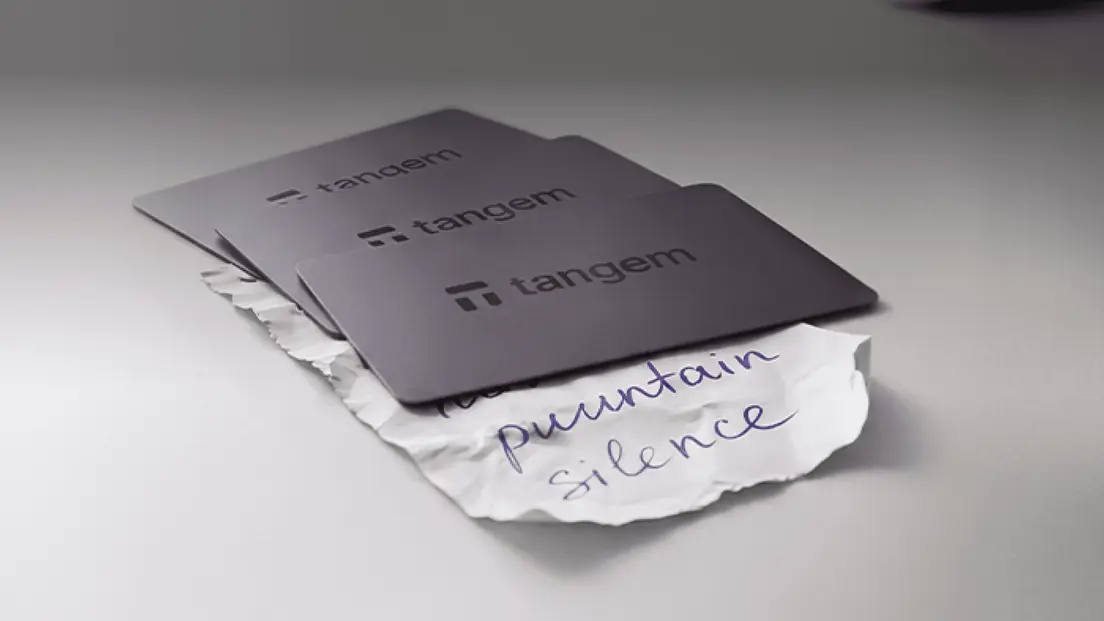
I began using Tangem roughly three years ago because it offered a different approach. Rather than requiring users to safeguard a 24-word seed phrase, Tangem creates the private key within the card’s secure element and provides multiple identical cards as backups. If one card is lost, the remaining cards continue to function.
You cannot steal a physical piece of paper or be tricked into entering words into a fake form. The common failure mode that leads to losses isn’t inherent.
However, using a seed phrase with Tangem remains an option if you need compatibility with other wallets or prefer that method. The primary setup is seedless, and I believe that the default is important. Most people don’t bother changing defaults. If the default safeguards against the main cause of losses, it offers a significant benefit.
The trade-offs are worth mentioning
I try to be fair about the trade-offs of any wallet I recommend. Seedless card wallets have real ones.
No inbuilt screen/display
A card wallet with no screen relies on your phone’s screen to display transaction details. If your phone is compromised, an attacker could, in theory, show you one address while another is signed. In practice, this has not led to real losses on any card wallet that I am aware of. But the risk is technically there. I mention this in my videos when I cover Tangem.
Tangem’s CTO, Andrey Lazutkin, has directly pushed back on this criticism: the Tangem app decodes and displays full transaction details before you approve them, so the signing is not truly ‘blind.’
He also points out that hardware wallet screens can only display what the device’s chip can parse from a smart contract, making them no more complete than a phone screen in many DeFi scenarios. Supply chain attacks on non-secure display components are an additional risk that screenless designs avoid entirely. A risk that has not materialised to any user so far gets lower priority in my security thinking than the risks that actually cause losses every day.
Tangem has hardened the app itself. The Tangem app is open source on GitHub, so anyone can inspect the code that renders transaction data on your screen. Cure53, an independent security firm, ran a white-box audit of the mobile SDK in 2026 with six senior researchers over 23 days.
On top of that, the app integrates Blockaid-powered transaction simulation: every transaction gets a dry run off-chain before you sign, surfacing the exact balance changes, hidden approvals, and contract calls in a human-readable preview. For WalletConnect sessions, Verified Transactions (VTX) cryptographically bind that preview to what actually executes onchain, so there is no gap between what you see and what gets signed.
Physical loss
There is also the risk of physical loss. If you lose all the cards in your set and do not enable the optional seed phrase backup, your funds will be lost. The multi-card design is your backup. You need to store the cards in different locations for it to work. That is a real responsibility, just a different one than protecting a piece of seed phrase paper.
No wallet is perfect. You choose which risks you are exposed to. I choose the risks that lower the overall probability of losing funds across the board. That seems like the logical approach: lower the net risk overall.
What I think matters most when choosing a wallet
After 6 years of this, my view is simple. The wallet you choose matters less than which risks you are actually exposed to. If the biggest reason people lose crypto is seed phrase-related mistakes, then choosing a wallet that removes seed phrase mistakes from the equation is a reasonable choice for most people.
This does not mean that seedless is the only right choice. There are people who want the traditional seed phrase approach because they know how to protect it, and they want the option to move their wallet to any other software or hardware that supports the same standard. That is fine. Everyone should pick what fits how they operate.
But for most people, especially those new to self-custody or those who know they will make mistakes over time, a seedless setup removes the failure mode that causes the most losses. That is why I use a seedless wallet for some of my long-term holdings.
Not because it is the most technically advanced wallet on the market. Just because it protects me from what keeps happening to other people.
Written by Nordic Crypto in partnership with Tangem, whose seedless wallet has helped thousands of crypto investors stay safe and protect their assets. You can find more hardware wallet reviews and comparisons on the YouTube channel or at nordiccrypto.io.