How Does Tangem NFC Work? The Technology Behind the Tap (2026)
This article is available in the following languages:
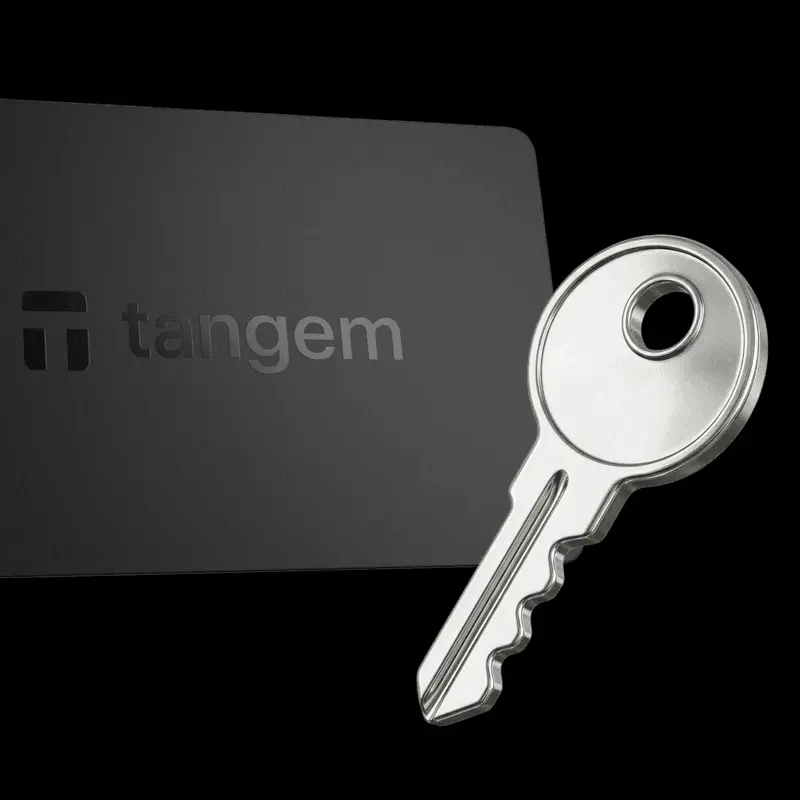
You tap a credit card to pay for coffee. The transaction completes in under a second. Tangem works on the same physical principle, but what happens inside the card is completely different. Instead of debiting a bank account, the tap triggers a cryptographic signing operation that never exposes your private key to any internet-connected device.
What Is NFC and Why Is It Secure?
NFC (Near Field Communication) is a wireless connectivity technology that enables devices to communicate when brought within a few centimeters of each other via magnetic field induction. Tangem product documentation lists its NFC standard as ISO 14443 Type A. The "near field" part is the key security property. Communication is limited to approximately 0-5 cm. Tangem's encrypted channel prevents NFC communication from exposing readable transaction data or private keys.
| NFC Property | Security Implication |
|---|---|
| 0-5 cm range | Requires close physical proximity |
| No battery required | The card is passive, so it cannot be remotely activated |
| No persistent connection | Session starts and ends with each tap |
| ISO 14443 Type A standard | Internationally standardized protocol |
| AES-256 encrypted channel | Communication between the app and the chip is encrypted |
Tangem cards are ISO 14443 Type A-compliant and use an AES-256-encrypted channel for all communication between the card and the Tangem app. Raw interception of the NFC signal yields ciphertext, not readable data.
That distinction matters. NFC moves messages between the phone and card, but it is not where the wallet's trust is concentrated. The channel allows the app to ask the card to perform a specific action. The secure element decides whether that request is authorized and returns only the result.
The card has no battery. It draws power entirely from the phone's NFC field through electromagnetic induction, the same principle that charges wireless earbuds, just at a much shorter range. No power source means no persistent radio signal. The card remains completely silent until you deliberately bring it within range.
The Secure Element: The Heart of the Card
NFC is only the transport. The security lives in what's at the end of that transport: the Samsung S3D350A secure element, developed in partnership with Samsung Semiconductor. This chip is certified EAL6+ under Common Criteria, one of the highest available security certifications, the same standard used in biometric passports and international payment cards. EAL6+ means the chip has been independently evaluated against sophisticated attack scenarios, including invasive physical attacks and side-channel analysis.
What makes the secure element different from regular chip storage:
- On-chip key generation. Tangem's private key is generated entirely within the secure element using a hardware True Random Number Generator (TRNG). The key never exists outside the chip, even during creation.
- Tamper-resistant hardware. The chip includes laser, temperature, light, and power sensors.
- Side-channel resistance. The design resists power analysis and electromagnetic analysis attacks, techniques that try to infer secret data by measuring the chip's physical emissions during operation.
- No key export. Keys cannot be extracted or duplicated, even with physical access to the card.
When you tap, the phone's NFC field powers the chip through induction. The chip activates, processes the signing request entirely within its own memory, and returns only the result. The private key is used but never transmitted. This is why the card can feel simple without being simple internally. You see a tap. The wallet sees a controlled signing request, an access-code check, a protected key operation, and a signature returned to the app.
Tangem's firmware is factory-installed and cannot be updated after production. This is a deliberate design choice: it removes the possibility of a malicious firmware update being pushed remotely. The trade-off is that the firmware cannot be patched either, which is worth knowing if you prefer updatable security systems. Independent audits by Kudelski Security (2018) and Riscure (2023) reviewed the firmware before it was locked.
The Full Technical Flow: Tap to Signed Transaction
Here's exactly what happens between the moment you tap and the moment your transaction reaches the blockchain.
Step 1: The app prepares the transaction. You initiate a send in the Tangem app. The app constructs the unsigned transaction data, destination address, amount, and network fees before any card interaction begins. At this stage, the app can prepare the information, display the send screen, and connect to the blockchain network. It still cannot spend from the wallet. Spending requires a signature from the private key inside the card. The phone can ask, but the card has to approve.
Step 2: NFC discovery and channel establishment. You bring the card within 0-5 cm. The phone's NFC controller creates the field, and the Tangem antenna harvests enough energy to power the secure element. After that, the app receives the card identification data and opens an encrypted communication session.
Step 3: Access code verification. The app sends the access code (Tangem requires at least 6 characters) to the card for verification inside the secure element. Incorrect codes trigger increasing delays. A correct code authorizes the signing session.
Step 4: Transaction signing inside the chip. The app sends the transaction details to the card. The secure element signs the transaction internally using the stored private key. The signing computation happens entirely within the chip. The private key is used but never exported. The output is only the cryptographic signature.
That signature is the important handoff. It proves that the transaction was approved by the wallet's private key, but it does not reveal the key itself. This is the same broad hardware-wallet pattern used across cold storage: prepare online, sign inside a protected hardware device, broadcast online.
Step 5: Return and broadcast. The signed transaction is returned to the Tangem app via the NFC channel. The app adds the signature and broadcasts the completed transaction to the blockchain network. Done. From tap to signed transaction: under 2 seconds. At no point in this flow does the private key come into contact with an internet-connected device.
That's the core principle of how hardware wallets work: the app receives a signed transaction, not the private key itself. Tangem's NFC implementation is one way to deliver that signing result to the app, but the security guarantee comes from the secure element doing the signing in isolation. That split is the reason the NFC can stay simple without carrying the wallet's secrets.
Why NFC vs. Bluetooth or USB?
Tangem connects via NFC without USB, batteries, or Bluetooth. That's not just a form-factor choice. Each interface has different security properties.
| Aspect | NFC (Tangem) | Bluetooth / USB (others) |
|---|---|---|
| Attack range | 0-5 cm, physical proximity required | Bluetooth: 10m+ / USB: direct connection |
| Persistent connection | No, session per tap | Bluetooth can maintain persistent session |
| Battery required | No, passive induction power | Varies by model |
| Physical wear | No connector to degrade | USB connector degrades with repeated use |
| Interception risk | Short-range and encrypted | Varies by model |
Some hardware wallet models use Bluetooth for wireless signing; others connect via USB cable to a computer. Tangem, along with Keystone and Ellipal, avoids both USB and Bluetooth connections, though Keystone and Ellipal use QR-code workflows rather than NFC. The security argument for NFC is specific. A tap is a deliberate human action. You physically bring the card to the phone, the session opens, the signing happens, and the session closes. No battery means the card cannot be remotely activated or polled. It's completely inert until you choose to use it.
That makes the user action visible. If a transaction needs a card tap, you have to bring the card into the phone's NFC field. The app alone cannot quietly move funds in the background, because the signing step still depends on the physical card.
One honest limitation: NFC requires physical proximity. You can't sign a transaction remotely, and Tangem has no desktop or web interface. Everything runs through the mobile app on iOS 16.0 or higher (iPhone 8 or newer) or Android 6.0 or higher with full NFC support. If you prefer managing your wallet from a desktop, that's a real constraint.
Can NFC Be Hacked?
Tangem NFC communication uses an AES-256 encrypted channel with a 0-5 cm range, requiring physical possession and proximity. Here's why that doesn't translate into a viable attack against Tangem specifically. The communication channel between the Tangem app and card uses AES-256 encryption. Raw capture of the NFC radio signal yields ciphertext, not readable transaction data, not key material.
The private key is never transmitted over NFC at any point. What travels across the channel is the transaction data going in and the cryptographic signature coming out. Even a complete, perfect capture of an entire NFC session would contain no private key information because the key never leaves the secure element.
There is also a practical boundary around attacks. NFC proximity is not a password by itself. An attacker would still need a usable signing session, the card near a phone, and the required authorization path. Capturing radio traffic does not automatically translate into the ability to generate new signatures.
The practical verdict: Tangem's NFC communication is short-range and encrypted, while the secure element architecture keeps private keys off the channel entirely. Tangem's NFC channel is short-range and encrypted; the on-chip signing model prevents intercepted traffic from exposing or deriving your private key.
Is Tangem Safe?
The broader safety picture extends beyond NFC. Tangem's security architecture is designed around a single principle: private keys are generated on-chip and never leave the secure element. Over 8 million devices have been distributed with zero successful hacks reported. The app code for iOS and Android is open-source on GitHub. Tangem reports independent firmware audits by Kudelski Security and Riscure.
A stolen Tangem card alone is not enough to access funds. An attacker also needs the phone with the Tangem app, the access code or biometric, and physical NFC proximity, all three simultaneously. This is why Tangem's security model has layers. The card holds the key. The app builds and broadcasts transactions. The access code authorizes signing. NFC supplies short-range communication. Removing one layer changes the risk, but it does not hand over the private key.
The honest caveats: Tangem has no desktop or web interface, which limits how you interact with your wallet. The firmware cannot be updated after production, which some advanced users view as a trade-off compared with updatable hardware wallets. And if all backup cards are lost and no seed phrase was configured, fund recovery is impossible. Tangem cannot recover the funds on your behalf.
For long-term self-custody of significant holdings, hardware wallets are the recommended cold storage solution. Tangem's NFC-based model is one implementation of that principle, with the secure element doing the cryptographic work and NFC serving as the delivery channel.
FAQ
-
Yes, particularly when the NFC interface connects to a hardware secure element like Tangem's EAL6+ chip. The 0-5 cm range requires physical proximity; the AES-256-encrypted channel protects the session; and the private key is never transmitted over NFC at any point. What travels across the channel is the transaction data in and the signature out.
-
Tangem supports iOS 16.0 or later on iPhone 8 or later. iPhone 7 and 7 Plus may lack full NFC functionality required for activation or for creating private-key backups, according to Tangem's own documentation. For full compatibility, an iPhone 8 or later running iOS 16.0 or higher is required.
-
Tangem uses ISO 14443 Type A for NFC communication. Communication between the app and card runs over an AES-256-encrypted channel.
-
Without an access code, the card cannot sign transactions. Tangem requires an access code of at least 6 characters for all transaction signing, and brute-force attempts trigger increasing delays. A stolen card without the access code, and a phone with the Tangem app, cannot be used to move funds.
-
Private keys are stored on the card, not the phone. Losing the phone doesn't affect wallet access; you can restore access on a new phone by downloading the Tangem app and tapping the card. Tangem wallets come as 2- or 3-card sets, so losing one card doesn't mean losing access. If all cards are lost and no seed phrase was configured, fund recovery is impossible.
-
No. Tangem has zero access to users' private keys and cannot access user funds. The private key is generated on-chip and stored in tamper-resistant memory inside the secure element. It never leaves the card. No account registration or KYC is required for basic wallet usage, and Tangem does not collect personal data or monitor transactions.
-
Some hardware wallet models use Bluetooth for wireless signing; Tangem connects via NFC without USB, batteries, or Bluetooth. NFC sessions open and close with each tap. There's no background radio connection. The card is also passive, meaning it cannot be remotely activated or polled without physical proximity. These properties make NFC a better fit for a security device where every signing action should be a deliberate physical act.