Switch to seedless. Get 30% off with SWITCH30 till Oct 21
Stronghold x Tangem Hardware Wallets
This article is available in the following languages:
Cross-border payments have a fee problem. A single transfer can lose a meaningful cut of its value to middlemen, currency conversions, and slow settlement rails. Stronghold built its platform to close that gap; it runs on the Stellar network and uses the SHx token to power fast, low-cost settlements, so value moves across borders without the usual toll.
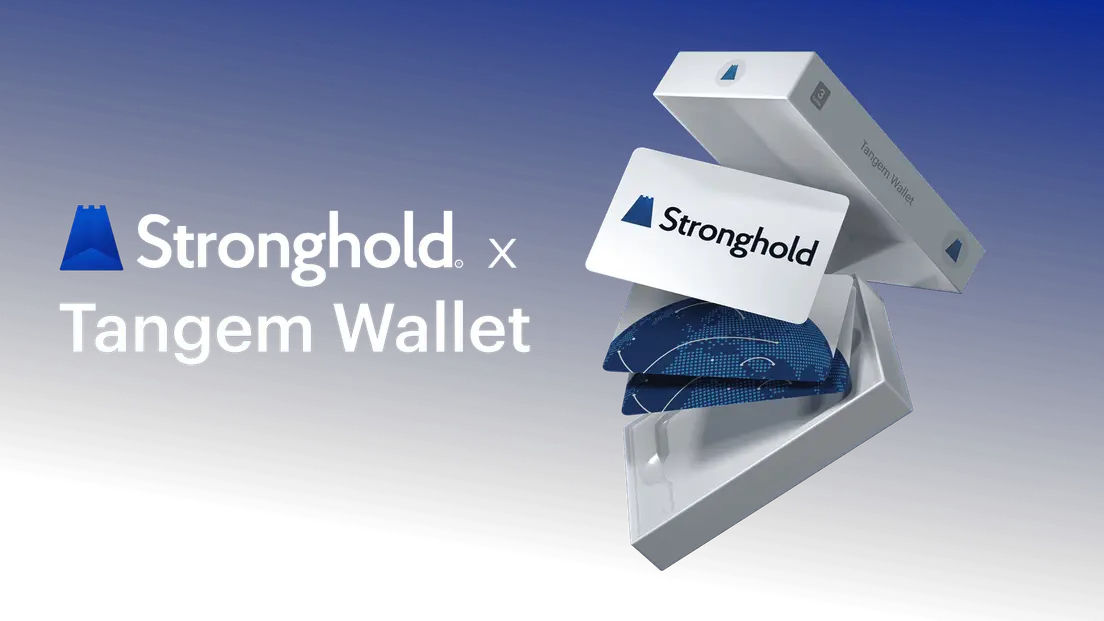
Once you hold SHx, you’ll want a management solution that matches the network’s security. The Stronghold and Tangem co-branded SHx wallet is built for exactly that. With it, your private key stays completely offline and never touches the internet. With multiple cards in one set, you can also opt out of managing seed phrases.
This guide breaks down how the SHx card works under the hood and walks you through best practices to keep your SHx secure over the long run.
What is Stronghold and the SHx token?
Stronghold is a payment and financial services company founded in 2017. In 2018, it launched its own stablecoin, Stronghold USD, a token tied to the U.S. dollar. Stronghold partnered with IBM to help financial institutions move money faster, at a lower cost, and with more security. The company pivoted to domestic payments, helping cash-reliant businesses accept digital transactions for the first time.
The SHx token powers much of this infrastructure. It exists natively on Stellar, a network built for payments and cross-border transactions, and on Ethereum, with bridges connecting both to Solana and XRPL as well. Across all four networks, SHx maintains a fixed supply of 100 billion tokens, used for real-time settlements, discounted transaction fees, and governance votes. Today, Stronghold builds payments infrastructure that bridges traditional financial rails with blockchain, including ACH payments, real-time settlement, merchant financing, checkout systems, and card processing.
SHx (Stronghold) Tokenomics
SHx is positioned as a utility token inside Stronghold’s payments and financing ecosystem rather than a pure speculative asset.
- Maximum supply: 100 billion SHx (fixed; will not increase).
- Total supply: ~99.75 billion.
- Circulating supply: Approximately 17.7–18.2 billion (mid-2026 figures reported by Stronghold and major trackers).
Native on Stellar. Also available/bridged to Ethereum (ERC-20), Solana, and the XRP Ledger. Divisible to 7 decimal places.
Supply Management (Escrow Ladder)
In 2025, Stronghold locked 60 billion SHx across 60 separate escrow accounts (1 billion each) using Stellar Soroban smart contracts.
- Unlocks occur on the 15th of each month in a staggered 60-month cycle.
- Any unused portion of a monthly unlock automatically relocks for another 5 years.
This creates a rolling ladder that releases only what is needed and avoids large, sudden supply shocks.
Utility
Rewards: Merchants and customers earn SHx based on transaction volume in the Stronghold payments network.
Merchant financing: SHx liquidity pools support Stronghold’s lending product.
Fee benefits: Can be used to offset processing costs.
Governance: Holders vote on network features and rule changes. One whole token = one vote (fractional balances do not count). Quorum requirements: 1% of active circulating supply for normal proposals; 25% for amendments to the governance rules.
Limited deflationary mechanics exist (e.g., burning a portion of certain financing-related fees).
Official details are available on stronghold.co/shx and the project’s governance documentation.
Keeping your SHx safe
When you hold crypto, the biggest risk stems from how you store the private keys that control your funds, and wallet design makes a major difference here.
A hot wallet stays connected to the internet, convenient for quick transactions, but it also expands the attack surface. Malware, phishing sites, compromised apps, or remote exploits all become realistic threats because the private key is accessible to software that can reach the network.
A cold wallet keeps the private key completely offline, so the key never touches an internet-connected device during normal use. This isolation eliminates most remote attack paths. An attacker would need physical access to the device itself, which is a much higher bar.
The SHx card builds on standard cold storage and further simplifies it. Instead of generating and demanding that you back up with a traditional seed phrase, the card is designed so that the private key is created and stored only on its secure chip by default. This removes one of the most common points of failure in crypto security (the seed phrase itself) while still keeping the key fully offline.
How the SHx card works
The Tangem x Stronghold cards are battery-free NFC hardware wallets built around a Common Criteria EAL6+ certified secure element chip.
In the default (seedless) mode, the private key is generated entirely inside the chip using its hardware True Random Number Generator (certified BSI PTG.2 / AIS 31). The TRNG draws entropy from physical noise (thermal, electronic, oscillator jitter), conditions it to remove bias, extracts 256 bits, validates it against the curve order, and uses it directly as the master private key; no seed phrase is ever created. The key stays in the chip forever and only ever outputs signatures.
In the optional seed-phrase mode
The app can generate a standard BIP-39 phrase (12/24 words) using the phone’s secure random generators if you want cross-wallet compatibility. This seed phrase is imported into the card’s chip and wiped from the phone’s memory. It also supports a passphrase for additional entropy.
Backup: The private key is securely cloned to one or two additional cards over an encrypted, mutually authenticated channel.
Tangem’s firmware has been independently audited by Kudelski Security and Riscure, its mobile app was reviewed by Cure53, and the cards themselves carry an IP69K certification for maximum dust and high-pressure water resistance.
Best practices for your SHx card
1. Understand your backup system
Each SHx set includes three cards. Every card holds a complete, independent copy of your private key. Losing one card does not put your funds at risk; the remaining cards still contain the full key, protected by the chip.
2. Store your backup cards separately
Keep the cards in different physical locations. Storing them all together creates a single point of failure; theft, fire, or flood could wipe out the entire set. Treat each card like a separate physical key. Note that two cards together also allow you to reset the access code, so plan storage with that recovery option in mind.
3. Set a strong access code
Add an access code during setup. This adds a second layer of protection beyond simply possessing the card. Choose a strong, random code so a lost or stolen card is far less useful to anyone who finds it.
4. Know the recovery limits
Self-custody has a hard boundary. If every card in the set is lost or destroyed and you did not set up a seed phrase backup, access to the funds is permanently lost. No support team, password reset, or recovery service can restore it. This is the trade-off of true self-custody: no third party can help you, and no third party can touch your funds either.
With the SHx card, you hold full control of your funds. No bank, exchange, or third party can freeze, seize, or lose them for you. This level of independence also means the responsibility sits with you.
Get this wallet here: https://stronghold.tangem.com/
If you’d like to understand the wallet's security design in more detail, visit our blog articles