A hardware wallet should not have an expiry date. It should work today, tomorrow, and in ten years without needing significant upgrades.
TL;DR
Every Tangem product ever shipped, the Note (2018), Wallet 1.0 (2022), and Wallet 2.0 (2023), still works today. Ledger's Nano S lost all software support in June 2025, leaving millions of users without new blockchain compatibility.
Tangem handles new chains, tokens, and features through app updates; the card never becomes obsolete. Ledger requires on-device apps that must fit in limited memory, and when that fills up, you need new hardware.
Tangem cards also have no battery to degrade because they're powered by your phone's NFC. Ledger's Nano X relies on a non-replaceable battery with widely reported failures. And while Ledger's depreciation cycle means buying new hardware every few years at $149–$399 plus migration gas fees, Tangem has no replacement cost and no forced migration.
Hardware wallet lifespan
When you buy a hardware wallet, you’re deciding on the long-term security of your assets. The implicit promise is durability: this device will protect your crypto for years, potentially decades. We think the Ledger Nano S and X don’t meet this standard.
The Ledger Nano S launched in 2016 and was sold for six years, becoming the most widely distributed hardware wallet in crypto history. Millions of users bought it on the understanding that it would secure their assets for the long term.
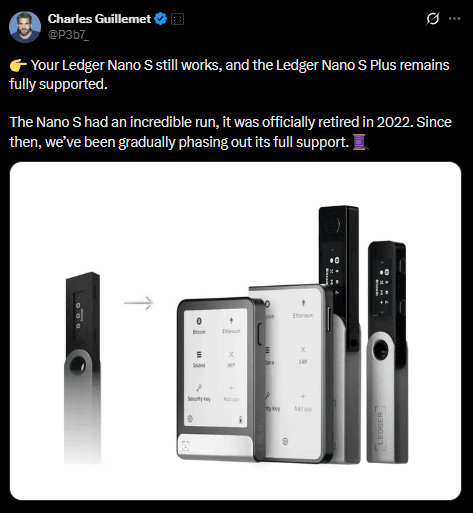
In 2022, Ledger formally retired the Nano S from its product line and replaced it with the Nano S Plus. However, the company continued to provide limited software support for existing devices until June 2025, when Ledger announced the end of all software updates, new app submissions, and security patches for the Nano S.
The reason is that the device’s 320 KB of flash memory, which was sufficient when the Nano S launched, can no longer support the growing requirements of Ledger’s software ecosystem.
Simply put, the Nano S cannot run Clear Signing, Ledger Recover, NFT transfers, THORChain or Uniswap swaps, language packs, Transaction Check, or Ledger Sync. The operating system, Bitcoin, Ethereum, and Exchange apps alone nearly fill the device’s entire memory.
Ledger has stated that emergency patches for critical security flaws may still be needed until 2026, but routine support is over. The device technically still works for basic operations, but future compatibility with blockchain protocol upgrades, new token standards, or evolving security requirements is not guaranteed.
The crypto community’s response
Users raised concerns about what happens when future bugs are discovered in a device that no longer receives patches. Others pointed out the uncomfortable implication: if you bought a hardware wallet expecting it to last indefinitely, you’re now being told to buy another one.
Ledger offered existing Nano S users a 20% discount on newer devices. Their current touchscreen models range from $149 (Nano Gen5) to $399 (Ledger Stax). Even at a discount, the replacement cost is high, raising the question of how many times a device must be upgraded over its lifetime.
Deprecation timeline
Date
Event
June 2016
Ledger Nano S launches at ~$66
2016–2022
Sold as Ledger’s primary consumer product for 6 years
All software updates, security patches, and new app support have been terminated
2026
Emergency-only critical patches may still occur (no guarantees)
Battery issues
The Nano S isn’t the only device with a ticking clock.
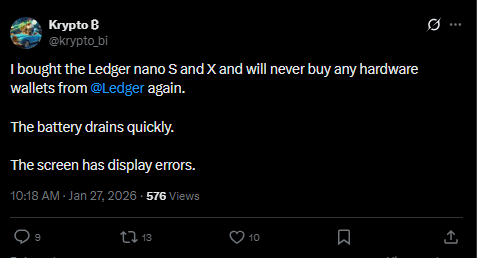
The Nano X, launched in 2019, uses a 100 mAh rechargeable battery that Ledger confirms cannot be replaced. Battery degradation is an inherent property of lithium-ion technology; over time and charge cycles, capacity diminishes.
Users have widely reported battery issues, including charging failures, critical battery errors, and devices that only function when plugged into a USB.
Ledger’s support documentation acknowledges these issues and recommends charging every 3 months to keep the battery in condition, storing the device within specific temperature and humidity ranges, and, ultimately, contacting support for a replacement if troubleshooting fails. If the device is out of warranty, the only option is to purchase a new one.
The Nano S Plus, Nano X, and other Ledger devices continue to receive support for now, but the question isn’t whether these devices will eventually be deprecated; it’s when.
This creates a recurring-cost model that is like a hardware subscription: buy a device, use it for 5–10 years, then discover it’s no longer supported, and migrate to a new device at a high cost.
Migration tax
When a Ledger device is deprecated, migrating to a new one requires either restoring from your 24-word seed phrase on a new device or transferring assets onchain, which means paying gas fees for every token and every chain you hold assets on.
For a user with assets spread across multiple networks (Ethereum, Solana, Bitcoin, various L2s, staked positions), the gas costs of a full onchain migration can be substantial. This is a hidden cost of device obsolescence that rarely appears in hardware wallet comparisons.
Every Tangem Wallet Ever Shipped Still Works Today
Tangem Note
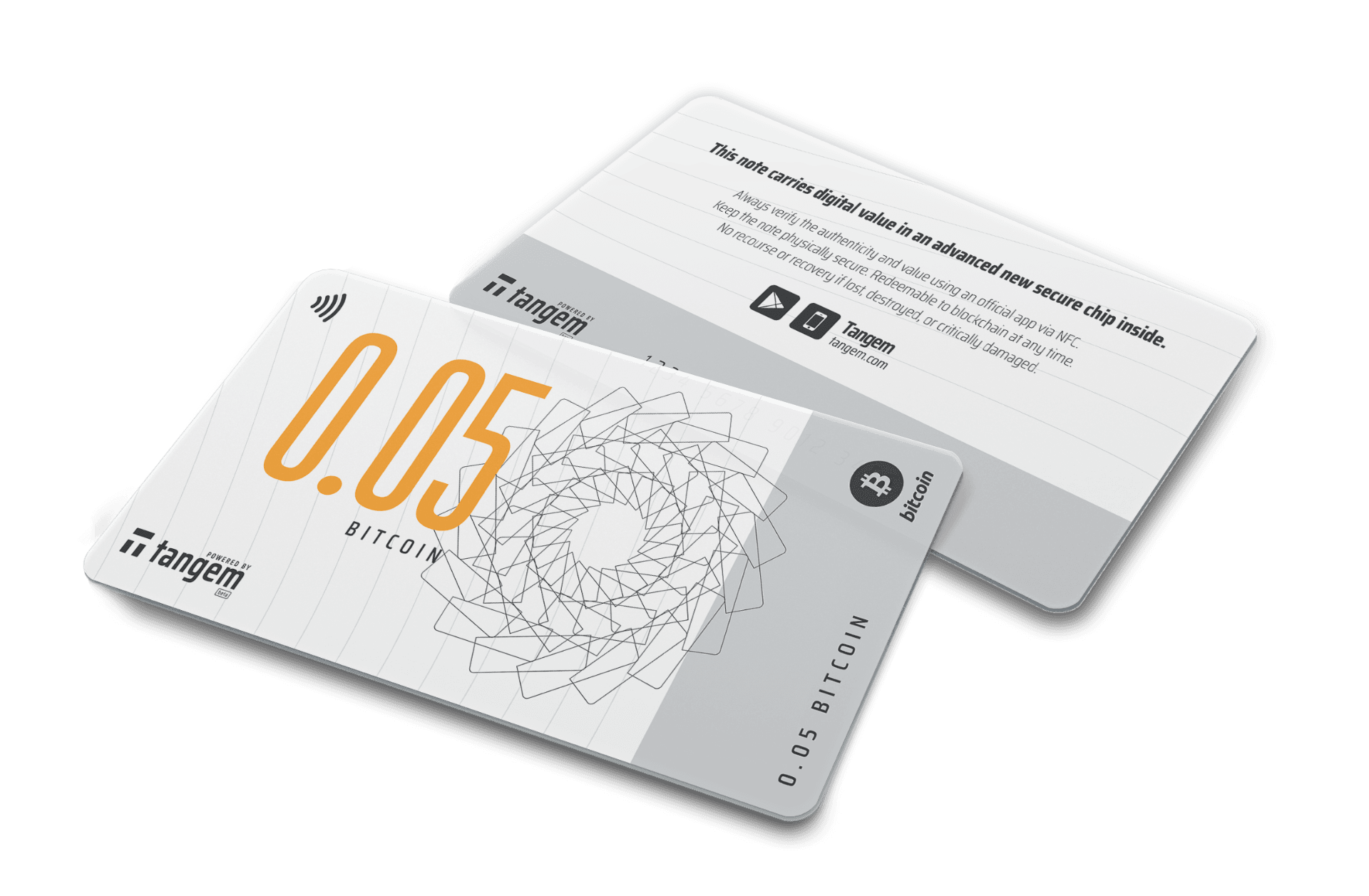
Launched in 2018, the Tangem Note is a physical bearer instrument that holds a fixed denomination of a single cryptocurrency. Think of it like a prepaid gift card, but for Bitcoin or Ethereum. Each Note came pre-loaded with a specific cryptocurrency and denomination (e.g., 0.01 BTC, 0.05 ETH).
Discontinued from production, but every Note ever sold still holds its keys, still signs transactions, and still communicates with the Tangem app. If you bought a Bitcoin Note in 2020, you can tap it today and move your Bitcoin. The app still supports it.
Tangem Wallet 1.0
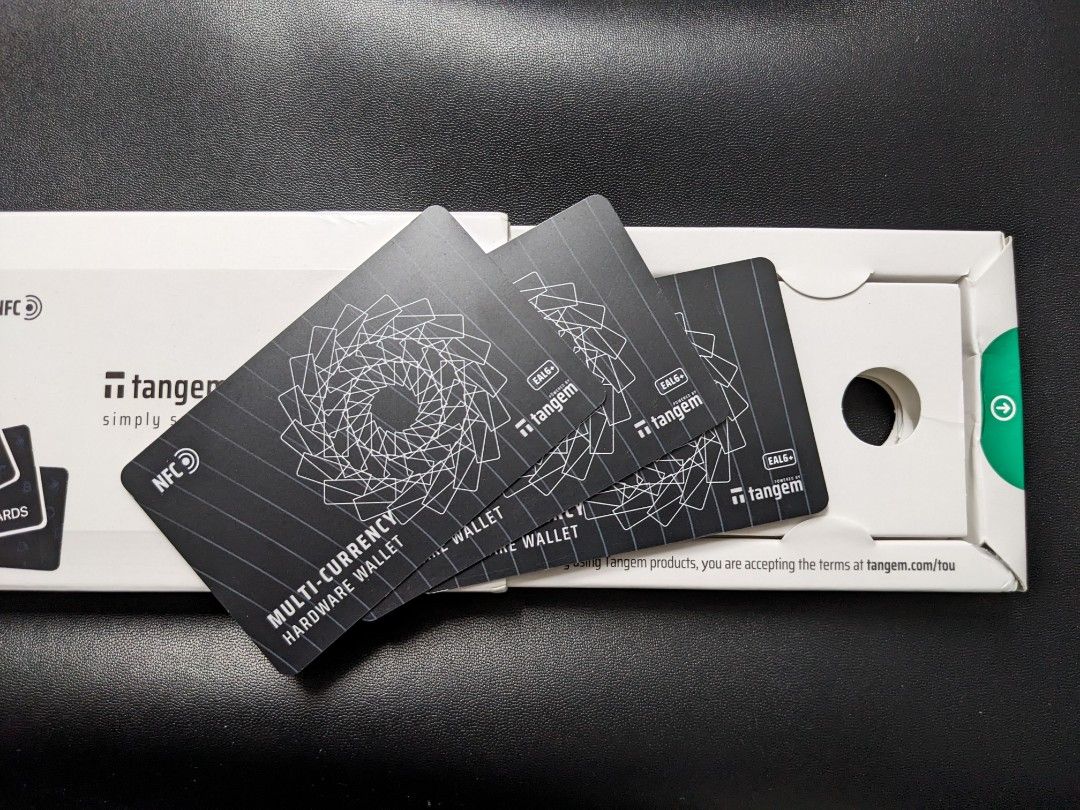
In September 2023, production discontinued in favor of 2.0, but all 1.0 cards remain fully functional. They support the same coins and tokens as 2.0 through app updates.
The only limitations are that 1.0 cards don't support seed phrase generation, seed phrase import, or disabling access code recovery. But they still work and receive app updates to this day.
The key insight is that app updates are available for all Tangem Wallet versions, and both generations support the same coins and tokens.
How Tangem differs from Ledger
Ledger's on-device apps must fit inside the Secure Element's limited memory. When that memory fills up (320 KB on the Nano S), the device can't support new features, new chains, or new security capabilities. The device itself becomes the bottleneck, and the only solution is to buy a new one.
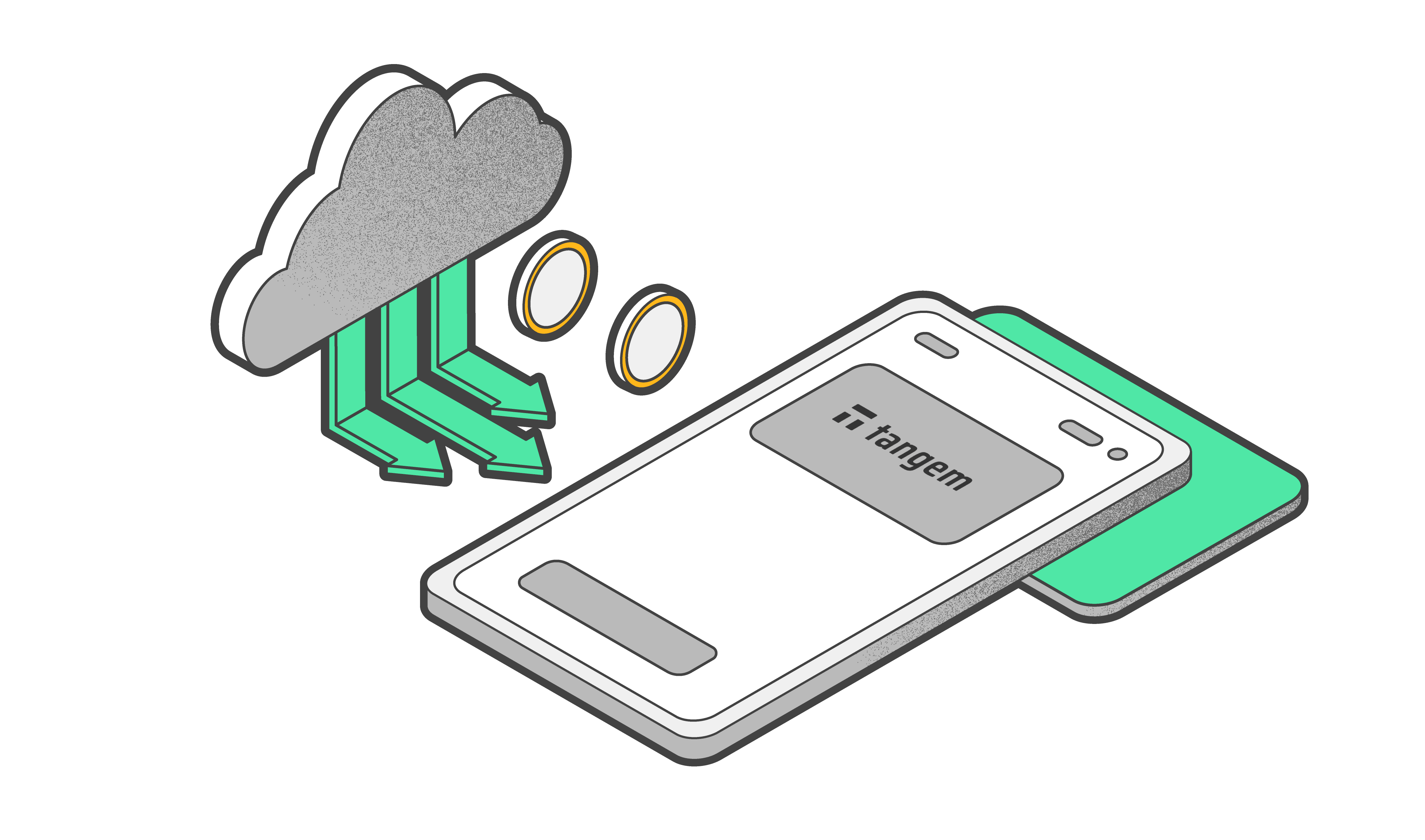
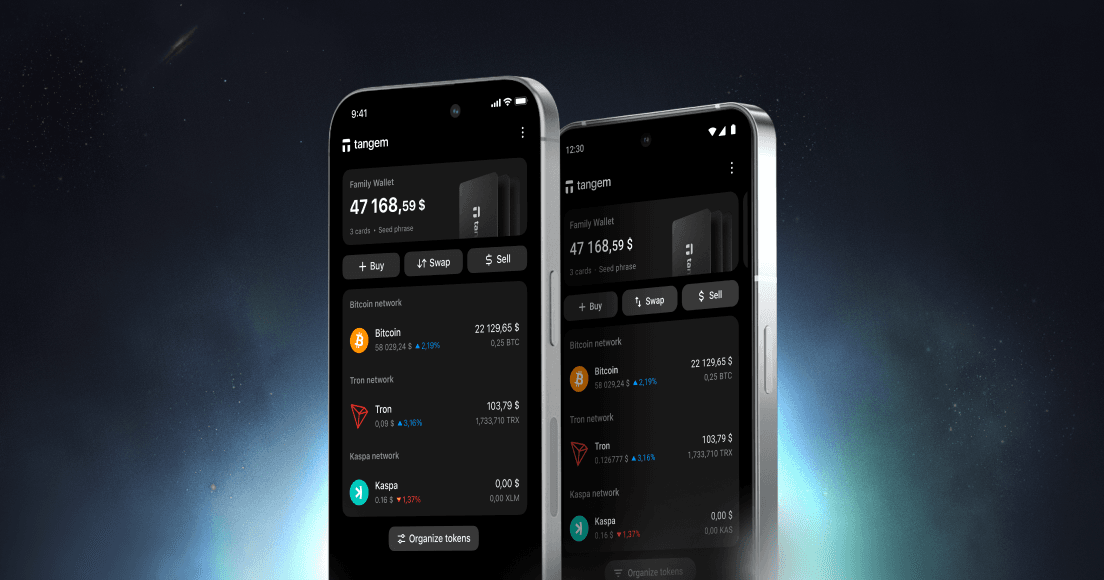
Tangem separates concerns differently. The card handles cryptography, and the app handles everything else: UI, blockchain integration, transaction construction, and network support. This means Tangem can add support for new blockchains, token standards, DeFi protocols, and features without ever touching the card's firmware.
This is why Tangem has never deprecated a product. Not because we’re a younger company with fewer products, but because our designs don't create the conditions for obsolescence.
Compare the track records directly:
Tangem
Ledger
Oldest product
Tangem Note
Ledger Nano S
Still works?
Yes
Technically yes, but no updates, no new apps, no security patches
Still receives app/software updates?
Yes (via the Tangem app)
No (terminated June 2025)
New blockchain support?
Purpose-built for a specific blockchain
No (requires on-device apps that can't be installed)
Recommendation
Still supported
Buy a new device (20% discount offered)
User action required to stay current
Update the mobile app
Purchase newer hardware, migrate all assets onchain
The Tangem Wallet is fundamentally different in its relationship with time and technology:
Tangem cards have no rechargeable battery, no lithium-ion cells, and no charge cycles. The card is powered passively by the NFC field from your phone during each tap. There is nothing to degrade, nothing to maintain, and no end-of-life from battery failure.
The card’s security and signing capabilities are built right into its unchangeable silicon; it doesn’t have memory limitations that require updates, unnecessary software that outgrows the hardware, or feature creep that could overwhelm the device and make it insufficient.
Real self-custody has no expiry date.
The real value of a hardware wallet is your keys, your permanent control. Ledger’s Nano S sabotaged the “permanent” part. Devices were sold, supported for a period, and then deprecated, creating recurring replacement costs and a migration burden that the user must bear alone.
Ledger Recover goes further, compromising your control by introducing mechanisms for seed phrase extraction, third-party custody, and identity linkage; all for a monthly fee.
 + Up to $20 in BTC till Apr 6