Switch to seedless. Get 30% off with SWITCH30 till Oct 21
UTXO Dynamic Addresses Now In Tangem
This article is available in the following languages:
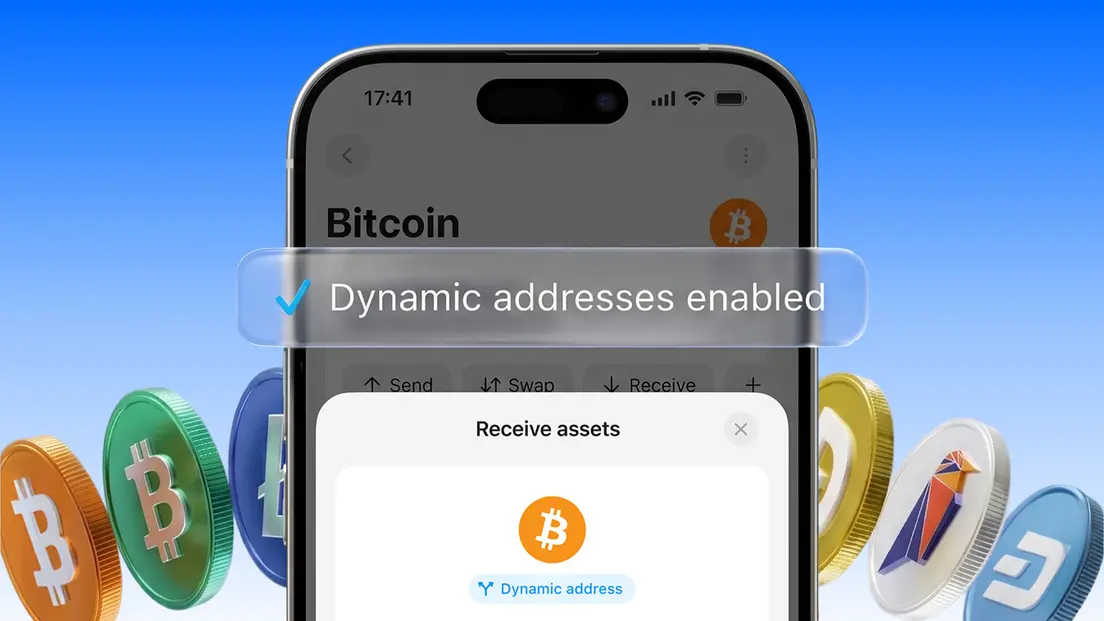
Every transaction you make is permanently visible on the blockchain. Anyone with your wallet address can trace every send and receive tied to it, check your balance, and map your activity over time. It is how the protocol works.
The privacy problem comes from address reuse. When you repeatedly share the same Bitcoin address, you hand observers a permanent thread to pull. Chain analysis firms, curious counterparties, and anyone who has ever paid you can see everything that has ever passed through that address. One address tied to an exchange KYC or a public donation can unravel an entire transaction history. This is why the Unspent Transaction Output (UTXO) exists.
What is a UTXO?
A UTXO is a discrete unit of Bitcoin that you've received but haven't spent yet. Think of it like a banknote: a specific denomination, sitting in your wallet, waiting to be used.
When you spend Bitcoin, you don't draw down a balance the way a bank account works. You hand over one or more of those notes as inputs, and the network creates new notes as outputs; one going to the recipient, one coming back to you as change if you overpaid. The original notes are gone, but new ones exist in their place.
Since every payment you receive arrives as a separate note tied to a specific address, the network can assign each one a fresh address without any extra complexity. Your wallet just collects all the notes across all your addresses and adds them up. So your balance is simply the sum of everything you're holding.
This is why address rotation is straightforward on Bitcoin but not on Ethereum. On Ethereum, your balance is a single number associated with a single address, like a bank account. Changing the address means moving the money, which costs fees and leaves a trail. On Bitcoin, each incoming payment is already its own object. Giving it a new address is no different from putting a new banknote in a different pocket. The total in your wallet stays the same.
What Are Dynamic Addresses?
Dynamic Addresses automatically generate a fresh receive address after each incoming transaction, for Bitcoin and other supported UTXO networks. You never reuse the same address twice.
All of these addresses belong to the same wallet and seed phrase. Your total balance is the combined sum across all of them. Nothing changes on the security side. The only difference is what the outside world can observe.
Also, you do not manage any of this manually. Tangem handles address rotation in the background. When you open the receive screen, you see the current active address. When a transaction confirms, the next address is ready.
How It Works
Dynamic Addresses uses standard BIP-44 derivation paths. Receive addresses follow m/44'/0'/0'/0/index, incrementing the index after each transaction. Change addresses follow m/44'/0'/0'/1/index.
Considering that these are industry-standard paths, any funds you previously held at these derivation paths in another wallet will be automatically detected and included in your balance when you enable the feature.
The balance shown in the Tangem app is always the aggregate across all addresses in your wallet. You do not need to track individual addresses or manage which ones hold funds.
Supported Networks
Dynamic Addresses is now available on the following proof-of-work blockchains:
- Bitcoin (BTC)
- Bitcoin Cash (BCH)
- Litecoin (LTC)
- Dash (DASH)
- Dogecoin (DOGE)
- Ravencoin (RVN)
All are UTXO-based networks. These networks track individual unspent outputs rather than running balances, which is what makes per-transaction address rotation practical.
How to Enable Dynamic Addresses
The feature is off by default. To activate it:
Open the Tangem app and go to the Token page for Bitcoin or any supported network.
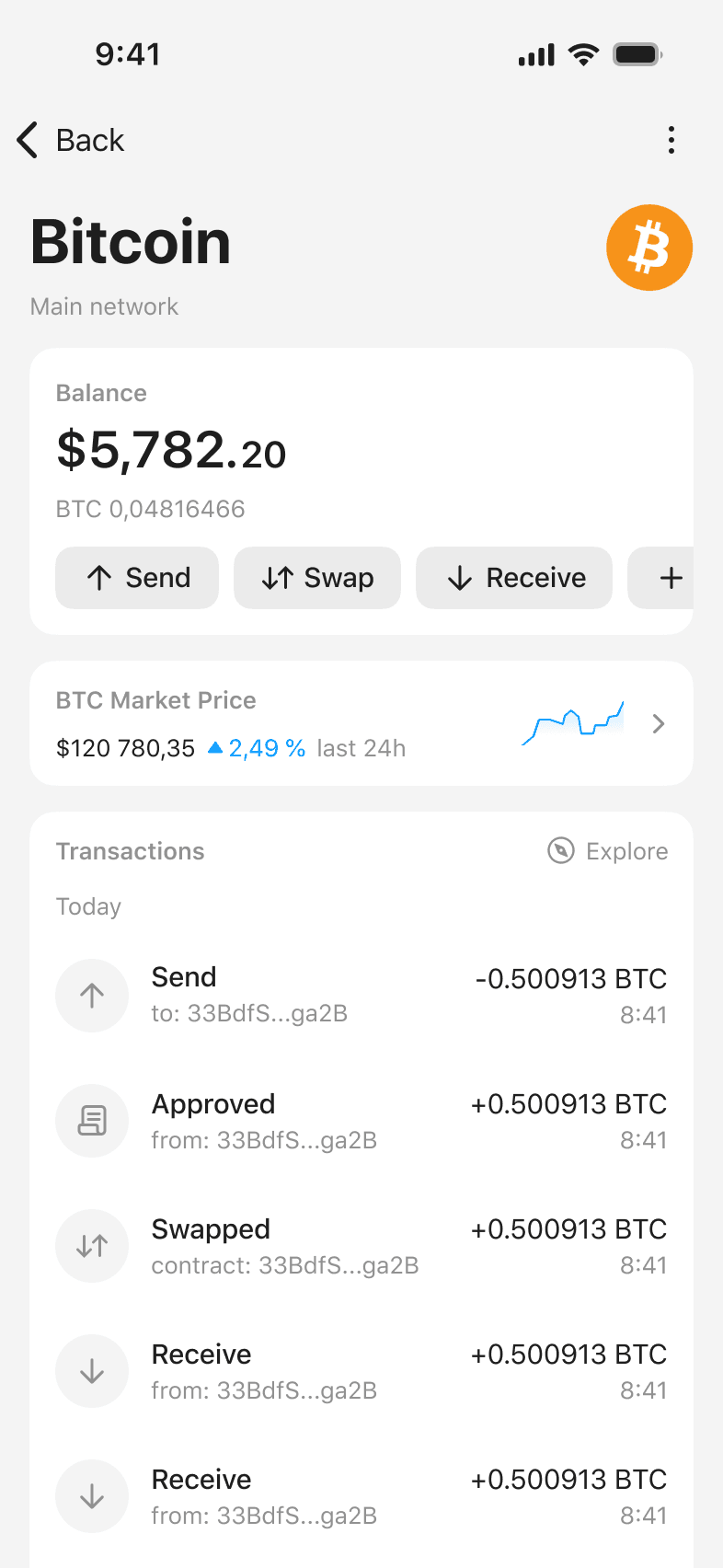
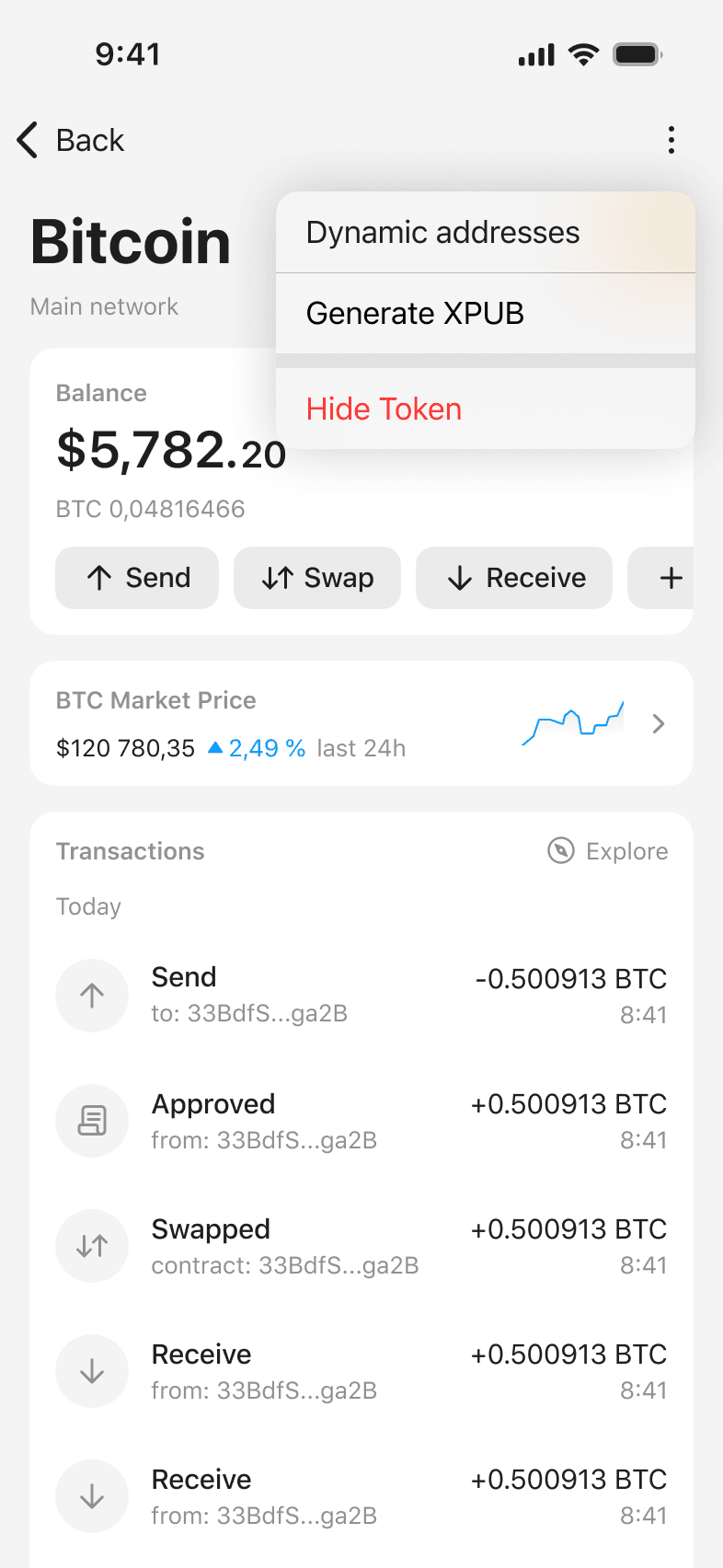
- Tap the three-dot menu in the top right corner.
- Select Dynamic addresses.
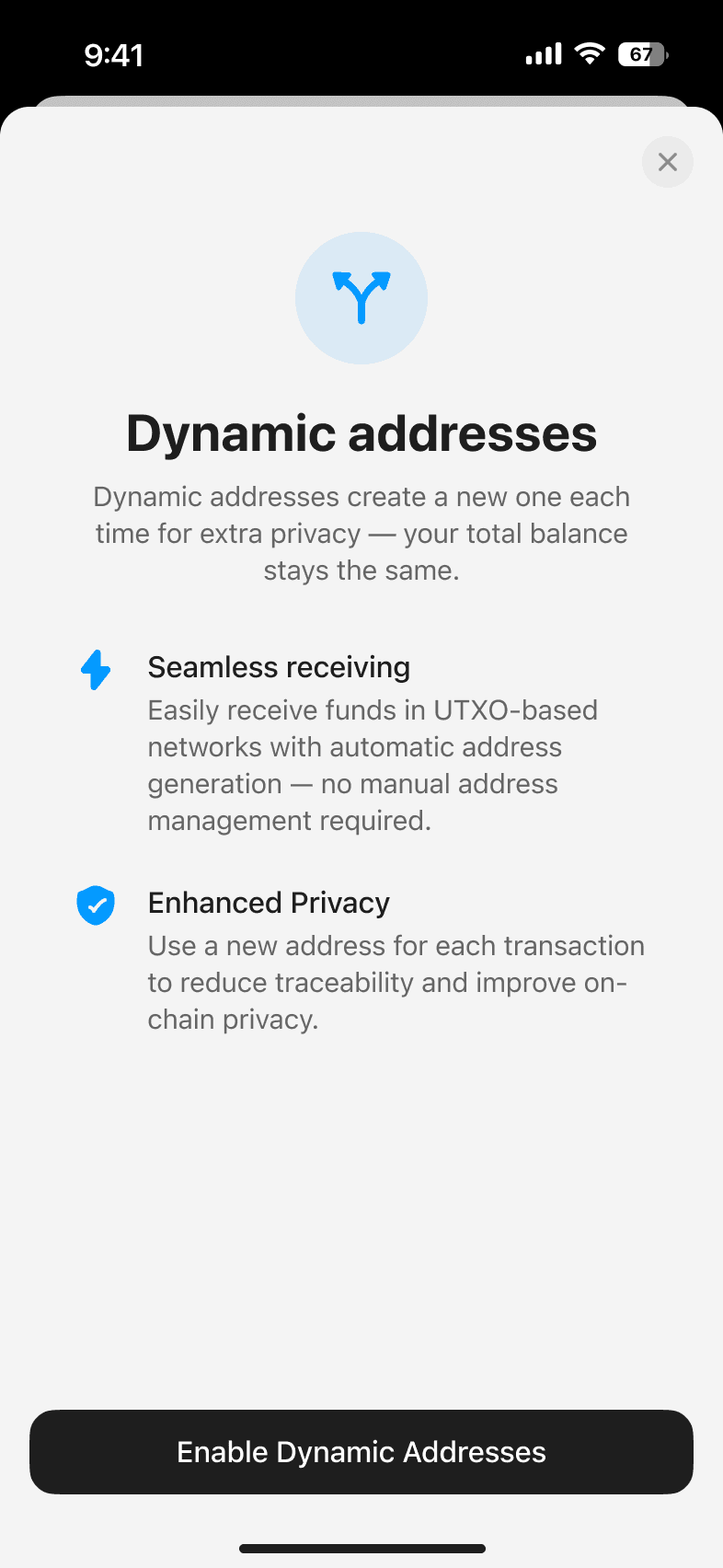
Select Enable Dynamic Addresses.
5. Done.
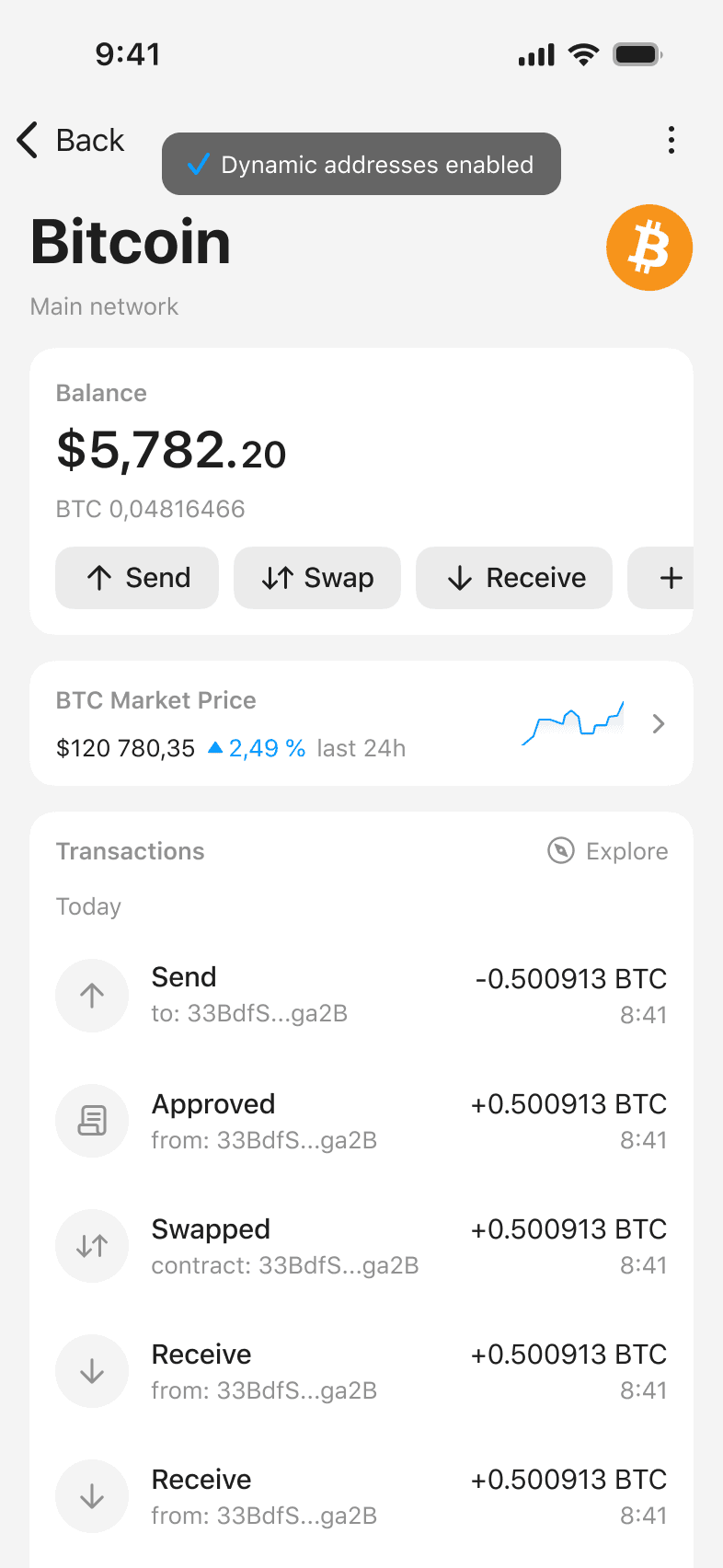
If you have multiple wallets, you will need to enable Dynamic Addresses separately for each token in each account.
What Dynamic Addresses Does Not Include Yet
Dynamic Addresses is a v1 privacy feature focused on address rotation. It is not a full coin control or UTXO management suite.
You cannot manually select which address to send or receive from. Transaction history shows a compounded view across all addresses. Past addresses are not displayed in the receive screen.
Turning Dynamic Addresses Off
You can disable Dynamic Addresses at any time. If you have only ever used the base address, the feature simply switches off. If additional addresses were used, Tangem will offer a consolidation operation to sweep all balances into your most recently used address.
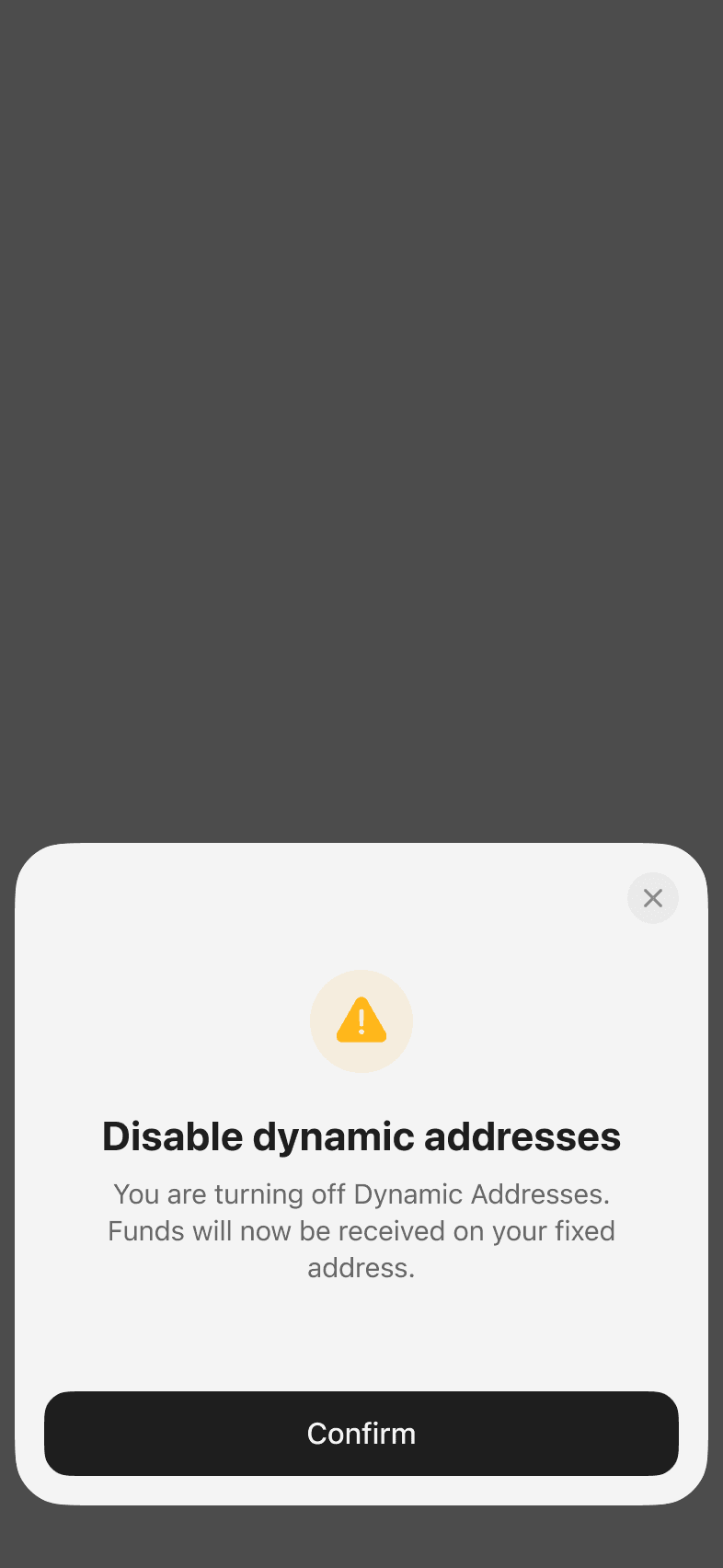
One thing to understand: consolidating inputs back to a single address reduces the privacy benefit. Multiple previously separate addresses get linked in a single on-chain transaction, which chain analysis tools can use to associate activity you had kept separate. Most users who enable this feature will leave it on.
Frequently Asked Questions
Does this affect my seed phrase or wallet security?
No. All addresses generated by Dynamic Addresses are derived from your existing seed phrase using standard derivation paths. Your wallet's security is unchanged. If you ever need to restore your wallet, the same seed phrase recovers all your addresses and their associated balances.
Will I lose access to funds in my old addresses?
No. Every address your wallet has ever generated is still accessible and included in your balance. Tangem calculates your total by summing across all derived addresses. Old addresses do not disappear. They simply are not shown on the receive screen to reduce clutter.
What happens if someone sends funds to an address I have already used?
It works normally. The funds have arrived and have been added to your balance. The feature rotates your active receive address after each transaction, but older addresses remain valid and can still receive funds at any time.
I used these derivation paths in another wallet. Will Tangem pick up those balances?
Yes. Tangem scans the standard BIP-44 derivation paths on activation and automatically detects any existing balances. You do not need to do anything manually.
Can I see all my past addresses?
Not in this release. The receive screen shows only the current active address. A full address history view is a possible addition in future versions, depending on user demand.
Can I choose which address to send from?
Not currently. This feature handles address rotation automatically. Manual coin selection, sometimes called coin control, is not part of this release. If that is a priority for you, let us know. Adoption signals drive what gets built next.
Does this work on Ethereum or other non-Bitcoin networks?
No. Dynamic Addresses is specific to UTXO-based networks. Ethereum and EVM-compatible chains use an account model rather than a UTXO model, so address rotation does not apply in the same way.
Will Kaspa and Cardano be supported?
We are evaluating both. They are technically more complex to implement and are not in this release. Additional network support will be determined by overall user adoption of the feature.
What if I have a custom token using the same derivation path?
If a custom token is already using a derivation path that Dynamic Addresses needs, you will see an error when trying to enable the feature for that token. You should remove the conflicting custom token first. This is an edge case that affects very few users.
Once I enable this, is there a reason to turn it off?
In most cases, no. The feature reduces your on-chain footprint with no downside to normal usage. The main reason someone might deactivate it is to consolidate inputs or manage a simpler address structure. Be aware that disabling and consolidating will link your previously separate addresses together in a single transaction.