Switch to seedless. Get 30% off with SWITCH30 till Oct 21
What Is an AI Agent Wallet?
A Plain-English Guide to Agentic Payments.
This article is available in the following languages:

Something quietly changed when AI got a wallet. AI assistants have existed for years, but they mostly just talked. They answered questions, summarized documents, and suggested things. Then we figured out how to give them the ability to act, and one of the most consequential actions is spending money. This is where the AI agent wallet comes in.
If you have ever wondered what it means for software to "pay" for something on your behalf, this guide breaks it down, from the basic definitions all the way to the security questions that actually matter.
What is an AI Agent?
Before the wallet makes sense, the agent has to make sense.
An AI agent is a software program that perceives its environment, makes decisions based on goals, and takes actions to accomplish those goals, all without a human directing every single step. A chatbot waits for you to type something. An agent goes and does things.
Here is a simple example. You tell an agent: "Research the cheapest flight to Chicago on Friday, book the best option under $400, and add it to my calendar." A chatbot would hand you a list of links. An agent would open the travel site, compare prices, book the ticket, and create the calendar event. It chained together multiple steps on its own.
Now add one more step to that chain: paying for the ticket.
This is exactly where wallets come into play. An agent cannot pull out a credit card. It cannot log in to a bank account or approve a wire. It needs a purpose-built financial instrument, something programmable, auditable, and controllable. This instrument is the agent wallet.
What is an AI Agent Wallet?
An AI agent wallet is a cryptocurrency wallet designed for autonomous software programs. It lets an AI agent hold, send, and receive digital assets in accordance with predefined rules, without requiring human approval for every transaction.
The key phrase is within predefined rules. A standard crypto wallet requires you, the human, to review and sign every transaction. An AI agent wallet flips that model: the human sets the rules up front, and the agent operates autonomously within them.
These rules typically look like this:
- A maximum spend per transaction (e.g., no single payment over $50).
- A daily spending cap (e.g., no more than $200 total per day).
- Whitelisted destination addresses (the agent can only send to approved wallets).
- Permitted token types (e.g., certain stablecoins only).
- Expiry times (the wallet’s permission window closes after 24 hours).
Once the rules are set, the agent can get to work. It can pay API providers, cover gas fees, route payments to sub-agents, or buy data, all onchain.
These wallets run on blockchain infrastructure, and every transaction is publicly verifiable. The agent cannot rewrite its own history.
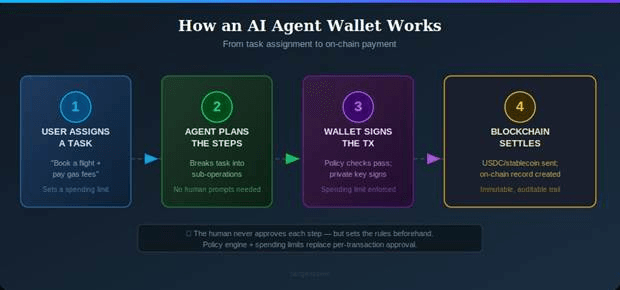
Figure 1: The four-stage flow from human task assignment to onchain settlement in an AI agent wallet.
What is an Agentic Payment?
An agentic payment is a financial transaction initiated, authorized, and completed by software without a human clicking "confirm" at the time it happens.
What makes it agentic is the lack of human confirmation. At 3 a.m., when the agent is pulling data from a paid API, no human is awake approving that API call. The agent pays for it automatically, the payment goes through, and the onchain ledger records everything.
Agentic payments differ from traditional automated payments in a few important ways. A subscription charge recurs on a fixed schedule, always the same amount, always the same recipient. An agentic payment is dynamic: the amount, timing, and destination depend on what the agent is doing in the moment.
Coinbase’s x402 protocol is one of the clearest working examples. It revives the HTTP 402 “Payment Required” status code so that when an agent calls a paid API endpoint, the server responds with payment instructions. The agent pays in USDC, attaches proof of payment to the next request, and receives the resource. The payment is woven directly into the workflow.
This is what makes agentic payments interesting: the payment is not an interruption to the workflow; it is part of the workflow.
Why Do Agents Use Crypto?
Credit cards are everywhere, and APIs take them, so why build a whole crypto-based payment layer for AI agents? The answer comes down to how agents and banks operate.
AI agents cannot open bank accounts. They have no government-issued ID, no Social Security number, and no way to pass Know Your Customer requirements at a traditional financial institution. A credit card company has nowhere to send the bill.
Crypto solves this because it does not require traditional identity verification. A wallet address is a public key on a blockchain. The private key controls it. That’s it. Any software with the private key can transact. No bank approval required.
There are a few other practical reasons crypto fits better here:
- Programmability: Smart contracts can automatically enforce spending rules. You do not need a bank to police the agent’s behavior; the code does it.
- Microtransactions: Paying $0.004 per API call is not viable on card rails. Stablecoin transfers on low-fee chains handle these tiny amounts fine.
- 24/7 operation: Card networks have downtime. Blockchains do not stop at 5 pm on Friday.
- Audit trails: Every onchain payment is permanently recorded. Compliance teams can verify exactly what the agent paid, when, and to whom.
Stablecoins are the preferred asset in most AI agent wallet setups because they eliminate price volatility. An agent making decisions based on whether it can afford something does not want that math constantly shifting because ETH moved 10% overnight.
For a deeper look at how private keys work and why they matter so much in this context, that article walks through the mechanics.
AI Agent Wallet vs. Standard Wallet
It helps to see the difference side by side.
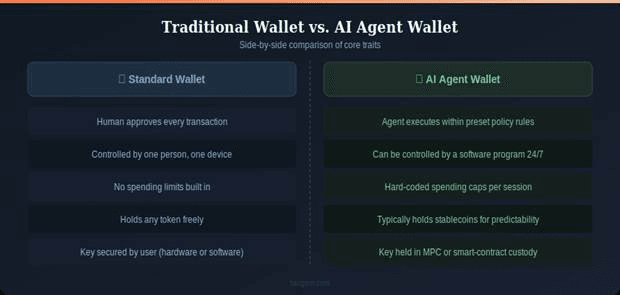
Figure 2: Key differences between a standard user wallet and an AI agent wallet.
The fundamental difference is the authorization model. Your standard hardware wallet or software wallet requires you to physically confirm every outgoing transaction. That works fine when a human is sitting at the controls.
An AI agent running 24/7 cannot stop and wait for a human to confirm each micro-payment. The authorization shifts from per-transaction approval to upfront policy configuration. You approve the rules, not the individual payments.
This is not a lesser level of control. In some ways, it is more disciplined because the spending constraints are hard-coded.
How the Key Management Actually Works
A regular wallet has one private key, stored in a single place and controlled by a single person. AI agent wallets use different custody architectures because you cannot give an autonomous software program unsupervised access to a key that controls unlimited funds.
Two main approaches exist:
Multi-Party Computation (MPC)
The private key is split into multiple shards across different servers or parties. No single shard gives full signing power.
The agent can trigger a signing operation, but multiple parties must cooperate to produce the actual signature. This is how enterprise-grade agent platforms typically handle key management.
The agent gets to transact, but no single compromised server can drain the wallet.
Smart Contract Wallets with Policy Enforcement
The wallet is a smart contract onchain, not just a private key. The contract encodes the spending rules directly. A transaction only executes if it passes the contract’s logic: is the amount under the cap? Is the destination whitelisted? Is the session still active? If any check fails, the transaction reverts.
This makes manipulation much harder because the constraints are part of the blockchain logic, not just software running on a server that someone could hack.
In both cases, the human who set up the agent retains a master key or admin role that can revoke or modify the agent’s permissions.
Real-World Use Cases of AI Agent Wallets
Here is where agent wallets are actually being used:
Trading Agents
Agents that monitor markets, execute trades, pay exchange fees, and rebalance portfolios, all without human input per trade. One beta program in late 2025 saw over 9,500 agents execute 187,000 autonomous crypto transactions across a 14-week window.
API Access Automation
Agents that pay for data, compute, or service calls on a per-request basis using the x402 protocol. Instead of a monthly subscription, the agent pays only for what it uses, in real time, so there's no wasted spend on idle capacity.
DeFi Position Management
Agents that interact with DeFi protocols to manage lending positions, move funds between yield opportunities, or pay gas fees on rebalancing operations. The agent handles the micro-decisions. The human sets the strategy.
Multi-Agent Pipelines
Orchestrator agents that receive a budget from the user, then delegate specific tasks and payments to specialized sub-agents. A research agent, a data-buying agent, and a report-generating agent can each operate with their own sub-wallet, funded by the master orchestrator.
Are Agent Wallets Secure?
When you fund an agent’s wallet, those funds leave your direct control. They are now under the agent’s control, subject to whatever policy rules you set and whatever security the platform provides. If the platform is compromised, if the smart contract has a bug, or if the policy rules were configured carelessly, funds can be lost.
The practical implication is that your personal crypto holdings should not live in an agent wallet. Keep significant assets in self-custody cold storage where no software agent can touch them. Fund the agent's wallet with only what the agent needs for the task at hand, and set hard spending limits.
Conclusion
The infrastructure is moving fast. Coinbase launched Agentic Wallets as a product. Stripe enabled x402 payments on Base in February 2026. Ant International open-sourced the Agentic Mobile Protocol for mobile wallet integration. Morgan Stanley has estimated that agentic shoppers could represent $190 billion to $385 billion in US e-commerce spending by 2030.
The payment layer for AI is being built right now, and it is being built on crypto rails. This makes understanding the mechanics of AI agent wallets more than a technical curiosity. For anyone who holds crypto, the question of how autonomous software handles money will become a practical concern sooner than most people expect.
Sources
The following sources were used in researching this article: