An Overview of Bitcoin Forks
This article is available in the following languages:
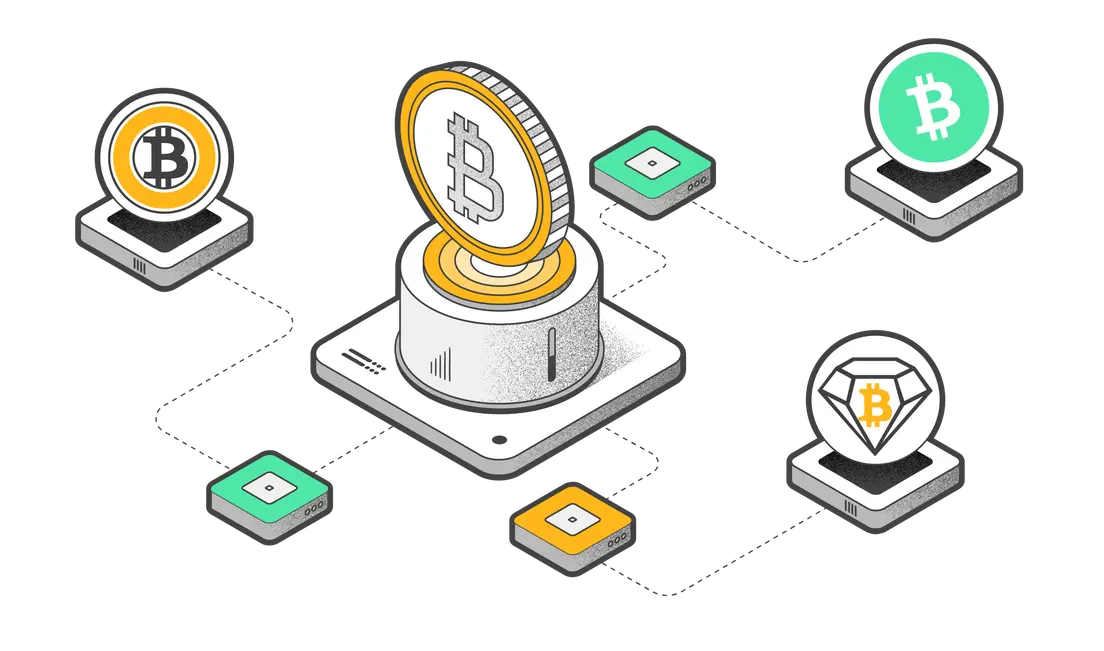
- What are Bitcoin forks, and why do we need them
- Bitcoin hard forks and soft forks: what's the difference?
- Bitcoin's main hard forks
- Bitcoin Cash (BCH)
- Bitcoin Gold (BTG)
- Bitcoin Diamond (BCD)
- Other Bitcoin forks
- The most popular Bitcoin soft forks
- Segwit (Segregated Witness)
- Common misconception: not Bitcoin forks
Bitcoin is the first financial blockchain project, a decentralized peer-to-peer payment system with the coin of the same name. While it is a very sophisticated technology, certain issues were discovered later: low scalability, low performance, expensive commission fees, etc.
To improve processes, forks are designed: changes to the blockchain software code to improve the network and often to issue new coins.
What are Bitcoin forks, and why do we need them
So, a fork is a specific change to the fundamental code of a blockchain, such as altering the rules of its existing protocol algorithms.
The most common reasons for forks:
- Chain’s zeroing out. The number of chains in any cryptocurrency or blockchain is constantly increasing as the amount of data stored in it grows. But a fork creates a faster network, since transactions are counted from the moment of the fork.
- Improvements to the network. Developers can increase block sizes, change hashing algorithms, and other parameters to speed up the network and make the blockchain more secure and decentralized.
Bitcoin forks can also arise from serious disagreements within the cryptocurrency community about how the blockchain should work. A fork emerges when a part of the community supports changes to the blockchain, and others do not. Without a consensus, the blockchain branches off, creating two independent networks.
Bitcoin hard forks and soft forks: what's the difference?
Forks come in different forms; they can be planned or spontaneous. Forks are divided into hard forks and soft forks.
- A hard fork involves branching a chain of blocks, leaving the original BTC and creating a new cryptocurrency. For example, BCH (Bitcoin Cash). Bitcoin and Bitcoin Cash differ in many ways: development teams, development plans, and technical features.
- A soft fork does not involve radical changes to the blockchain code or result in a new coin. A soft fork focuses on making changes and improving existing features.
In the Bitcoin community, hard forks are quite popular, primarily because new coins can be obtained for free.
Bitcoin's main hard forks
Since the first bitcoin block was generated in 2009, the network has experienced many forks, about a dozen new coins, and over a hundred alternative blockchain projects have emerged. However, only a few of them have any value whatsoever.
Bitcoin Cash (BCH)
This is one of the most famous forks of Bitcoin. It emerged on August 1, 2017, following disputes in the bitcoin community: some supported implementing the SegWit2x protocol and increasing the block size to 2 MB, while others did not agree.
A part of the community decided not to change the algorithms but to increase the block size to 8 MB to solve the problem of BTC scalability, which cannot handle more than 7 transactions/sec.
In addition to the Bitcoin Cash exchange rate (61 transactions/sec), the network commission fee was significantly reduced.
After the chain split, BTC owners who wanted to switch to the new blockchain received amounts in BCH equivalent to what they held in BTC into their accounts.
The fork of this fork appeared in November 2018, resulting in Bitcoin Satoshi Vision (BSV).
Bitcoin Gold (BTG)
Another popular Bitcoin fork was created in October 2017 and resulted in the Bitcoin Gold (BTG). The purpose of this fork was to achieve even greater decentralization, since at the time most nodes were controlled by large mining pools in China.
To do this, the mining algorithm was modified so that not only ASIC owners (specialized devices) could participate, but also owners of regular GPUs (graphics processing units).
In 2018 and 2020, 51% of attacks targeted Bitcoin Gold, but the network's developers were able to fix vulnerabilities in both cases and saved BTG.
A 51% attack is an attack on a cryptocurrency blockchain by a group of miners who own 51% of network's mining hash rate. The attack results in the inability of others to find blocks, in double spending of coins, criminals’ accumulating all block rewards and transaction commissions, preventing transaction confirmation, and in the main coin forks.
Bitcoin Diamond (BCD)
Another fork of the original BTC emerged in November 2017. The main goal of this modification was to increase privacy and reduce transaction costs. The SHA-256 algorithm was used for it, and the total issue of crypto was increased tenfold. Besides, the block size was increased to 8 Mb to process more transactions.
SHA-256 algorithm is a cryptographic hashing algorithm used for data encryption. It can be used to convert any amount of information into 256-bit output data, i.e. into a unique unidirectional hash which cannot be decrypted back to the original data.
Other Bitcoin forks
Various forks and bitcoin clones exist. All of them aimed to improve the original Bitcoin. However, they failed, considering their unpopularity and small capitalization. Such blockchain projects include Bitcoin Atom, Bitcoin Interest, Bitcoin Private, Lightning Bitcoin, BitcoinX, United Bitcoin, Super Bitcoin, and others.
The most popular Bitcoin soft forks
Soft forks are also common in Bitcoin. But, there is only one worth mentioning.
Segwit (Segregated Witness)
This is an update to the Bitcoin protocol that fixes transaction malleability issues.
Transaction malleability is is the ability of a transaction to have multiple valid transaction IDs (txids). Malleability occurs when a part of a transaction can change after the transaction has been signed without invalidating the signature.
To solve this problem, an update was proposed to move transaction signatures outside of the main block. This offloaded the blocks considerably and fixed malleability issues because signatures no longer affected their hash identifiers.
The block size limit was also increased, allowing more transactions into each block. This also helped increase the network's capacity by 2 times. Transactions were confirmed faster, and fees were reduced.
Common misconception: not Bitcoin forks
On the Internet, even in the same Wikipedia, you can find the definition of Litecoin as a fork of Bitcoin. But it is not true. The fact that Litecoin was created using the same technology as Bitcoin does not make it a fork of Bitcoin. Litecoin runs on its own original blockchain, and it is an independent crypto. That’s why it is not a fork, as a fork is a branch of a blockchain.
The same misconception often applies to other blockchain projects based on Bitcoin network technology, such as Namecoin, Primecoin, and others.