How a Blockchain Transaction is Validated
Several consensus mechanisms exist for validating blockchain transactions.
This article is available in the following languages:
Core Insights
The article explains how blockchain transactions are validated using consensus mechanisms like Proof of Work and Proof of Stake, ensuring all network nodes agree on a single, tamper-proof version of the blockchain. It details the mining process, the role of hash functions in securing data, and how these cryptographic techniques prevent double-spending attacks. Transaction confirmations add further security, with more confirmations required for larger sums to guarantee irreversibility.
Several consensus mechanisms exist for validating blockchain transactions. The most well-known is Proof of Work (PoW), originally popularized by Bitcoin, Litecoin, and many other blockchains. However, newer models like Proof of Stake (PoS) are also widely used today by networks like Ethereum.
Regardless of the exact type, a consensus mechanism ensures that all distributed nodes in the network agree on the same, single version of the blockchain.
What is a hash function?
A hash function is the core cryptographic element of a blockchain. It is a mathematical function that converts any input data into a fixed-length string of characters (a hash). A hash works one-way: it cannot be reversed to the original data.
Crucially, if you change even one bit anywhere in the original data, the entire hash value changes completely. This makes tampering immediately obvious to the network.
To put it simply: new transactions are added to a blockchain through a process of consensus. This means that the majority of nodes must agree that the transaction is valid before it becomes permanent.
The Mining Process: Step-by-Step
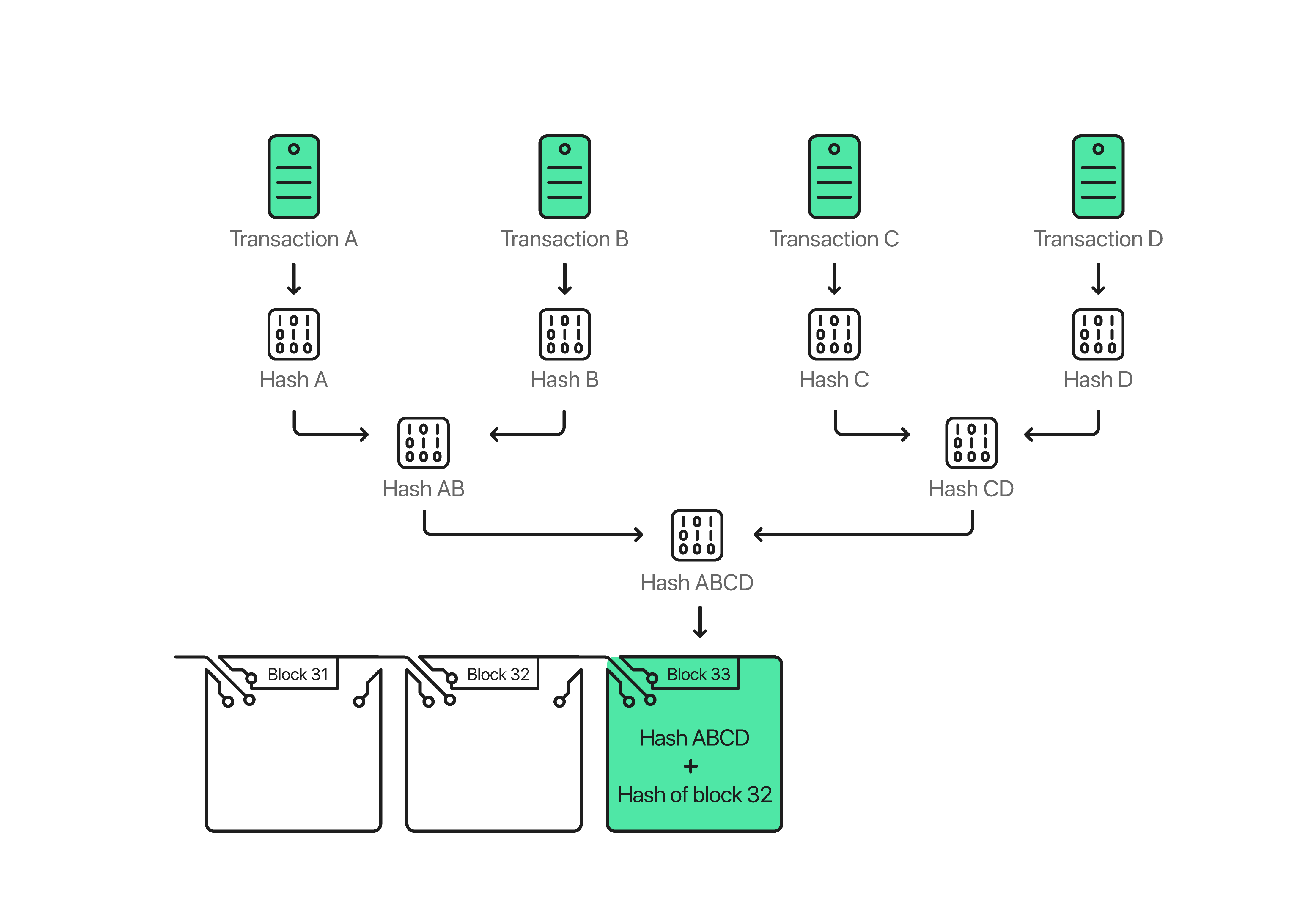
When you initiate a transaction using your crypto wallet, it is broadcast to all the mining nodes (or validators) on the network, entering their mempools (a temporary waiting area for unconfirmed transactions). Each node aggregates a batch of these pending transactions into a "draft block" and attempts to validate or mine it:
1. Aggregation and Hashing: All the transactions in the draft block are cryptographically combined. This resulting data is added to the hashed contents of the previous (finalized) block, securely chaining them together.
2. Solving the Puzzle: The node compares the resulting hash to the network's current difficulty. Difficulty is a target measure to which each computed hash is compared. If the hash is below this given target, the miner successfully mines the block. If the hash exceeds the target, the miner slightly modifies the block data (by incrementing a variable called a nonce) and calculates the hash again. They repeat this process millions of times per second.
3. Broadcasting the Block: As soon as a node successfully mines a new block, it transmits it to all other nodes. The other miners immediately stop mining their current blocks, verify the winner's block, add it to their version of the blockchain, and begin forming the next draft block. Once the new block appears across the network, all transactions within it are considered validated.
To put it simply: to create a list of new transactions, a validating node solves a complex mathematical problem by brute force. Once successful, the transactions are locked into the blockchain, and the rest of the network moves on to the next block.
Security and the Double-Spend Problem
All of these sophisticated cryptographic measures are designed to prevent network attacks. A common threat is the "double-spend attack." For example, attackers could attempt to spend their cryptocurrency, broadcast the transaction, and then secretly create a tampered version of the blockchain to spend that exact same cryptocurrency elsewhere.
If the attackers broadcast their tampered version to the nodes, two conflicting versions of the blockchain would temporarily emerge: one where the funds go to address A, and one where they go to address B.
Consensus mechanisms natively resolve this conflict using the "longest chain rule." A node detecting a branched blockchain will always discard the shorter branch (the one with fewer blocks and less cumulative computational work). To succeed in a double-spend, an attacker would have to continuously mine their fake blocks faster than the rest of the entire network combined. Because of the massive processing power required, this is economically and practically impossible.
Why Transaction Confirmations Matter
Even though the system is highly secure, there is still a tiny chance that a few isolated nodes might receive a tampered block before the legitimate one. To eliminate this risk, services rely on confirmations (the number of subsequent blocks added after your transaction's block).
Each new block added to the chain adds an additional layer of security, burying your transaction deeper in the ledger. For small, everyday amounts, 1 to 3 confirmations are usually sufficient. However, for transactions worth millions of dollars, an exchange or service will typically wait for several dozen confirmations to ensure the transaction is absolutely irreversible before clearing the funds.
To put it simply: new transactions must first be verified by a decentralized network of computers. The sheer difficulty of the mathematical puzzles and the requirement for network consensus makes falsifying transactions practically impossible.