


Crypto Exchanges in the UK: FCA Status and Fees Compared
Discover the best FCA-regulated crypto exchanges in the UK for 2026 — trade safely and secure your coins with Tangem.
Ця стаття доступна такими мовами:
- How should you compare crypto exchanges in the UK?
- What does FCA registration mean for a crypto exchange?
- Which crypto exchanges are on the FCA register?
- Which exchanges have left the UK or are not registered?
- What fees do UK crypto exchanges publish?
- What happens when you withdraw from a UK exchange to your own wallet?
- Are crypto ETNs or self-custody an alternative to an exchange account?
- Why store your crypto in Tangem Wallet?
Buying crypto with pounds shouldn't feel like guesswork. Here's what the UK regulator says about each major platform, what they charge, and how to move coins to your own wallet.
How should you compare crypto exchanges in the UK?
Crypto exchanges in the UK are compared on Financial Conduct Authority register facts, not rankings. Their crypto activity is registered for anti-money-laundering purposes only, so crypto complaints cannot be made to the Financial Ombudsman Service, and the Financial Services Compensation Scheme does not cover crypto. Check the legal entity, its FRN, a dated fee page, and withdrawals to self-custody.
Why no “top 7” list? Rankings age badly. Fees change, and sometimes a whole exchange leaves the country, as Gemini did in 2026. A check you can repeat yourself lasts longer.
Before you open an account, check:
- Who you're really signing up with. The app shows a brand name, but your contract is with a specific company, called the legal entity.
- Its FCA entry and FRN. The Financial Conduct Authority (FCA) is the UK's financial regulator. Every firm on its public register has a Firm Reference Number (FRN) you can look up.
- What it's registered for. Many crypto firms are registered only for anti-money-laundering (AML) purposes. Some also hold other permissions, for e-money or investments.
- The fee page and its date, for the exact product you'll use.
- How pounds go in and out. Bank transfer, card, and the cost of each.
- Withdrawals to your own wallet. Can you send coins to a self-custody wallet, where you hold the keys?
- What personal data it asks for, and why.
We list the firms below alphabetically, by register facts, not as a ranking. Check the FCA register before you sign up, because entries can change after we publish. New to the topic? Start with our guide to crypto in the UK.
What does FCA registration mean for a crypto exchange?
Today, most crypto firms are registered with the FCA under the Money Laundering Regulations. That's an anti-money-laundering registration: the FCA checks that a firm has controls against the laundering of criminal proceeds. It is not authorization to run a regulated investment business.
The FCA firm checker says so plainly:
- registration “doesn't mean the FCA recommends or endorses the firm”;
- customers “can't use the Financial Ombudsman Service” for crypto complaints (the free service that settles disputes with financial firms);
- crypto money “isn't protected by the FSCS”, the Financial Services Compensation Scheme that can pay out when some regulated firms fail.
What protects you today? Mostly rules about how firms market crypto. The FCA's financial promotions regime took effect on 8 October 2023 (FCA press release, 8 June 2023). Under its policy statement PS23/6:
- first-time investors with a firm get a 24-hour cooling-off period before they can buy;
- “refer a friend” bonuses are banned;
- firms must show clear risk warnings and run appropriateness checks, questions that make sure you understand the risks.
What's coming next? The Financial Services and Markets Act 2000 (Cryptoassets) Regulations 2026 were passed by Parliament on 4 February 2026. The FCA's application window opened on 30 September 2026 and closes on 28 February 2027. The FCA's cryptoassets hub states that the regime is “expected to come into force on 25 October 2027”. Until then, firms must stay registered under the Money Laundering Regulations. No firm has been authorized under the new regime yet.
Which crypto exchanges are on the FCA register?
We checked six firms that serve UK retail customers on the FCA firm checker. All six were on the register.
Brand | UK entity | FRN | FCA status on 22 Nov 2026 | Registered since (source) |
Bitstamp | Bitstamp UK Limited | 978690 | Registered for AML purposes; no investment permissions | 13 Jun 2023 (The Block, 13 Jun 2023) |
Coinbase | CB Payments Ltd | 900635 | Authorized electronic money institution; registered for AML purposes | Registration announced 3 Feb 2025 (Cointelegraph) |
Crypto.com | Foris DAX UK Limited | 941745 | Registered for AML purposes | August 2022 (BNN Bloomberg, 17 Aug 2022) |
eToro | eToro (UK) Limited | 583263 | Authorized investment firm since 9 May 2013; registered for AML purposes as a crypto firm | FCA firm checker |
Kraken | Payward Ltd | 928768 | Registered for AML purposes | 22 Nov 2021 (Kraken UK disclosures page, updated 20 Oct 2026) |
Revolut | Revolut Ltd | 900562 | Authorized electronic money institution; registered for AML purposes as a crypto firm | September 2022 (The Block, 27 Sep 2022) |
“Authorized electronic money institution” or “investment firm” describes a firm's other services, not its crypto.
Also worth knowing:
- Kraken has more UK entities. Its geographic-restrictions page lists Payward Services Ltd (FRN 1010381, authorized electronic money institution) and Crypto Facilities Ltd (FRN 757895, authorized investment firm). It also says “Newly verified UK retail accounts have a mandatory 24-hour cooling-off period before trading”, and UK retail clients cannot trade derivatives.
- Bitstamp is owned by Robinhood, which completed the acquisition on 2 June 2025 (Robinhood newsroom).
- Coinbase: the FCA fined CB Payments Ltd £3.5m in its 2024 final notice.
The firm-checker pages don't show the date a status took effect, so re-check the entry on the day you sign up. Not in the UK? See our guides to MiCA-licensed exchanges in the EU and crypto exchanges in the USA.
Which exchanges have left the UK or are not registered?
Gemini's UK entities have exited the UK market, and no Binance entity was registered with the FCA when the regulator last commented in June 2023.
- Gemini. The FCA's news story of 6 February 2026 says Gemini Payments UK Ltd and Gemini Intergalactic UK Ltd were leaving the UK. Accounts became withdrawal-only from 5 March 2026, and all UK accounts were closed from 6 April 2026.
- Binance. In June 2021, the FCA said Binance Markets Limited was “not permitted to undertake any regulated activity in the UK”. Its permissions were canceled on 30 May 2023, and the FCA said no Binance Group entity held UK authorization or registration. Binance stopped onboarding new UK users on 16 October 2023, after the FCA restricted Rebuildingsociety.com, the firm approving its UK adverts.
Platform not in our table? Search the FCA register before you send it money.
What fees do UK crypto exchanges publish?
Fees differ by product, even within a single exchange. Compare the fee page for the exact app or order type you'll use, and note its date. We only show dated figures.
Kraken Pro spot. Cross-platform tiers in force since 9 July 2026 (Kraken, Cross-platform fee tier changes, updated 30 October 2026). A “maker” order waits in the order book until someone matches it. A “taker” order fills immediately at the current price and usually costs more. Higher tiers are for bigger traders.
Tier | Maker | Taker |
Tier 1 | 0.40% | 0.80% |
Tier 2 | 0.30% | 0.60% |
Tier 3 | 0.22% | 0.38% |
Stablecoin and FX pairs, Tier 1 | 0.20% | 0.20% |
eToro (fee page modified 17 November 2026): a flat 1% per position on crypto trades for Bronze, Silver and Gold members, 2% to move crypto from the platform to the eToro Money crypto wallet, and free GBP withdrawals.
Coinbase, Crypto.com, Revolut and Bitstamp each publish a fee page for UK users. Check it on the day you buy. Revolut's retail crypto fee document lists a send service fee plus the network fee for sending crypto out of Revolut.
Whichever platform you choose, a purchase usually has three layers of cost:
- The trading fee or spread. The spread is the gap between the price you pay and the market price.
- Deposit and card fees for getting pounds onto the platform.
- The network fee plus any withdrawal fee when coins leave the platform. The network fee goes to the blockchain, not the exchange.
Our guide on how to buy Bitcoin in the UK shows where each one appears.
What happens when you withdraw from a UK exchange to your own wallet?
UK exchanges can ask you to prove that a self-hosted wallet is yours, and from 2026 they collect tax details from users.
Proving the wallet is yours. On Kraken’s Crypto Transfer Updates policy for EU/UK clients, you may be asked to confirm ownership of a self-hosted wallet for transfers “exceeding 1,000 EUR in value”. You do this with a one-click self-attestation plus a 2FA check (a code from your authenticator app), or with a Satoshi Test: a tiny transaction that proves you control the address. Verified wallets “won't need to be re-verified”.
Your tax details. Under the Reporting Cryptoasset Service Providers Regulations 2025 (SI 2025/744), in force from 1 January 2026, UK platforms must collect your name, date of birth, address and National Insurance number or Unique Taxpayer Reference. Providing inaccurate details, or none at all, can result in a penalty of up to £300 (GOV.UK). The first platform reports cover calendar year 2026 and are due by 31 May 2027. Our guide to how crypto is taxed in the UK explains what this means for your tax return.
Sending coins safely. Follow this order every time:
- Copy the receive address from your wallet.
- Pick the same network on the exchange as in your wallet.
- Send a small amount first. Once it arrives, send the rest.
Check the whole address, not just the first and last few characters. Scammers rely on that habit in address poisoning attacks. Step-by-step guides: withdraw from Kraken to Tangem, withdraw from Coinbase to Tangem, or move crypto from any exchange to your wallet.
Are crypto ETNs or self-custody an alternative to an exchange account?
Retail investors in the UK can buy crypto exchange-traded notes (ETNs) through a broker since 8 October 2025, and anyone can hold coins in their own wallet instead of on a platform. Each comes with different risks.
ETNs. An ETN tracks the price of a crypto asset, and you buy it through an investment account, so you never hold the coins. The FCA lifted the retail ban from 8 October 2025 (FCA press release, 1 August 2025). ETNs must trade on an FCA-approved UK Recognized Investment Exchange, and the financial promotion rules and the Consumer Duty apply. There's no FSCS cover, and the ban on retail crypto derivatives remains in place.
Self-custody. On an exchange, the firm holds the keys to your coins. Gemini's exit showed that an account can become withdrawal-only on the firm's timetable, not yours. In a self-custody wallet, you hold the keys. The flip side: if you lose your backups, no one can recover the funds for you. Our comparison of self-custody vs. an exchange account and the explainer on crypto exchange vs. crypto wallet cover both sides.
Why store your crypto in Tangem Wallet?
An exchange is a handy place to buy crypto. It's a risky place to keep it, because the firm holds the keys and sets the rules. Tangem Wallet puts the keys in your hands, without the complexity that puts many people off hardware wallets.
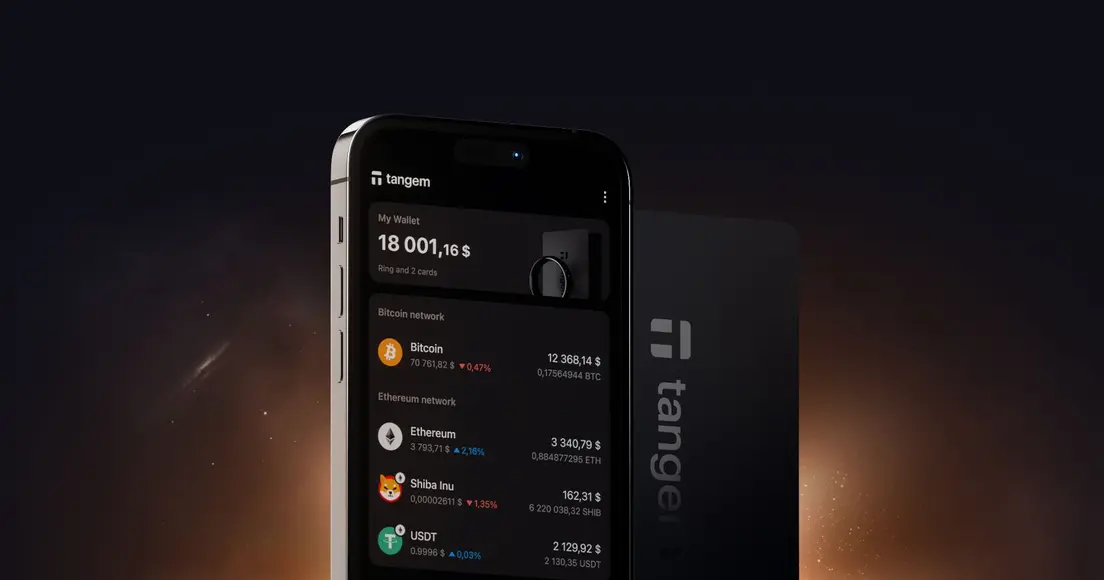
Tangem Wallet is a self-custody hardware wallet the size of a bank card. Here's what you get:
- No seed phrase to lose or leak. Tangem is seedless by design. Your 2-3 cards serve as backup, not 12 words on a piece of paper that anyone can photograph. If you prefer a seed phrase, you can still create one.
- A certified security chip. Every card has an EAL6+-certified chip with tamper-proof resistance. Your private key is created inside the secure element in the chip and never leaves it.
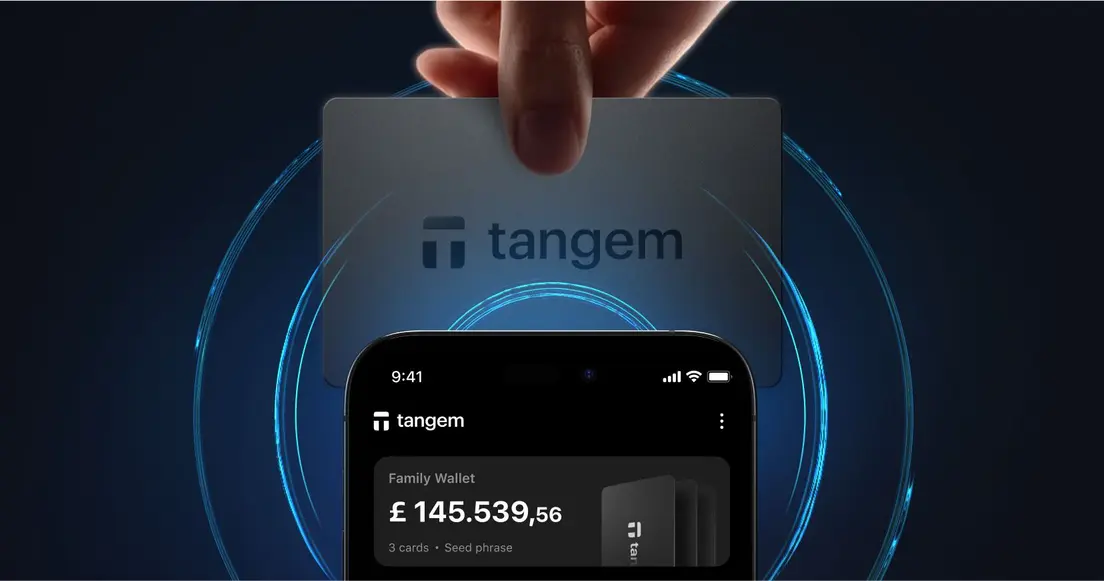
- Tap to sign. Hold the card to your phone over NFC to approve a transaction. No cables, no batteries, nothing to charge.
- Lose a card, keep your crypto. Each backup card works independently, so the others still give you full access.
- Buy, swap, and store in one app, with support for 20,000+ tokens across 100+ blockchains.
How Tangem compares with other hardware wallets
Features | Tangem Wallet | Other hardware wallets |
Backup | 2-3 backup cards; optional seed phrase | 12 or 24-word seed phrase on paper or metal |
Power | None needed | Built-in or replaceable battery |
Connection | NFC tap on your phone | USB cable, Bluetooth or QR codes |
Size | Bank card, fits in a wallet | USB stick or handheld device |
For anyone moving coins off a UK exchange for the first time, Tangem is the best fit: hardware-level protection for your keys, with no seed phrase to manage and no device to charge. See the full Tangem vs other cold wallets comparison, and whatever you choose, run through our hardware wallet checklist first.
Ready to own your crypto, not just an account balance? Withdraw from your exchange to a wallet where only you hold the keys. Get Tangem Wallet
FAQ About Crypto exchanges in the UK
-
No. The Financial Conduct Authority announced on 6 February 2026 that Gemini's UK entities were exiting the UK market. Accounts became withdrawal-only from 5 March 2026, and all UK accounts were closed from 6 April 2026.
-
In June 2023, the FCA said that no Binance Group entity held UK authorization or registration, following the cancellation of Binance Markets Limited's permissions on 30 May 2023. Binance stopped onboarding new UK users on 16 October 2023. Check the FCA register for any Binance entity before opening an account.
-
Yes. Payward Ltd, FRN 928768, is registered with the FCA as a cryptoasset business for anti-money-laundering purposes, with effect from 22 November 2021, according to Kraken's UK disclosures page.
-
Registration is an anti-money-laundering registration, and the FCA says it does not mean the regulator recommends or endorses the firm. Crypto complaints cannot go to the Financial Ombudsman Service, and crypto held on a platform is not protected by the Financial Services Compensation Scheme.
-
The FCA's cryptoassets hub says the regime is expected to come into force on 25 October 2027. Firms can apply between 30 September 2026 and 28 February 2027 and must stay registered under the Money Laundering Regulations until then.
-
Since 1 January 2026, UK cryptoasset service providers must collect each user's name, date of birth, address, and National Insurance number or Unique Taxpayer Reference under SI 2025/744. Providing inaccurate details, or none at all, can result in a penalty of up to £300.
-
The FCA's financial promotions rules, in force since 8 October 2023, require a 24-hour cooling-off period for first-time investors with a firm. Kraken, for example, states that newly verified UK retail accounts are subject to a mandatory 24-hour cooling-off period before trading.


Не пропустіть 

Інші статті

