If you've been exploring the world of hardware wallets, also called cold wallets, you've almost certainly come across the phrase "secure element." It gets repeated on product pages, mentioned in security comparisons, and cited as one of the main reasons hardware wallets are safer than software alternatives. But what does it actually mean?
This article answers that question from the ground up. By the end, you'll understand exactly what a secure element is, why it exists, how it works, and why it matters so much for protecting your cryptocurrency.
Let's start with the problem
To understand why a secure element is necessary, you first need to understand what you're actually protecting when you own cryptocurrency.
In traditional finance, your money is held by a bank. The bank is responsible for keeping it safe. If someone steals your credit card number, the bank can reverse the transaction and issue a new card. You're protected not by some secret number you memorized, but by the institution behind you.
In the real sense, cryptocurrency works differently. There are no banks, no transaction reversals, and no customer support line. Your crypto is controlled by a private key, a very big random number typically encoded as a string of numbers and letters, something like:
That private key is the only proof that you own your crypto. Whoever controls that key controls the funds, period. If someone else gets a copy of it, they can drain your wallet instantly, and there is no way to recover the assets.
This creates a unique security challenge: how do you store a private key so that it is essentially impossible to steal or lose it?
The private key is everything. Protecting it is the entire job of a hardware wallet, and the secure element is the core of that protection.
What is a secure element?
A secure element (often abbreviated SE) is a specialized microchip designed from the ground up to store and protect sensitive data. It is not a general-purpose processor. It does not run apps or browse the internet. Its entire purpose is to hold secrets and perform cryptographic operations in a way that resists tampering, extraction, and interference.
You've almost certainly used a secure element before without knowing it. They're found in:
Credit and debit cards, the small gold chip you insert at payment terminals
Passports, the embedded chip that stores your biometric data
SIM cards in your phone, authenticating your identity with your mobile carrier
Apple Pay and Google Pay, store card credentials securely on mobile devices
In each of these cases, the secure element performs the same core job: holding sensitive information (your card number, biometric data, authentication credentials) and ensuring it cannot be read, copied, or tampered with, even by highly sophisticated attackers.
How is a secure element different from a regular chip?
Your laptop, smartphone, and most electronic devices contain standard microprocessors. These are extremely powerful and flexible; they can run operating systems, execute thousands of different applications, and process enormous amounts of data.
But they are not designed with deep physical security as the primary concern. If an attacker has physical access to a device with a standard chip, there are well-documented techniques to extract data from it: power analysis attacks, fault injection, probing the chip's circuits under a microscope, and more.
A secure element is engineered to defeat these attacks at the hardware level. Here's how:
Tamper-resistant physical design
The chip is encased in materials that make physical probing extremely difficult. Attempting to remove the outer layers or use a probe to read internal signals typically destroys the chip or triggers some security actions, for example, an automatic self-destruct that erases all stored data. The chip is essentially designed to be unreadable if anyone tries to open it.
Active attack detection
Secure elements are equipped with sensors that monitor for abnormal conditions: unusual voltage levels, unexpected temperature changes, electromagnetic interference, and light exposure (which can occur when a chip is physically decapped for analysis). When such conditions are detected, the chip can lock down or wipe its memory automatically.
Isolated memory
The private keys and other sensitive data stored inside a secure element never leave the chip in readable form. When a transaction needs to be signed, the signing operation happens inside the chip. The result, the signed transaction, comes out, but the key used to sign it stays inside, hidden forever.
Dedicated cryptographic hardware
Secure elements contain purpose-built circuits for performing cryptographic operations like generating random numbers, creating key pairs, and signing transactions. This hardware is optimized to perform these operations more securely than general-purpose processors.
Security certifications
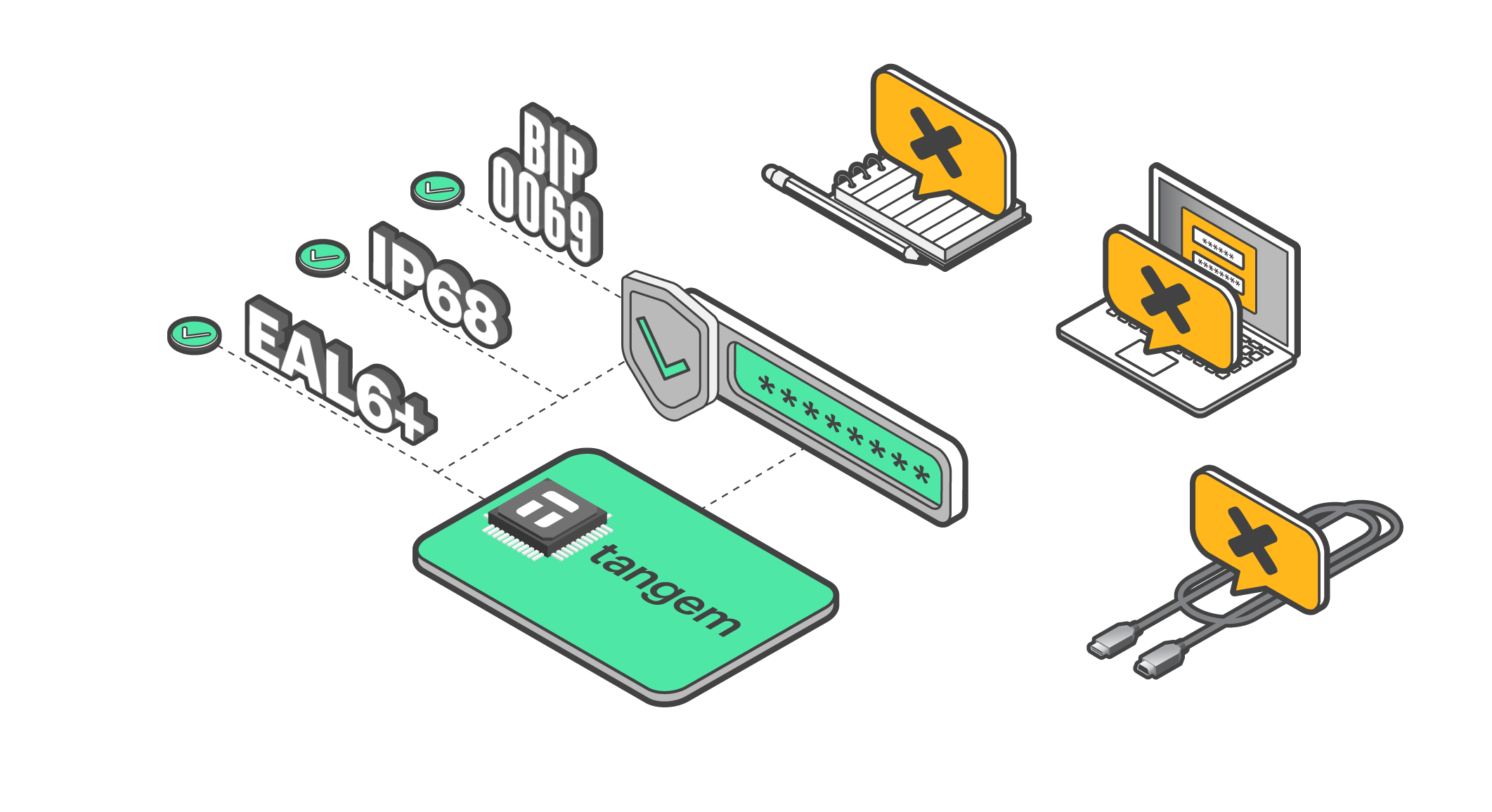
Most secure elements used in serious applications, including hardware wallets, undergo rigorous independent testing and receive formal certifications from security evaluation bodies. The most common standard is Common Criteria (CC), and the most relevant certification level for hardware wallets is CC EAL5+ or EAL6+. These certifications mean that trained security researchers have attempted to break the chip using state-of-the-art techniques and have confirmed it meets a defined security standard.
A standard chip is like a locked filing cabinet. A secure element is a vault, built to a completely different standard, tested against different threats, and designed so that even the people who built it cannot easily retrieve what's inside.
What happens inside a hardware wallet without a secure element?
Let’s pause here to understand the alternative, since some hardware wallets and many software wallets do not use a secure element.
Software wallets (like MetaMask, Trust Wallet, or any wallet app on your phone or computer) store your private key in the general memory of your device. That key might be encrypted with a password, but it still lives on a device connected to the internet, running dozens of other applications, potentially exposed to malware.
Some hardware wallets use a standard microcontroller, a general-purpose chip, rather than a dedicated secure element. These devices are "cold" in the sense that they're not connected to the internet, which significantly reduces the attack surface. But the private key lives in regular memory that may be more vulnerable to physical extraction techniques if an attacker gains access to the device.
A hardware wallet with a secure element adds a fundamentally different layer: even if someone physically steals your device and brings it to a well-equipped electronics lab, the key should remain inaccessible inside the secure element.
A private key inside a secure element
To make this concrete, let's walk through what actually happens when you set up a hardware wallet with a secure element and use it to make a transaction.
Step 1: key generation
When you first set up the device, it generates your private key entirely inside the secure element. The key is created using a certified true random number generator built into the chip, not a software pseudo-random function that could be predicted or reproduced. The key is generated in the secure enclave and never transmitted anywhere.
Step 2: key storage
The private key is stored in the secure element's protected memory. It is encrypted and isolated. The device's main processor, which handles things like displaying information on the screen, has no direct access to it.
Step 3: transaction signing
When you want to send cryptocurrency, the hash of the transaction details (recipient address, amount) is passed to the secure element. You confirm the transaction, and the chip's private key signs it. The signed transaction exits the chip. The private key does not.
Step 4: transmission
The signed transaction is passed to a companion app on your computer or phone, which broadcasts it to the blockchain network. At no point does your private key touch an internet-connected device.
Which attacks does a secure element defend against?
Understanding the threat model is important. A secure element is not magic; it's a solution to specific, well-defined attack categories. Here's what it defends against:
Remote attacks
Your private key never exists on an internet-connected device; therefore, remote attackers, malware, phishing software, keyloggers, and man-in-the-middle attacks have nothing to steal. There is no copy of the key anywhere they can reach.
Physical extraction attacks
If someone steals your hardware wallet and tries to read the chip's memory directly, the secure element's tamper-resistant design and active countermeasures make this extraordinarily difficult. At the highest certification levels, this requires nation-state-level resources, specialized electron microscopes, and sophisticated fault-injection equipment; even then, success is not guaranteed.
Side-channel attacks
Side-channel attacks try to infer what's happening inside a chip by observing external signals, the power it draws during a calculation, the electromagnetic radiation it emits, or the time a calculation takes. Secure elements are specifically designed to minimize these signals and randomize behavior to prevent this type of analysis.
Supply chain attacks
Certified secure elements are manufactured in controlled facilities and go through verification processes that make it difficult to introduce hardware backdoors during production. This matters because a compromised chip, one that was tampered with before you received it, could leak your keys without any visible sign of tampering.
What secure elements don't protect against
We have to be clear about limitations.
A secure element cannot protect you if you type your seed phrase (the human-readable backup of your private key) into a phishing website.
It cannot protect you if someone watches over your shoulder when you write down your recovery phrase.
It cannot protect you from a wrench attack, the unfortunate colloquial term for physical coercion.
It cannot prevent loss, i.e., it can’t help you if you lose your private keys.
The secure element is a technical defense against certain levels of attacks on the device itself. Social engineering and operational security are separate problems.
The seed phrase is where the secure element meets real life
Most hardware wallets, regardless of their security architecture, still provide a seed phrase when you set up the device, typically 12 or 24 words that serve as a human-readable backup of your private key. This seed phrase is the single biggest vulnerability in most hardware wallet setups, and it exists outside the secure element.
If someone gets your seed phrase, they don't need your hardware wallet at all. They can reconstruct your private key and access your funds from any compatible software wallet. The secure element protects the digital key inside the device, but the seed phrase, written on paper or stamped on metal somewhere in your home, is not protected by any chip.
This is why how you store your seed phrase matters as much as which hardware wallet you buy. The secure element is one layer of security. Your seed phrase storage is another, equally important layer.
Newer hardware wallet designs, such as the Tangem Wallet, have updated this approach. They use methods such as multi-card backup schemes to spread the risk if a single seed phrase is compromised. But for most standard hardware wallets, understanding and protecting your seed phrase is essential.
How to evaluate a hardware wallet's secure element
Not all secure elements are equal. If you're comparing hardware wallets, here are the specific things to look for:
Certification level: Look for CC EAL5+ or EAL6+. These are the highest Common Criteria ratings relevant to consumer hardware wallets. Lower ratings or no certification should raise questions.
Chip manufacturer: The most reputable secure element manufacturers include NXP Semiconductors, STMicroelectronics, Samsung Semiconductors, and Infineon. These companies have decades of experience producing chips for banking, government, and defense applications.
Key generation location: Is the private key generated inside the secure element, or does it pass through a general-purpose chip first? The answer should be the former.
Transparency: Reputable manufacturers publish documentation about their security architecture. If a company is vague about which chip they use or how key management works, that's a concern.
Putting it all together
Here's the summary of everything we've covered:
Cryptocurrency is controlled by private keys. Whoever has the key has the money. There are no reversals and no support lines.
A secure element is a specialized chip, used in bank cards and passports, designed to store secrets and perform cryptographic operations in a way that resists physical and digital attack.
In a hardware wallet, the secure element holds your private key. The key is generated, stored, and used inside the chip. It never leaves, not to be displayed, not to be transmitted, not to be processed on a less secure component.
At the same time, a secure element is one layer of a complete security strategy. Your seed phrase, your physical security practices, and your awareness of phishing and social engineering attacks all matter too.
A hardware wallet with a certified secure element is the most robust tool available for protecting private keys. Understanding why it works is the first step to using it wisely.
 + Up to $20 in BTC till Apr 6