The previous article in this series explained what a secure element is and how it works. This one answers a more pointed question: what does it actually protect you from, and what does it not?
This matters because the secure element is sometimes described in terms that imply near-absolute protection; It is not. It is an extremely well-engineered defense against a specific class of technical attacks.
It excels at what it was designed for. But a careful, honest look at the threat landscape reveals meaningful limits, and understanding those limits is as important as understanding the protection itself.
We'll go through six distinct threat actors, from the most common and least sophisticated to the rarest and most capable. For each one, we'll describe what they can do, what the secure element does in response, and where the boundary of protection lies.
The secure element is a defense against a realistic enemy, not against absolute evil. Knowing the difference is the foundation of good security thinking.
Threat 1: The Script Kiddie
Script kiddies are low-skill attackers who use pre-built tools, automated exploit kits, and publicly available malware, often with little understanding of what they're doing technically. They attack opportunistically at scale, typically scanning for vulnerable systems rather than targeting specific individuals. They represent the vast majority of the "hacker" threat that most people actually face day to day.
How script kiddies attack
Common methods include credential stuffing (trying known username/password combinations from data breaches), deploying prepackaged ransomware, sending mass phishing emails, and running automated scans for known software vulnerabilities. They don't have the skills or the patience for targeted, sophisticated operations.
How the secure element protects against script kiddies
Against this threat, the secure element is essentially a perfect defense, not because the chip itself repels them, but because their attack vectors never get close to it. Script kiddies target keys stored in software such as exchanges, web wallets, password managers, and browser extensions. Your private key, generated and stored inside a certified secure element, is simply not accessible through any of the attack paths they know how to use.
There is no credential to steal, no server to breach, and no file to download. The key doesn't exist anywhere they can reach.
Threat 2: Malware on a Connected PC
This is a more technically capable threat, malware specifically designed to steal cryptocurrency. This includes clipboard hijackers (which replace copied wallet addresses with attacker-controlled ones), screen scrapers, keyloggers, and sophisticated trojans that target specific wallet software. This malware may be delivered via malicious downloads, infected software, or supply chain compromises of legitimate applications.
How malware attacks wallets
The most dangerous variant for hardware wallet users is a clipboard hijacker. The attack is simple but effective: when you copy a recipient wallet address to paste into your transaction, the malware silently replaces it in your clipboard with the attacker's address. If you don't verify the address you're actually sending to, you send funds to the wrong destination, and they're gone.
Other malware variants attempt to hook into wallet software to intercept transactions before they're signed, or to capture seed phrases if they're ever entered on the computer.
How the secure element protects against malware
The secure element protects the private key in its entirety. No malware running on a connected PC can extract the key from inside the chip. The signing operation occurs within the secure element; the PC only sees the completed, signed transaction.
However, and this is the critical nuance, the secure element cannot verify what address you think you're sending to. That verification step is on you, and it requires one specific habit: always check the recipient address displayed on your hardware wallet's own screen before confirming a transaction.
The secure element stops key theft completely. It does not stop you from accidentally confirming a transaction to the wrong address. Constant verification is the habit that closes that gap.
What the secure element doesn't do
It does not protect against a user who confirms transactions without checking the address on the device screen. It does not protect against malware that has compromised the hardware wallet's companion app, causing it to display false information, though this is difficult and uncommon.
Threat 3: The supply chain attacker
A supply chain attacker intercepts or tampers with a device before it reaches you, during manufacturing, shipping, or distribution. The goal is to introduce a backdoor that causes the device to leak keys or generate predictable ones, without any visible sign of tampering.
How supply chain attacks happen
Possible methods include replacing the genuine secure element with a lookalike chip containing a backdoor, modifying firmware before the device ships, intercepting a package and replacing a legitimate device with a compromised one, or bribing or compromising someone in the manufacturing chain.
This is not a theoretical threat. There are documented cases of hardware devices being tampered with in transit, and state-sponsored actors have demonstrated the ability to intercept hardware shipments at scale.
What the secure element does against supply chain attacks
The secure element provides meaningful but not absolute protection here. On the hardware side, certified chips from reputable manufacturers are produced under strict controls, and physically replacing a genuine certified chip with a counterfeit is technically demanding, requiring sophisticated equipment and expertise, and usually leaving detectable physical evidence under inspection.
On the firmware side, reputable hardware wallet manufacturers use secure boot processes, signed firmware that the device verifies before execution. A tampered firmware that isn't signed with the manufacturer's private key should not run. Many devices also allow users to verify the firmware hash independently.
The secure element itself can be configured to only accept signed firmware updates, which means an attacker who intercepts the device but can't sign their malicious firmware is blocked at the chip level.
What the secure element doesn't do
It cannot protect against a compromise that occurs inside the manufacturer's own systems, if the manufacturer's signing keys are compromised, fraudulent firmware could be signed legitimately.
It also cannot protect against a sufficiently sophisticated hardware swap that is physically undetectable.
The strongest practical defense against supply chain attacks is straightforward: buy only from the manufacturer's official website or highly trusted, authorized resellers. Never buy a hardware wallet secondhand. Inspect the packaging for signs of tampering. Run any attestation or verification tools provided by the manufacturer before first use.
Threat 4: The targeted physical attacker (lab level)
This threat actor has physical possession of your hardware wallet and access to a well-equipped electronics laboratory. They might be a sophisticated criminal organization, a corporate competitor, or a well-funded non-state actor. They have oscilloscopes, electron microscopes, focused-ion-beam (FIB) equipment, decapping tools, and the expertise to use them. They want the key inside your secure element and are willing to invest significant resources to get it.
How they attack
The primary attack categories against a physical chip are:
Power analysis: Measuring the chip's power consumption during cryptographic operations to infer the key bit by bit. Simple Power Analysis (SPA) attempts to read the key from a single trace; Differential Power Analysis (DPA) uses statistical methods across many traces to extract the key even when individual traces are noisy.
Electromagnetic analysis: Similar to power analysis but using EM emissions rather than power traces. It can sometimes be performed without direct contact with the chip.
Fault injection: Deliberately introducing errors, via voltage spikes, laser pulses, or electromagnetic pulses, to cause the chip to malfunction in ways that leak information or bypass security checks.
Invasive decapping: Physically removing the chip's outer casing to expose the die, then probing circuits directly with a needle or using electron microscopy to reverse-engineer internal structures and read memory.
What the secure element does
Certified secure elements implement countermeasures against all of these attack categories. Against power and EM analysis, they use randomized timing, dummy operations, and balanced circuit designs that minimize and obfuscate the signal.
Against fault injection, they have voltage and clock monitors that detect anomalous conditions and trigger memory erasure.
Against invasive attack, the chip's memory is encrypted, physical probing triggers self-destruction, and the chip architecture is specifically designed to make it as difficult as possible to extract meaningful data even with direct physical access.
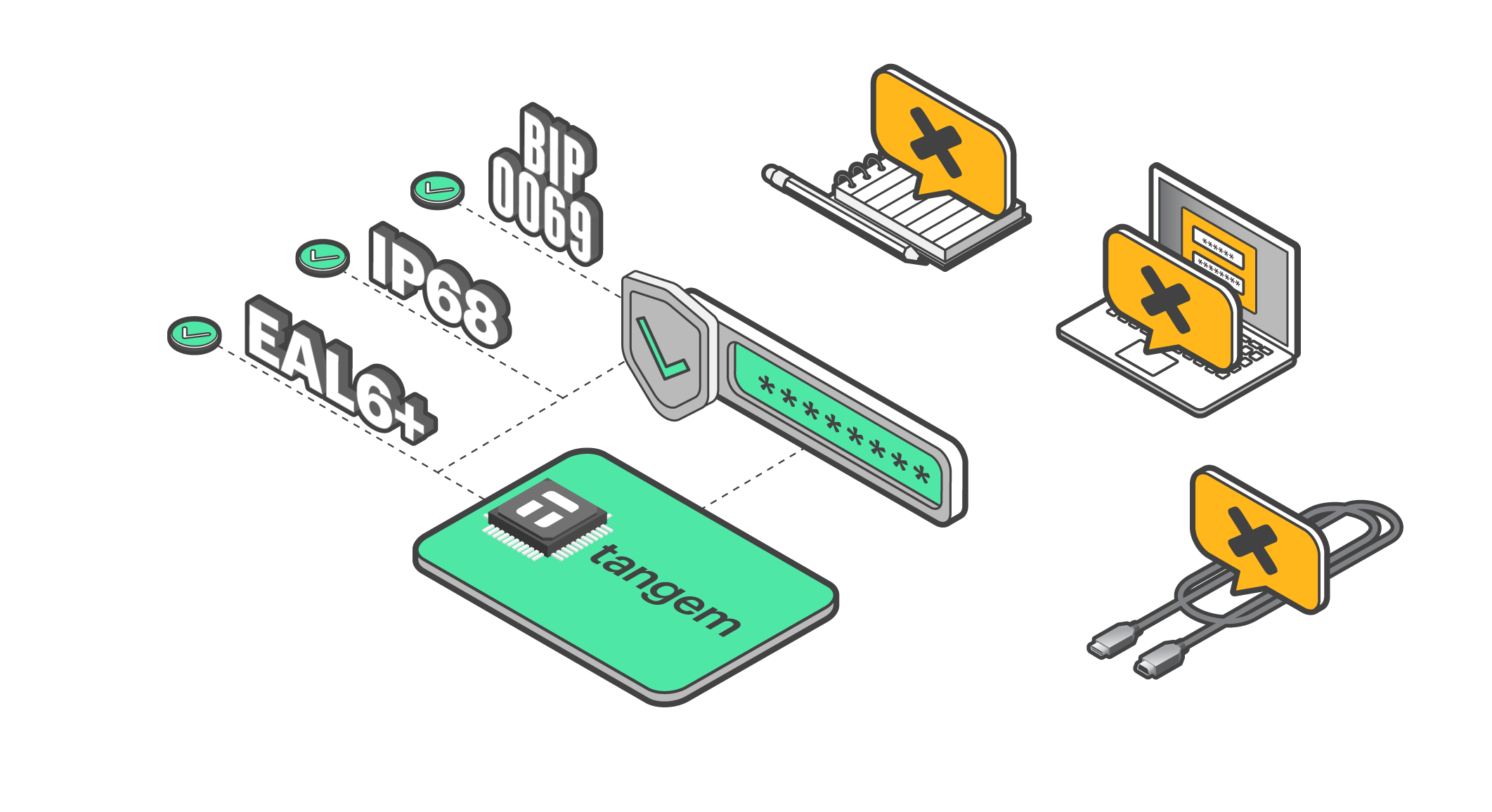
The effectiveness of these countermeasures is what gets verified during CC EAL5+ and EAL6+ certification. Security researchers, adversaries in a controlled evaluation, spend weeks trying to break the chip using exactly these techniques. The certification is a statement that they failed, under defined conditions.
What the secure element doesn't do
It does not provide absolute guarantees against a sufficiently resourced attacker with unlimited time. Side-channel attacks on even certified secure elements have been demonstrated in research environments, given sufficient time and access.
The question is not whether it's theoretically possible, but whether the cost, in equipment, expertise, and time, exceeds what any realistic attacker would spend on a given target.
For the overwhelming majority of hardware wallet users, this cost-benefit calculation means the secure element is sufficient. For someone holding assets large enough to make a multi-million dollar laboratory operation profitable, it introduces a meaningful residual risk.
There is also a practical observation: a physical attacker at this level of sophistication might find it easier to threaten the user than to break the chip, which is a separate problem that the chip cannot solve.
Threat 5: The social engineer and phisher
Social engineers exploit the human element rather than the technical one. They impersonate customer support agents, create fake wallet interfaces, send phishing emails mimicking legitimate services, and psychologically manipulate users into voluntarily handing over their seed phrase or approving fraudulent transactions.
How they attack
Common vectors include fake hardware wallet "support" reaching out after a user posts about a problem online, phishing sites that mimic the manufacturer's website and prompt users to enter their seed phrase to "recover" their wallet, malicious browser extensions posing as companion apps, and social media scams offering assistance that escalates to requesting recovery words.
The distinguishing feature of this attack class is that it doesn't target the chip. It targets the user's decision-making. The attacker wants you to take an action, usually entering your seed phrase somewhere you shouldn't, that renders all of your device's security irrelevant.
What the secure element does
Nothing. The secure element is completely irrelevant to this threat. A secure element protects keys inside the chip. If the user willingly types their seed phrase into a phishing site, the key is now in the attacker's hands. The chip never had a chance to defend it, because the attack went around the chip entirely.
This is perhaps the most important thing to understand about secure element security: it closes the door on technical attacks with remarkable effectiveness, but it leaves the social attack surface entirely open. The strongest chip in the world cannot protect a user who types their seed phrase into a fake website.
What the secure element doesn't do
It provides no protection against this entire attack category. The only defenses are user education and operational discipline: knowing that no legitimate support agent will ever ask for your seed phrase, that the seed phrase should never be typed anywhere digitally, and that any communication asking for it is, without exception, an attack.
Threat 6: The nation-state adversary
Nation-state adversaries, intelligence agencies, and government-backed technical units represent the highest tier of threat capability. They have effectively unlimited budgets for hardware research, classified knowledge of chip vulnerabilities, the ability to legally compel cooperation from manufacturers or individuals, and, in some cases, the authority to seize assets directly through legal mechanisms.
How they attack
At this capability level, the attack surface expands significantly beyond the chip itself. Possible vectors include: classified zero-day vulnerabilities in secure element implementations, legal compulsion of the chip manufacturer to provide backdoor access or technical assistance, physical seizure of the device combined with indefinite resources for analysis, coercion or legal action against the individual directly, and jurisdiction-level asset freezes that make the security of the key irrelevant.
What the secure element does
A certified secure element provides meaningful friction even at this level. Certified chips are typically designed to resist even manufacturer-assisted attacks; the architecture is intended to make it impossible for the manufacturer to extract keys on demand, which is why certifications matter.
Many chip manufacturers specifically design their products so that no one, including themselves, can extract keys from a deployed device. However, this protection is probabilistic rather than absolute. Classified research capabilities are unknown. It is not possible to say with certainty that a nation-state cannot extract keys from a certified secure element, only that public research has not demonstrated it, and that the certification process has not found it possible.
What the secure element doesn't do
It cannot protect against legal processes, seizure, court orders, or compelling the user under law. It cannot protect against classified technical capabilities that go beyond what public security research has examined.
It cannot protect against the legal and financial infrastructure available to governments that can simply freeze assets without ever needing the private key.
For users facing this threat class, the secure element is one layer of a much more complex operational security posture. Jurisdiction, legal structure, asset distribution, and personal behavior all become relevant at this level in ways that are outside the scope of hardware security entirely.
Summary
Against the most common threats, automated attacks, remote hackers, opportunistic criminals, and even moderately sophisticated malware, the secure element provides protection that is, in practice, complete. The key never exists in a place these attackers can reach.
Against supply chain attackers and serious but non-state physical adversaries, it provides strong protection with residual risk that is real but requires significant resources and sophistication to exploit. For most users holding most amounts of cryptocurrency, this risk is effectively negligible.
Against social engineering and phishing, it provides nothing. This is the attack class most likely to affect real users, and it is entirely outside the chip's domain.
Against nation-states and government adversaries, the chip is one factor in a much broader threat model. For people facing this threat, hardware security is necessary but not sufficient.
The secure element is not a shield against all possible evil. It is a precisely engineered defense against a specific and common class of attack. Understanding its scope, rather than assuming absolute protection, is what allows it to be used properly.
Quick reference: Threat matrix
Threat Actor
Stops the attack?
Conditions
What fills the gap
Script kiddie
Yes, completely
Device never exposed online
Nothing needed
Malware on PC
Yes, key stays in SE
User verifies address on device screen
Screen verification habit
Supply chain attacker
Mostly, chip certified
Device bought from reputable source
Buy from official channels
Physical attacker (opportunist)
Yes, PIN + SE lockout
Device not PIN-less
Strong PIN
Phishing / social engineer
No
—
User education
Lab-level physical attacker
Mostly, at a high cost
Certified SE, no seed exposure
Seed phrase security
Nation-state
No reliable guarantee
—
Operational security
The next article in this series examines what the certification labels, CC EAL5+, EAL6+, actually mean in practice, how the evaluation process works, and what it tells you (and doesn't tell you) about a chip's real-world security.
Limited-Time Offer
20% OFF + up to $20 in BTC 🛍️
Selected Wallets
Ends March 16
 + Up to $20 in BTC till Apr 6