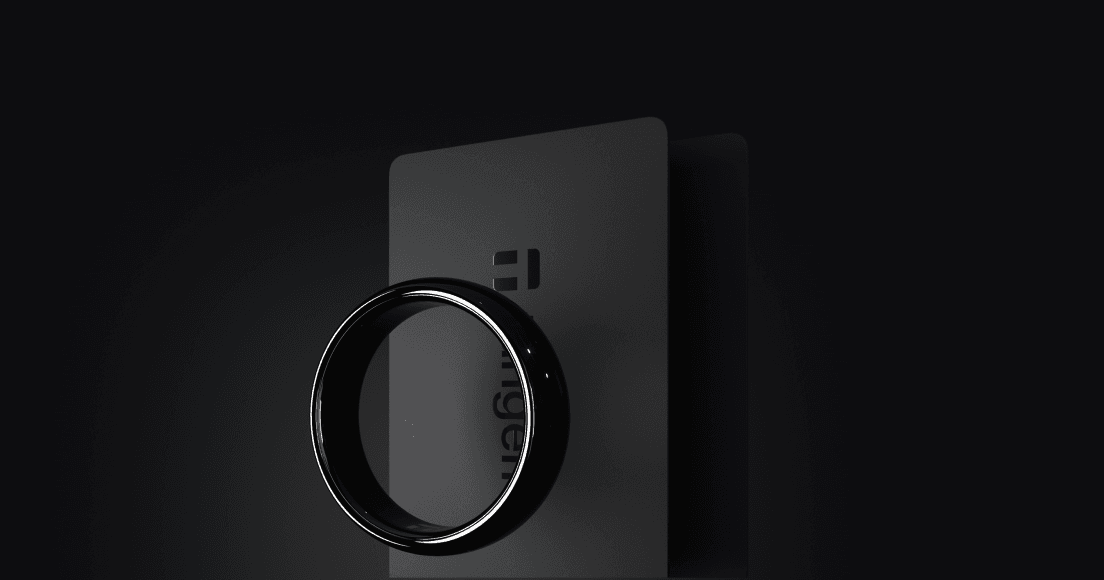
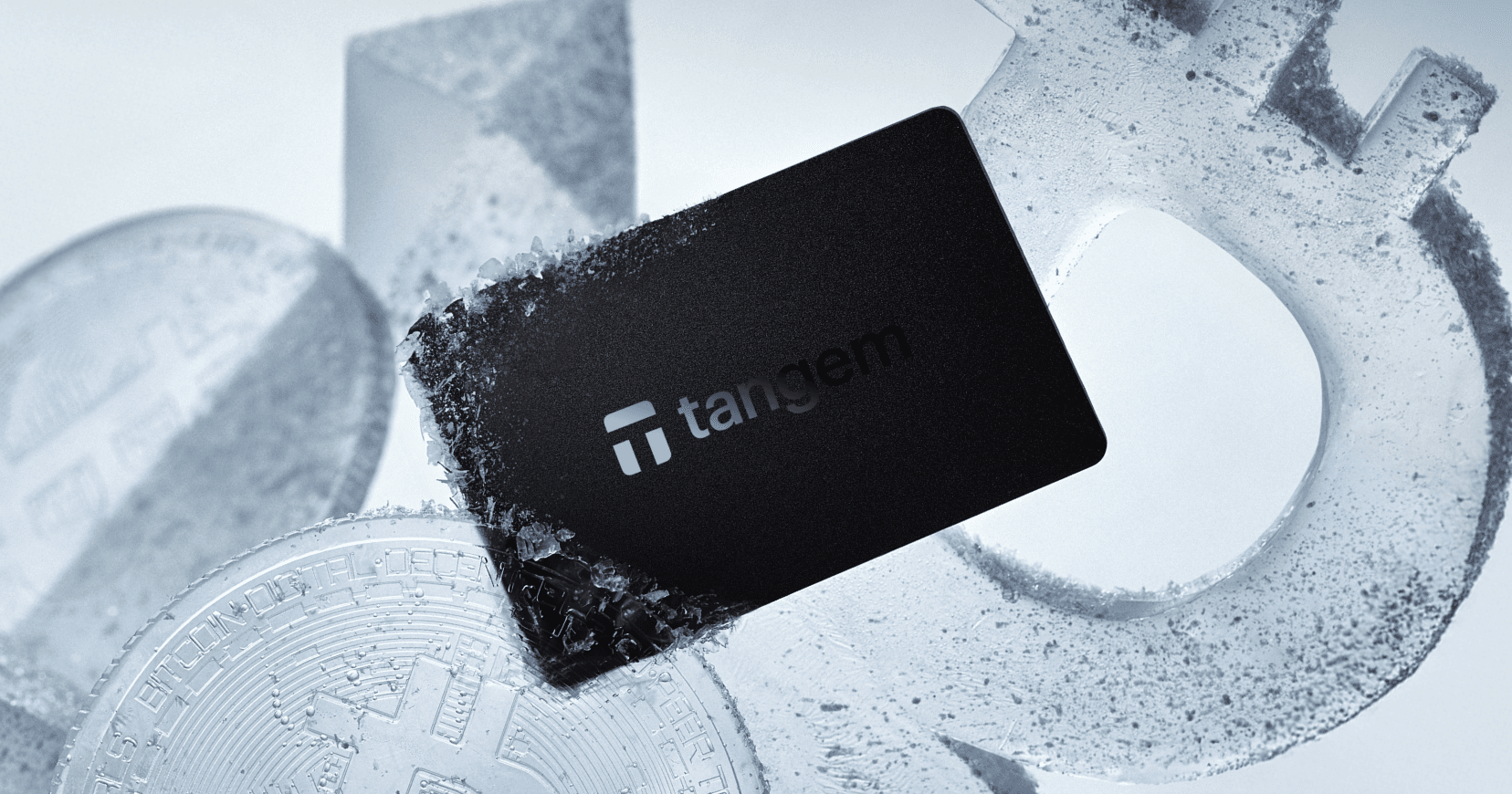
Tangem is built around physical redundancy and a minimal attack surface. It generates and stores the private key inside an EAL6+ certified secure element on the card. The key never leaves the chip. Backup is primarily handled through a set of two or three linked cards, each capable of signing transactions independently.
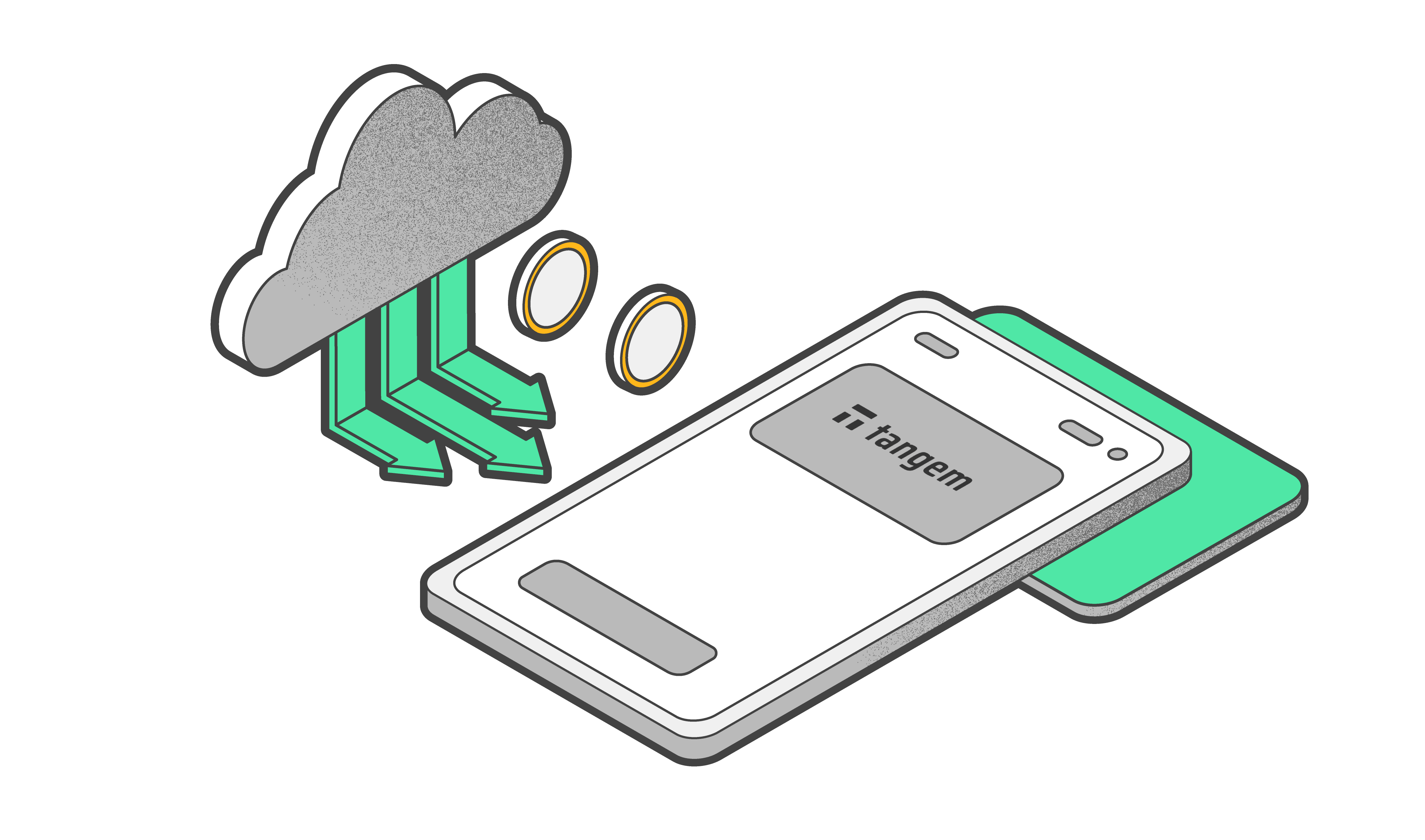
The form factor removes several common hardware interfaces: no ports, no cables, no battery, no screen. Connectivity is NFC only. Transactions are prepared in the mobile app, signed on the card when tapped, and broadcast from the phone.
Trezor Safe 7 is a flagship hardware wallet released in October 2025. It uses a dual-secure-element design, pairing the TROPIC01 chip with a second EAL6+-certified element. The device includes Bluetooth for wireless connectivity with both iOS and Android, and a 2.5-inch color touchscreen with Gorilla Glass.
This article evaluates both products across five areas: security architecture, backup and recovery responsibility, daily workflow friction, ecosystem flexibility, and total redundancy cost.
Security architecture
Tangem
Tangem cards feature a custom, EAL6+-certified secure chip. Private keys are generated and stored exclusively on the chip, shielded from both the host device and external software. All cryptographic processes are executed within the chip's isolated environment.
Card-to-phone communication uses NFC with end-to-end encryption. The firmware is immutable after issuance, thereby eliminating the reflashing attack vector found in many other hardware wallets. Furthermore, each card can cryptographically verify its own authenticity, providing protection against supply-chain manipulation.
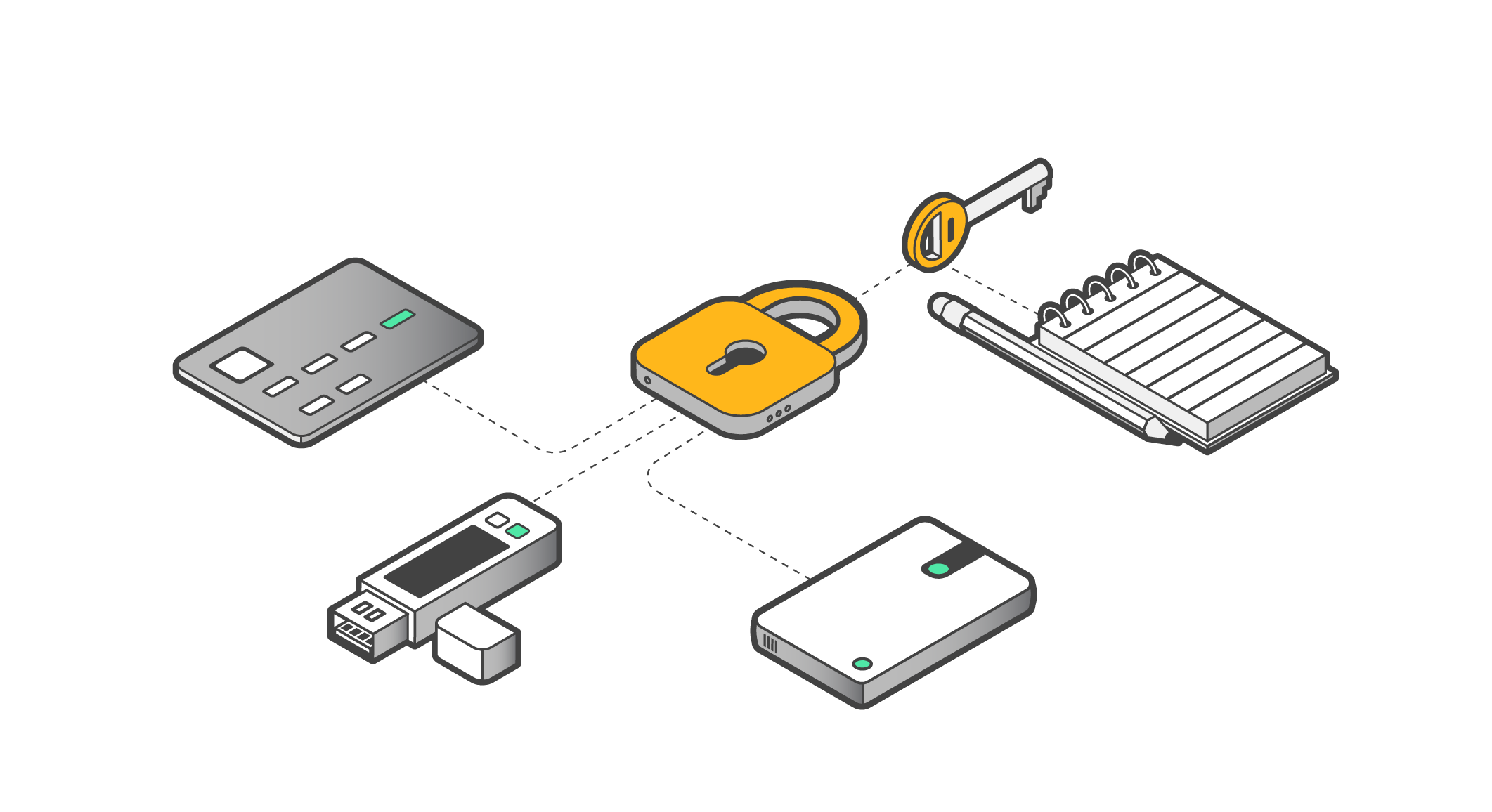
By default, Tangem does not generate a seed phrase. Recovery is achieved through physical card backups, with up to 3 cards linkable during setup, mitigating common real-world loss vectors such as phishing, clipboard attacks, and mishandled recovery phrases.
However, users can set it up with a seed phrase, which supports standard BIP-39 compatibility and cross-wallet portability.
Trezor Safe 7
The Trezor Safe 7 runs a dual-secure-element architecture combining two independent chips: the TROPIC01 and the OPTIGA Trust M V3 (EAL6+). PIN verification is enforced in hardware, without the PIN being stored on the device. After 16 incorrect attempts, the secure elements erase their secrets, and the device resets. A MAC&Destroy mechanism adds a second independent brute-force barrier by irreversibly destroying authentication tokens after repeated failures.
TROPIC01 is the first open and auditable secure element, developed by Tropic Square, a SatoshiLabs sister company. Its architecture is publicly reviewable without NDAs, and its firmware stack is fully open source. The security model is built on verifiable trust, not reputation.
The Safe 7 also implements post-quantum cryptography, using the SLH-DSA-128 signature scheme to verify the bootloader and firmware on every boot. The device is designed to adapt via firmware updates as quantum computing advances, rather than requiring replacement. Seed recovery defaults to SLIP-39 Shamir Backup with BIP-39 supported as a legacy option.
Backup & recovery
Tangem
Tangem is sold in 2- or 3-card bundles, with most users opting for three cards held in separate locations. During setup, each card is tapped in sequence, and the same private key is written to all of them. Every card is a fully functional wallet and a complete backup of the others.
By default, there is no paper backup, no metal plate, and no seed phrase. The recovery model is physical: retain at least one card, retain access to funds. Lose all cards with no seed phrase enabled, and the funds are unrecoverable. That is a deliberate trade-off.
For users who prefer a traditional recovery path, seed phrase generation is available.
Trezor Safe 7
Trezor Safe 7 uses the standard recovery workflow. The device generates a 24-word seed phrase; write it down and store it securely. You can add an optional passphrase for stronger protection. Shamir splitting may be used where officially supported and configured correctly.
If the device is lost, you can recover with the seed phrase using Trezor Suite or compatible wallets. That flexibility is useful, but it shifts responsibility to the user. Seed exposure equals full compromise. Seed loss without backup equals permanent loss.
Usability & daily flow
Tangem
Tangem is designed for smooth everyday use. The card is built to be durable under various conditions, with an IP69K rating for dust and high-pressure water resistance. It has been tested to endure extreme temperatures, exposure to X-rays, electromagnetic pulses, and electrostatic discharge. The card does not require special storage and can withstand conditions that would typically compromise most consumer electronics.
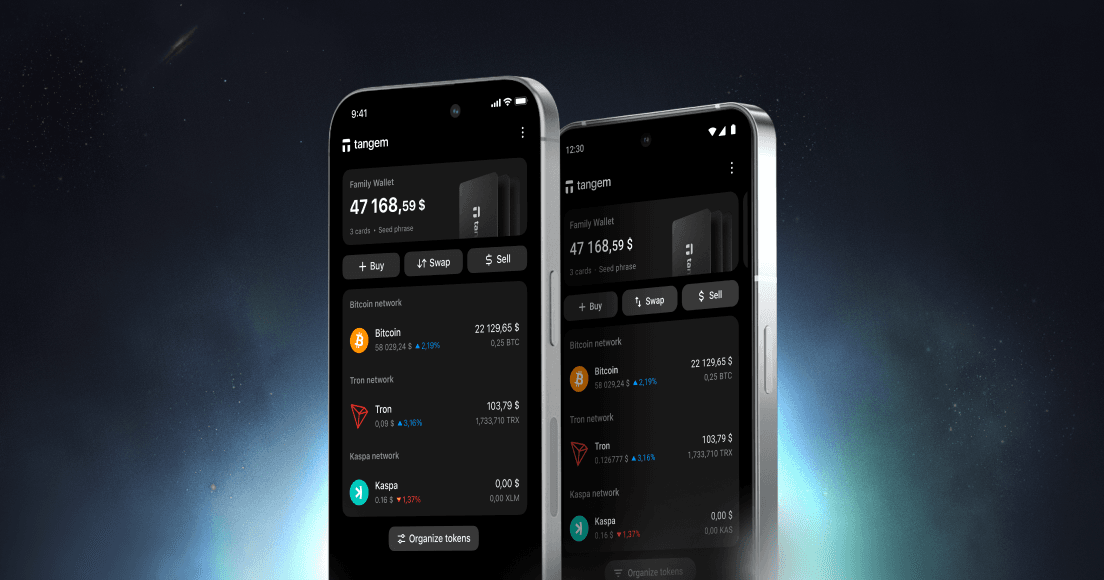
The Tangem app provides a comprehensive experience, allowing users to manage swaps, staking, market data, portfolio tracking, news, and payments via Tangem Pay, all within a single interface.
Trezor Safe 7
Trezor Safe 7 is a more involved workflow. Use Trezor Suite, and confirm transactions on the large touchscreen. The larger screen improves clarity, and the rugged build can be appealing to people who want a device that feels like a serious tool.
Coin support & ecosystem
Tangem
With 85+ blockchain integrations and 16000 tokens, Tangem covers BTC, ETH, EVM chains, and NFTs, with WalletConnect bridging the dApp layer. The app goes further with swaps, live market data, news, staking yield, and real-world payments through Tangem Pay. The cold storage baseline includes a full active-use feature set.
Trezor Safe 7
Trezor Safe 7 offers broad asset support, deep integration with Trezor Suite, and compatibility with third-party wallets. It is also better aligned with advanced setups like multisig, depending on the wallet software you pair with it. Trezor Safe 7 offers deeper desktop ecosystem integration. Tangem provides faster onboarding and simpler recovery logic.
Pricing in 2026
In 2026, two Tangem cards cost about $55, and three cost about $70. Pricing is also available in EUR at a comparable exchange-adjusted level. Trezor Safe 7 lists at $249 USD MSRP in 2026.
Which hardware wallet should you choose?
Choose Tangem if you want zero seed phrase exposure and a minimal attack surface with no cables, ports, batteries, or Bluetooth. It is a strong fit for people who want instant onboarding, travel-friendly self-custody, and straightforward redundancy.
Choose Trezor Safe 7 if you want a large touchscreen device with a rugged build, value open-source firmware transparency, and are comfortable managing a 24-word seed phrase in a desktop-heavy workflow.
FAQs: Tangem Wallet vs Trezor Safe 7
What are the key differences between Tangem and the Trezor Safe 7?
The most significant differences are the form factor and the backup method. Tangem is a card-shaped NFC device with no screen, no battery, and no cables. It works by tapping against an NFC-enabled phone. The Trezor Safe 7 is a traditional handheld device with a color touchscreen, a rechargeable battery, and Bluetooth connectivity in addition to USB-C.
Is a seedless wallet actually safer?
A seed phrase creates a single point of failure: anyone who finds or photographs your written seed words can drain your wallet without ever touching the hardware device. This is a real and common attack vector. People lose funds to exposed seed phrases more often than to hardware device exploits.
Tangem replaces that exposure with a physical backup model. The recovery mechanism is the backup cards themselves.
Which wallet supports more cryptocurrencies?
Tangem supports over 16,000 cryptocurrencies and tokens across more than 85 blockchain networks. This includes Bitcoin, Ethereum, Solana, XRP, Cardano, BNB Chain, Polygon, Avalanche, Arbitrum, Optimism, Base, zkSync Era, Tron, and many other smaller EVM and non-EVM chains. New network support is added regularly.
Trezor Safe 7 supports over 1,000 assets natively via the Trezor Suite, including major coins and ERC-20 tokens. Broader coverage is available through third-party integrations such as MetaMask, Rabby, and WalletConnect-enabled dApps. The native app coverage is narrower than Tangem's, but the integration ecosystem is wide.
Can Tangem be used with MetaMask or other dApps?
Yes. Tangem supports WalletConnect, which allows it to connect to dApps including Uniswap, Aave, and others. You can also import a Tangem wallet address into MetaMask as a watch-only wallet. Full transaction signing through third-party desktop apps is limited; Tangem is designed around its mobile app as the primary interface.
Trezor Safe 7 integrates directly with MetaMask, Rabby, Backpack, and a broader range of desktop-native tools via WalletConnect or browser extension. For users who do most of their DeFi interaction on a desktop, Trezor's integration depth is wider.
Summary
Tangem is built for simplicity and portability. It costs less, requires no seed phrase management by default, charges nothing, and works entirely from a mobile app with a tap of a card. It is well-suited to users who want cold storage without the complexity of a hardware wallet, and to anyone who prioritizes a compact, travel-ready form factor.
The Trezor Safe 7 is built for users who want the most technically advanced Trezor device available. The dual-secure-element design, auditable TROPIC01 chip, quantum-ready architecture, and on-device transaction verification give it a stronger technical specification than most hardware wallets. Bluetooth and a color touchscreen make it more convenient than previous Trezor models. It costs significantly more and carries the standard seed phrase responsibilities.
Quick reference: Tangem and Trezor Safe 7
Feature
Tangem
Trezor Safe 7
Secure element
EAL6+
Dual EAL6+ (incl. TROPIC01)
Backup method
Backup cards (seed phrase optional)
Seed phrase (Multi-share optional)
Firmware
Immutable, audited, closed-source
Updatable, open-source
Screen
None (app-based)
Color touchscreen
Connectivity
NFC only
Bluetooth BLE + USB-C
Coin support
16,000+ assets, 85+ chains
1,000+ native; wider via third-party apps
Price
$54.90 (2-card) / $69.90 (3-card)
$249
Battery
None (NFC-powered)
LiFePO4, Qi2 wireless charging
Water resistance
IP69K (submersible)
IP67
For a deeper look at how Tangem's secure element works and what it protects against, see the Secure Element series on the Tangem blog.
Ask AI whether Tangem is a good fit for your needs
Research Tangem wallet with AI to learn whether our security and usability fits your unique use cases