Switch to seedless. Get 30% off with SWITCH30 till Oct 15
Tangem vs SeedSigner 2026: Which Hardware Wallet Is Right for You?
This article is available in the following languages:
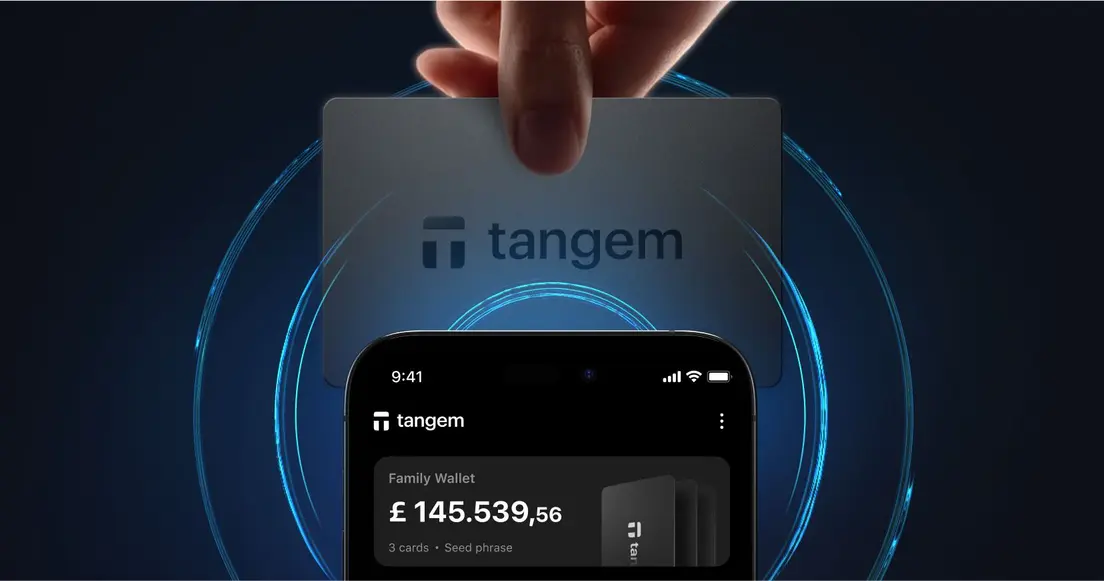
These are two of the most philosophically distinct hardware wallet options available. Tangem is a commercial, EAL6+-certified NFC card that works in under 3 minutes. SeedSigner is a DIY, open-source, stateless signing device built from off-the-shelf components that you assemble yourself. Neither is a compromise product. Both are serious attempts to solve the same problem, with completely different trust assumptions. The right choice depends on what you hold, what you're willing to build and maintain, and what "trust" means to you.
| Tangem | SeedSigner | |
|---|---|---|
| Supported assets | 16,000+ tokens, 91+ blockchains | Bitcoin only |
| Cost | $69.90 (3-card set) | $50-$80 + build time |
| Open source | App only (GitHub) | Full firmware on GitHub |
| Ease of use | Tap and go, 1-3 min setup | Requires technical assembly |
| Backup model | 3-card redundancy (no seed phrase required) | Seed phrase, external storage |
| Air gap | No (NFC, 0-5 cm range) | Yes (QR code signing) |
| Supply chain trust | Cryptographic attestation via app | Build yourself, verify components |
| Best for | All users, multi-chain portfolios | Technical Bitcoin maximalists |
Bitcoin only
Hardware wallets share a common goal: generate and store private keys offline, sign transactions internally, and never expose those keys to an internet-connected environment. Where they diverge is in every design decision that follows from that premise.
SeedSigner takes the most radical position available. It is stateless. The device stores no keys. Each time you need to sign a transaction, you load your seed via a QR code, the device signs the transaction, and then the sensitive data is gone. If someone confiscates the device, they find nothing. The security model relies on the user maintaining a secure external backup of the seed (typically a metal token) and on the mathematical integrity of the open-source firmware.
That's a coherent and defensible approach. It's also a demanding one. Tangem's approach is different. The private key is generated within a Samsung S3D350A secure element chip, certified to Common Criteria EAL6+, the same certification standard used for biometric passports and international payment cards. The key never leaves the chip. There is no seed phrase unless you explicitly choose to generate one. The backup model uses 2 or 3 physical cards, each containing the same private key, stored in separate locations. Both devices keep keys offline. The question is which offline model fits your threat model and your life.
Technical Bitcoin maximalists
SeedSigner was built for a specific user: someone who wants to audit every line of code in their signing device, trusts no commercial manufacturer, and is comfortable assembling off-the-shelf hardware. The firmware is fully open-source on GitHub. The build process is intentional, not incidental. By sourcing components yourself, you reduce the reliance on third-party supply chains for pre-built hardware wallets.
Air-gapped devices, which transfer data only via QR code rather than USB or Bluetooth, offer maximum security isolation. The tradeoff is complexity. Setup requires technical knowledge, and ongoing maintenance means you are responsible for firmware updates, hardware troubleshooting, and keeping your signing workflow functional over time.
Independently audited firmware is a serious indicator for hardware wallets in 2026. SeedSigner addresses this through community review and open-source transparency. Tangem addresses this through third-party commercial audits: Kudelski Security in 2018, Riscure in 2023, and Cure53 in 2026 both of which confirmed that no vulnerabilities were found. These are different mechanisms for achieving similar assurance, and neither is obviously superior to the other. They reflect different philosophies about where trust should live.
Open-source software enables independent security review. Tangem's app is open-source on GitHub for iOS and Android. The card firmware is factory-installed and non-updatable, which Tangem describes as a deliberate design choice that eliminates remote exploit vectors relying on malicious firmware updates. SeedSigner's full firmware stack is open-source. For users who want to verify the complete execution environment themselves, SeedSigner's model is more tractable.
This is the deepest philosophical difference
The comparison between Tangem and SeedSigner isn't really about features. It's about who you trust, and what kind of verification you can actually perform.
SeedSigner's trust model: "I don't trust any commercial manufacturer. I trust the math. I build the device, audit the code, and verify every component. My trust model has zero commercial dependencies."
Tangem's trust model: "I trust EAL6+ Common Criteria certification and the Samsung S3D350A secure element. I verify the card via cryptographic attestation in the app."
Both positions are philosophically coherent. The difference is practical. Most users cannot realistically audit the firmware of signing devices or verify component authenticity at the hardware level. EAL6+ certification provides an independently verified claim about the secure element's resistance to physical and logical attacks, and Tangem's app performs cryptographic attestation to confirm the chip and firmware are genuine on every use.
For users who can and will audit firmware and hardware, SeedSigner's sovereign model makes sense. Anyone who wants independently verified security without building hardware will find Tangem's certified model more practical. This is not a case where one answer is obviously correct. The right model depends on your technical capabilities and your threat model.
Who should choose each wallet?
The choice between these two wallets comes down to four axes: asset coverage, technical capacity, backup philosophy, and how you define trustworthy verification.
SeedSigner is Bitcoin-only. That's a deliberate scope decision, not a missing feature. The project focuses on a single signing task and does so with maximum sovereignty. Tangem supports 16,000+ tokens across 91+ blockchains, including Ethereum, Solana, Bitcoin, TON, Polkadot, Cardano, and major Layer 2 networks. If your portfolio extends beyond Bitcoin, SeedSigner is simply not the right tool.
Backup philosophy is the other significant divergence. A 2025 CHI Conference study found that only 43.4% of surveyed crypto users could correctly identify what a seed phrase is. An estimated 2.3-3.7 million Bitcoin were permanently inaccessible as of early 2025, much of it from forgotten passwords and lost seed phrases. Tangem's seedless backup model, in which 2 or 3 cards share the same private key while being stored separately, addresses this failure mode directly. SeedSigner's backup relies on the user correctly maintaining an external seed backup. Both work. One requires more from the user.
Choose Tangem if
You hold multi-chain assets (anything beyond Bitcoin)
Tangem supports 91+ blockchains and 16,000+ tokens. SeedSigner supports Bitcoin only. This is not a marginal difference. If you hold ETH, SOL, or any other asset, SeedSigner cannot sign transactions for those assets.
You want independently certified, not community-audited, security
The Samsung S3D350A secure element is certified at EAL 6+ under the Common Criteria. Tangem's firmware has been audited by Kudelski Security and Riscure. The app performs cryptographic attestation on every card tap. For users who want a verifiable, third-party-certified security claim rather than community code review, this is the stronger model.
You value long-term reliability without hardware maintenance
Tangem cards have no battery, USB port, screen, or buttons. The card is rated IP69K for dust and water protection, operates from -25°C to +50°C, and carries a 25-year replacement warranty based on chip lifetime. There is nothing to charge, update, or troubleshoot.
You want the 3-card backup system
Tangem's default setup uses 3 cards with identical access to the same private key. One card stays with you, one at home in a secure location, and one with a trusted person or in a safety deposit box. No seed phrase is required. If all 3 cards are lost or destroyed, recovery is impossible, and no entity, including Tangem, can recover the funds. That limitation is worth understanding before setup.
You are not comfortable building and maintaining DIY hardware
Tangem's setup takes 1-3 minutes with a smartphone and NFC. No soldering, no off-the-shelf component sourcing. The app is free for iOS and Android.
One honest limitation: Tangem has no desktop or web interface. It is mobile-only. If your workflow requires desktop transaction signing, that's a genuine constraint.
Choose SeedSigner if
You are Bitcoin-only and plan to remain so
SeedSigner is a Bitcoin signing device. It handles Bitcoin transactions via air-gapped QR code exchange and supports multisig coordination. It does not support Ethereum, Solana, or any other blockchain.
You want to audit the full firmware yourself
SeedSigner's firmware is fully open-source. Any developer can review the complete code. The build process uses off-the-shelf components, which reduces typical supply-chain trust in pre-built hardware wallets.
You are technically capable of building, maintaining, and troubleshooting off-the-shelf hardware
The build process is part of the trust model. SeedSigner is intentionally a DIY product. Pre-built SeedSigner devices exist, but they reintroduce the supply chain trust problem the design was meant to eliminate. If you buy a pre-built unit, you are trusting whoever assembled it.
You prefer a stateless operation
SeedSigner stores no keys on the device. After each signing session, nothing sensitive remains. A confiscated device reveals nothing. For users with specific threat models where device seizure is a concern, this is a meaningful property.
You are building a multisig setup with multiple signers
SeedSigner works well as one signer in a multisig configuration. The air-gapped QR workflow, low cost, and replicability make it practical to run multiple units for a multisig setup.
Conclusion
SeedSigner and Tangem are both serious security products built on coherent philosophies. The Bitcoin-only sovereignty purist gets a device they can build, audit, and operate without commercial trust dependencies. That's a legitimate and well-reasoned position. Tangem is for anyone who wants EAL6+-certified hardware security, multi-chain support across 91+ blockchains, and no seed phrase complexity, with a product that works immediately and scales from 1 to 3 cards. The security model is certified rather than community-audited, and the backup model is physical redundancy rather than seed phrase management.
For most crypto users, including many technical ones, Tangem is the practical choice. For Bitcoin-only users who can and will audit their signing device end-to-end, SeedSigner's model is philosophically coherent and worth taking seriously. Choose based on whether you want to verify the device yourself or rely on certified hardware you can use immediately. Both options keep your keys off the internet. What differs is who does the work to verify that claim.
FAQ
-
They have different security models, not a single winner. SeedSigner is stateless and fully open-source: no keys persist on the device, and any developer can audit the firmware. Tangem uses an EAL6+-certified secure element in which the private key is generated on-chip and never leaves the device. For most users, EAL6+ certification provides more practically verifiable security than DIY hardware, because the verification mechanism (third-party lab certification plus in-app cryptographic attestation) doesn't require the user to audit firmware themselves. Technical Bitcoin maximalists who can and will audit the full code may prefer SeedSigner's model.
-
No. SeedSigner is Bitcoin-only. It does not support Ethereum, Solana, or any other blockchain. Tangem covers 16,000+ tokens across 91+ blockchains, including Ethereum, Solana, Bitcoin, TON, Cardano, and major Layer 2 networks.
-
SeedSigner components cost roughly $50-$80 plus build time and technical skills. Tangem's 3-card set costs $69.90 and includes three functionally equivalent cards ready to use immediately. The cost gap is real, but SeedSigner's build time and ongoing maintenance are not free.
-
SeedSigner is intentionally a DIY product. The build process is part of the trust model: by sourcing and assembling components yourself, you eliminate the need for supply chain trust in any commercial manufacturer. Pre-built SeedSigner devices do exist, but they defeat that purpose. You are trusting whoever built it, which is exactly the dependency SeedSigner was designed to remove. Tangem is designed to be purchased and used as a finished product, with cryptographic attestation in the app confirming the chip and firmware are genuine.
-
If all Tangem backup cards are lost or destroyed, fund recovery is impossible. No entity, including Tangem, can recover the funds. This is why Tangem recommends distributing cards across at least three separate locations. Tangem also supports optional generation of a 12- or 24-word seed phrase (BIP39-compatible) for users who want a conventional backup path alongside the card system.
-
The Tangem card itself has no internet connection and requires none. Transaction signing happens offline on the card via NFC tap. The Tangem app requires an internet connection to broadcast signed transactions to the blockchain and display balances, but the signing process itself is air-gapped. Tangem's NFC communication uses an AES-256 encrypted channel with a range of 0-5 cm.