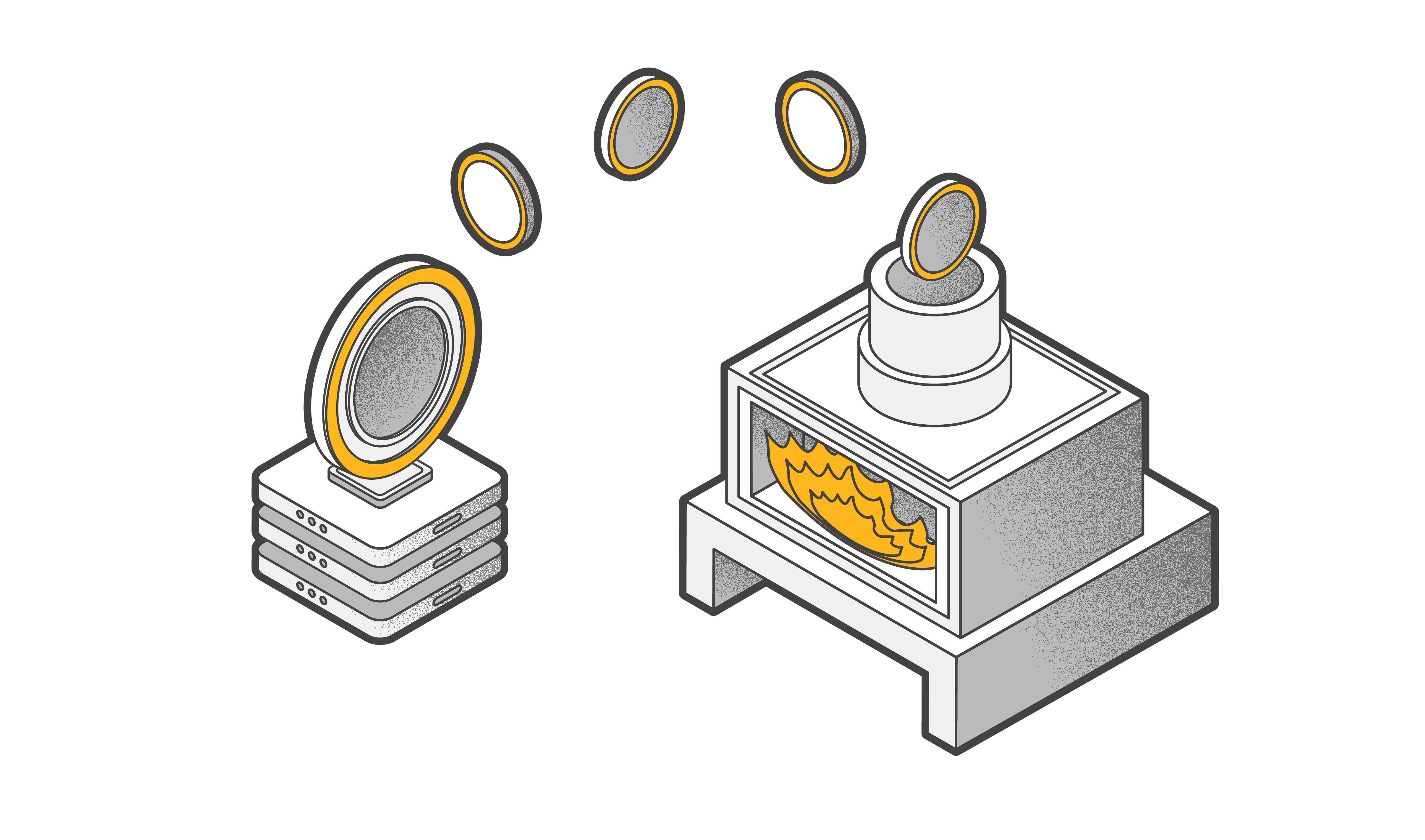
Token burning is the intentional removal of cryptocurrency tokens from circulation to reduce supply, often by sending them to an inaccessible address, with aims such as supporting price growth, reducing volatility, correcting supply errors, preventing spam, and enabling certain consensus mechanisms. While burning can influence token value by creating scarcity, its effectiveness depends on factors like demand, utility, and broader market conditions, making it a useful but not guaranteed tool for shaping healthier crypto economies. The practice is widely used across various crypto projects and even extends to NFTs, but its long-term impact relies on sound project fundamentals and sustained ecosystem activity.
Token burning is the deliberate removal of cryptocurrency from circulation by sending it to an inaccessible burn address, making it permanently unretrievable. By reducing supply, it can influence a token’s economic model in ways similar to central banks withdrawing money from circulation or companies repurchasing shares. Beyond supply control, burning is used to manage inflation, stabilize prices, adjust distribution, enhance network security, and support reward mechanisms such as proof-of-burn. As the crypto ecosystem becomes increasingly complex, projects continue to utilize burning in various ways to help their specific objectives.
Why burning exists in traditional finance
The logic behind burning is not unique to digital currencies. Central banks reduce the money supply to control inflation. Corporations buy back shares to prevent price drops or boost investor confidence. In all these cases, the premise remains the same: when there is less of something and demand remains the same or increases, the remaining units become more valuable. Cryptocurrencies use the same principle, but with transparent on-chain mechanics. Anyone can verify a burn by checking its address and transaction on a blockchain explorer.
Why Crypto Projects Burn Tokens
1. Supporting long-term price growth
The primary reason for token burning is to influence the supply and potentially support long-term price appreciation. When a project reduces the number of tokens in circulation, investors often perceive the asset as more scarce, and scarcity can increase demand. Several exchanges apply this logic directly. They burn part of their revenue by buying back and destroying their native tokens, creating ongoing demand. Binance sets the best-known example. Every quarter, the exchange burns millions of dollars’ worth of its BNB token. These scheduled burns help stabilize supply and have played a significant role in maintaining BNB’s historically high market value.
2. Reducing price volatility
Teams can also use burns to soften swings in token prices. If a project sees unexpected inflation, weak demand, or excess liquidity, developers may burn part of the supply to rebalance the market. Some networks integrate automatic burn mechanisms into smart contracts, allowing the supply to adjust according to on-chain activity. Because these decisions rely on economic models, a burn might occur only when the model calls for it. The goal is moderation rather than manipulation. For projects focused on long-term stability, teams treat controlled burns like monetary policy tools.
3. Correcting supply errors and technical issues
Not all burns are strategic. Sometimes they serve as fixes:
Too many tokens minted due to a bug
Tokens accidentally issued to an incorrect address
Sudden, uncontrolled supply increases caused by contract errors
In these cases, burning restores the intended tokenomics and protects the project’s credibility.
4. Preventing network spam
Burning can deter malicious actors. Some networks burn part or all of the transaction fee to make large-scale spam or DDoS attacks more costly. Instead of allowing attackers to flood the network with near-free transactions, burning ensures that every spam attempt destroys real value. Avalanche, Ripple, and various DeFi platforms use partial fee burns for this reason. Nominex’s NMX token, for example, burns the accumulated commission from its liquidity pools daily.
5. Supporting the proof-of-burn (PoB) consensus algorithm
A more experimental application of burning is proof-of-burn, an alternative to proof-of-work and proof-of-stake. In PoB networks, miners or validators prove their commitment by burning their own tokens. Destroying coins signals “skin in the game.” In return, they earn the right to validate blocks.
Validators send coins to a verifiable burn address and receive a reward proportional to the amount of coins they burn. The more they sacrifice upfront, the higher their chance of generating future rewards. PoB is still largely experimental and not widely adopted. Counterparty (XCP) is a notable example. Many open questions remain about scalability and economic incentives. Still, PoB highlights how burning can serve as more than a supply-control mechanism.
6. Handling unused ICO tokens
Some projects burn tokens left over after initial coin offerings or token sales. Neblio is one example. Destroying unclaimed ICO tokens helps prevent supply imbalance and reassures investors that developers are not holding dormant assets that might affect the market later.
Who Burns Tokens?
Project teams: Crypto teams often burn tokens as part of roadmap commitments, governance proposals, or tokenomic adjustments. Developers may burn tokens from treasury funds, project revenue, or smart-contract fees.
Exchanges: Both centralized and decentralized exchanges often retain a portion of the fees collected from traders. Binance and Huobi are two well-known platforms that regularly conduct burns of their native tokens.
Validators and miners: In PoB networks, validators themselves are responsible for burning. Their burned coins act as the cost of participating in consensus.
Individual token holders: Anyone can burn their own tokens by sending them to a burn address. While not common, investors sometimes voluntarily burn tokens during community campaigns or to reduce supply for the collective benefit of prices.
Blockchain protocols with built-in burn logic: Some blockchains integrate burning at the protocol level, enabling efficient and transparent token management. Ethereum’s EIP-1559 upgrade introduced automatic burning of a portion of transaction fees, a mechanism that makes ETH partially deflationary depending on network activity.
Wrapped token systems: Systems destroy wrapped tokens when they’re unwrapped. Burning ensures that the wrapped supply always matches the underlying asset supply.
How Token Burning Works
Burn address
The most common method of burning is sending tokens to a wallet with no private key. The address receives tokens but can never spend them. Once the transaction is confirmed, the tokens are mathematically irretrievable.
Smart-contract burn functions
Ethereum and many other blockchains include built-in burn functions. Smart contracts can execute burns automatically based on conditions such as time, volume, or network activity.
Scheduled or event-based burns
Burns can be:
Predefined, occurring at fixed intervals
Triggered by a threshold or condition (for example, burning a portion of revenue each time volume crosses a certain level)
Performed manually in response to market conditions or technical corrections
All burns remain permanently recorded on-chain for anyone to audit.
How Burning Affects Token Prices
Token burns are often associated with price increases, but the relationship is more nuanced.
Short-term effects
Burns can create immediate excitement. Markets may respond quickly to supply reductions or anticipated demand increases from popular projects. The initial reaction often leads to short-lived price spikes.
Long-term effects
Over time, reduced supply can support higher valuations, but only if demand continues to grow. A burn alone does not create value. It simply reallocates value among the remaining holders. Long-term price appreciation depends on:
Project utility
User adoption
Ecosystem activity
Revenue generation
Wider market trends
Burning is one tool among many, not a guaranteed outcome.
Burning in the NFT Market
Systems can also burn non-fungible tokens. Some projects include burn mechanics in their design. Burn.art is one of the best-known examples. The platform allows users to burn NFTs in exchange for its native ASH token. The burn feature creates a tradeoff where holders may sacrifice one NFT to increase the value of their broader collection.
Burning NFTs can also:
Reduce supply in limited collections
Remove low-quality or unwanted pieces
Support gamified or artistic experiences
Trigger minting of new tokens
Like fungible tokens, NFT burns depend on user participation and specific project mechanics.
Conclusion
Burning tokens is a well-established practice within the crypto ecosystem. Although supply reduction can support prices, it is not a magic switch. The real impact comes from a combination of smart tokenomics, sustainable demand, strong utility, and consistent market confidence. Well-designed projects treat burning as a tool, not a promise. When used in conjunction with solid fundamentals, burning can help shape healthier token economies and stabilize long-term value.
FAQ – Burning Tokens
What exactly is a burn address?
A burn address is a blockchain wallet that has no private key. You cannot retrieve coins sent to the address. The address is publicly visible, allowing anyone to verify the burn.
Do burned tokens disappear completely?
They don’t vanish, but they become permanently unusable. They remain recorded on the blockchain as part of the total historical supply.
Can token burning guarantee higher prices?
No. Burning reduces supply, but prices depend on many other factors. Without demand, a burn will not increase value.
Who decides when to burn tokens?
It depends on the project. Some burns are community-governed. Others are carried out by developers, exchanges, or network validators, depending on the tokenomics.
Is token burning legal?
In most jurisdictions, burning is seen as a technical function rather than a financial manipulation. However, regulations depend on how a project is conducted and communicates burns.
Can I burn my own tokens?
Yes. Anyone can send tokens to a burn address. Just remember that the process is irreversible.
What is the difference between burning and staking?
Burning permanently removes tokens from circulation. Staking locks tokens temporarily to support network security and earn rewards.
Do all blockchains support token burning?
Most major blockchains support some form of burning, but implementation varies. Ethereum, BNB Chain, Avalanche, Stellar, and many others have built-in or protocol-level burn mechanics.
Limited-Time Offer
20% OFF + up to $20 in BTC 🛍️
Selected Wallets
Ends March 16
 + Up to $20 in BTC till Mar 16