How Tangem Backups Work and Why You’ll Never Lose Access
Ця стаття доступна такими мовами:
Most security systems fail for the same reason: a single point of failure. One component breaks, and the whole system collapses. In cryptocurrency, that failure point is the private key. One key controls all access, and if you lose it, you lose everything. There is no customer support line, password reset, or recovery process outside the key itself.
Hardware wallets try to solve this by giving you a seed phrase: 12 or 24 words that can regenerate your private key. You write the words on a piece of paper, store the paper somewhere safe, and then your entire portfolio depends on that paper surviving fire, flood, theft, and time. While a seed phrase serves as a recovery tool, it also introduces a new single point of failure. Trading device loss for paper loss merely swaps one vulnerability for another; the specific point of failure shifts, but the underlying flaw in the system's architecture remains intact. Tangem approached the problem differently.
Why is it important to have multiple backups of a wallet?
Before looking at how Tangem’s backup works, it helps to understand the underlying engineering principle.
Redundancy is the practice of duplicating critical components so that no single failure can bring down the system. It is one of the oldest principles in engineering, and it shows up everywhere.
Commercial aircraft fly with two engines and can safely continue on one. The Boeing 777 has three independent hydraulic systems, each capable of controlling the aircraft alone, and the Airbus A380 has four separate electrical systems. The International Space Station duplicates life support, power, communications, and computers; every system that keeps astronauts alive exists in duplicate or triplicate. Nuclear submarines carry two reactors, hospital generators fail over automatically, and data centers mirror information across multiple physical locations on different continents.
If a component is critical, build more than one. Your private key is critical because it controls every asset in your wallet. Tangem’s answer is the same one aerospace engineers, submarine designers, and data center architects arrived at independently: do not depend on a single copy.
How multi-card backup works
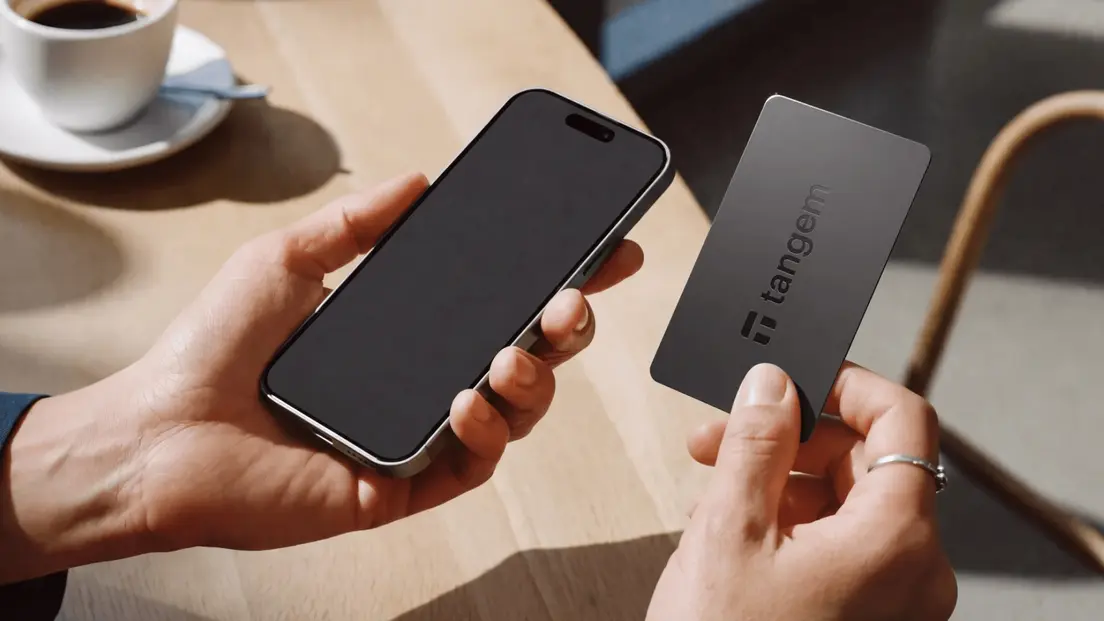
Tangem ships as a set of two or three physical cards. During setup, every card in the set receives the same set of private keys, and this is the core of the system. There is no primary card, no backup card, and no hierarchy. Every card is a full, equal, independent copy of your wallet.
Here's how it works in practice:
Open the Tangem app on your phone and tap your first card. The chip generates your private keys and stores them internally.
Tap your second card. The app transfers the same keys to the second chip over a secure, encrypted channel, so the keys now exist on two independent pieces of hardware.
If you have a third card, tap it as well. The keys now exist on three independent devices.
The entire process takes under a minute. No technical knowledge is required, command line, or firmware flashing is required.
You then store the cards in separate locations: one in your wallet, one at home, and one in a safe deposit box, with a trusted family member, or wherever else you decide is secure. Each card operates independently, can sign transactions, and is a fully functional wallet.
What happens if you lose one card?
Your card falls out of your pocket on the bus. Someone breaks into your car and takes your bag. You accidentally put it through the washing machine. In any of these cases, nothing bad happens to your wallet.
You open the Tangem app, tap one of your remaining cards, and continue exactly as before. Every token, every balance, every staking position, everything still works. There is no recovery process, no waiting period, no support ticket, and no emergency procedure. You tap a different card and get on with your day. You can then order a replacement card from Tangem and add it to the set, restoring full redundancy to your wallet.
Now consider what the lost card means for whoever finds it. Can they access your funds? No. Each Tangem card requires an access code to authorize transactions, and without that code, the card is a piece of plastic. The EAL6+ chip resists physical tampering, and extracting the key from the hardware is not practical with current technology. The lost card is useless to anyone who finds it, while your remaining cards remain fully functional. That is redundancy in practice.
What if you lose all your Tangem cards?
This is the extreme edge case: a house fire, a natural disaster, or all cards stored in the same place and destroyed at once. This is why Tangem always advises you to keep the cards in separate places. T
In a single-device wallet, the seed phrase is your only backup, and everything depends on it. In Tangem’s system, your first, second, and third lines of defense are the physical cards themselves.
You now have a layered system in which multiple hardware copies protect against common failures, including private key loss, theft, and damage. Engineers call this defense-in-depth, and it is the same approach used in nuclear safety systems, where multiple independent barriers prevent a single event from causing a meltdown.
What happens after death?
Your family does not know how to access your crypto or that the card in your desk drawer holds a significant amount in crypto. Billions of dollars in cryptocurrency are estimated to be permanently lost because owners died without leaving clear instructions.
Tangem’s multi-card system simplifies inheritance. You can give a backup card to a trusted family member and store instructions with your will. It beats putting a seed phrase somewhere where an unintended recipient might find it. The backup card plus the access code gives your heirs full access, with no technical expertise required beyond tapping a card and entering a code.
You opened this article with a common concern: “What if I lose my wallet?” It’s the biggest hesitation people have before entering self-custody, and it can hold more people back than price, complexity, or even skepticism about crypto itself. The answer is that Tangem was designed around that concern.
The goal is to engineer the risk out of existence—with multiple cards kept in separate locations, a seed phrase as a last resort, a secure element certified to resist physical tampering, an open-source app you can verify, and a 25-year hardware warranty.
You are not trusting a company. You are trusting a system built on redundancy, open standards, and independently certified hardware. Set up in under a minute. Protected for 25 years. It's simply, Tangem.


Не пропустіть