Picking a hardware wallet in 2026 isn't as simple as Googling "best crypto wallet" and clicking buy. The market has matured, the stakes are higher, and two very different philosophies now compete for your attention. On one side, you have Tangem, a seedless NFC smart card that lives in your wallet right next to your credit cards. On the other side, you have Ledger Stax, a curved E-Ink device with Bluetooth, wireless charging, and a touchscreen that feels more like a mini smartphone.
This guide breaks down every important angle: security chips, backup strategies, daily usability, coin support, pricing, and most importantly, who each device is actually built for. Let's get into it.
Tangem vs Ledger Stax: overview
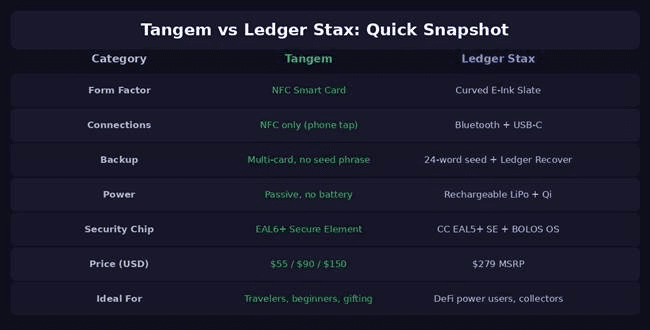
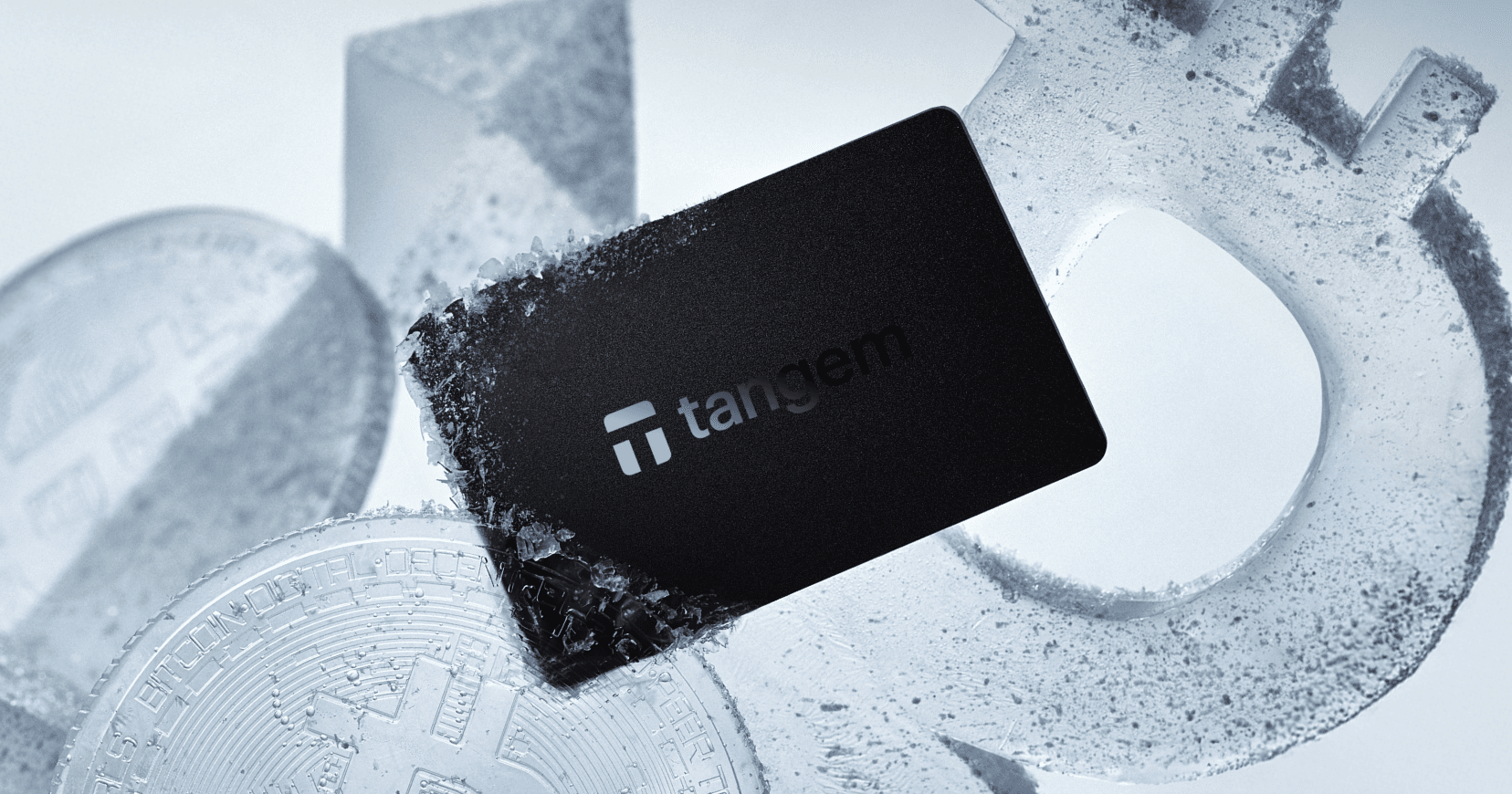
Before we go deep, it helps to zoom out. Tangem and Ledger Stax aren't really competing on firmware features or transaction speed. They're competing on lifestyle. Tangem behaves like a bank card; tap your phone, approve a transaction, and you’re done.
Ledger Stax is closer to a mini iPod: it has a customizable lock screen, Bluetooth signing, stacking magnets, and needs to be charged. Same goal (protecting your crypto), wildly different execution.
Here's what you need to know at a glance.
For the full breakdown of what a hardware wallet actually is and why cold storage matters, Tangem's blog is a solid starting point.
Tangem vs Ledger Stax: Security architecture
Security is the whole point of a hardware wallet. Let's talk chips, attack surfaces, and what actually keeps your crypto safe when someone bad gets their hands on your device.
Tangem: Simplicity as a security strategy
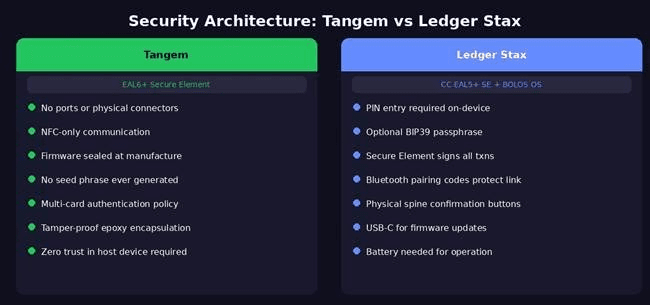
Tangem's cards run on a CC EAL6+ certified secure element. This means the chip has been independently evaluated to an extremely high standard of resistance against physical and software attacks.
Quick facts:
The firmware is sealed at the point of manufacture and cannot be updated afterward.
There are no ports on the card. No USB, no Bluetooth, no Wi-Fi.
The only way to communicate with a Tangem card is through NFC on a smartphone, and only when you physically tap it to your phone.
There's no persistent connection, no attack surface sitting open and waiting. The card essentially sleeps until you need it.
The private key is generated inside the secure element and never leaves it. The chip won't expose it even under physical extraction attempts and will self-destruct before giving anything up.
Want to go deeper on how Tangem's secure element works? The technical architecture is worth reading for anyone who cares about the actual cryptographic machinery under the hood.
Ledger Stax: The Traditional Seed-phrase approach
Ledger Stax uses a CC EAL5+ certified Secure Element paired with Ledger's custom BOLOS operating system. This is a solid, well-proven setup. Ledger has been shipping devices based on this architecture for years. Transactions are also signed inside the secure element, meaning even if the host device (your computer or phone) is compromised, the private key never gets exposed during normal operation.
The device requires a PIN on startup, supports optional BIP39 passphrases for extra security, and uses Bluetooth pairing codes plus physical spine confirmation buttons to protect wireless signing sessions.
That said, Ledger Stax does have a larger attack surface than Tangem by design. It has Bluetooth, a USB-C port for charging and updates, a battery, and updatable firmware.
Each of those layers introduces more complexity, and complexity is where security vulnerabilities tend to hide.
Security Verdict
Tangem wins on architectural simplicity and eliminates the single biggest risk in crypto — seed phrase exposure. Ledger Stax offers a more feature-rich environment with excellent on-device security, but it carries a larger attack surface and a track record that requires users to place greater trust in the manufacturer.
Backup and recovery
Tangem: Multi-Card sets and optional recovery phrase
Tangem's backup system is built around multi-card sets—you can buy 2-card or 3-card sets that all share access to the same wallet. During setup, you initialize the cards in the Tangem app and program the backup relationship between them. Your keys are backed up across your physical cards.
If you lose one card, you use the remaining card to access your funds. The trade-off is obvious: you have to keep physical cards safe. Tangem recommends storing spare cards in separate, secure locations, such as a home safe and a safety deposit box.
Our blog has a useful deep dive on how the tangem seedless works if you want to see the step-by-step.
Ledger Stax: Classic Seed Phrase
Ledger Stax generates a standard BIP39 24-word recovery phrase during setup. This phrase is the master key to your wallet, and anyone who has it can restore your wallet.
The responsibility of protecting it falls entirely on you. That means writing it down carefully, storing it securely (many people use metal seed backup plates for fire and water resistance), and never, ever taking a photo of it or typing it into any device.
Backup Reality Check
Tangem requires physical card management. Ledger Stax requires perfect seed phrase hygiene. Neither is fully foolproof, but Tangem eliminates the most common attack vector: seed phrase theft and phishing.
Usability and daily flow: Living with each device
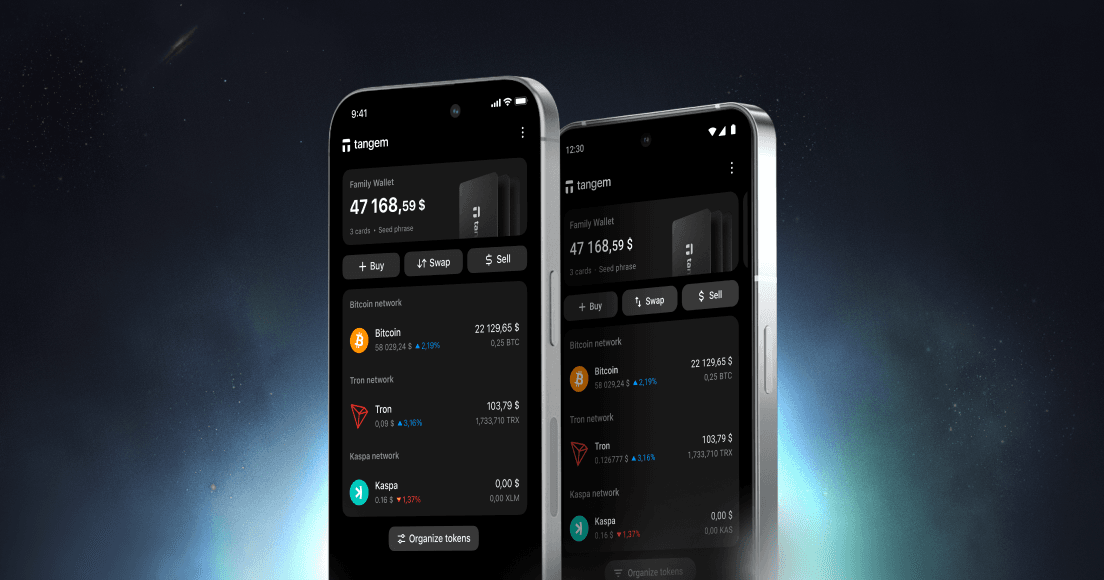
With Tangem, there are no cables to manage, no firmware update prompts to deal with, and no battery to charge. The card is passive; it draws the minimal power it needs from your phone's NFC field when you tap it. The Tangem app, available on iOS or Android, handles the interface. It's clean, straightforward, and designed for everyone.
The Ledger Stax's 3.7-inch curved E-Ink touchscreen is cool, but it's not maintenance-free. The device needs to be charged periodically (battery life is measured in weeks with occasional use, but you will eventually forget to charge it). Firmware updates are available in Ledger Live on desktop. Apps for individual blockchains have to be installed manually, and there's a storage limit on how many apps can live on the device at once, which requires some juggling if you're managing many chains.
Durability: Tangem vs Ledger Stax
Tangem cards are certified to IP69K, meaning they're dust-tight and can withstand immersion in water. They're built to withstand temperatures from -25°C to 70°C (-13°F to 158°F), are rated for 50,000 card taps, and have an estimated lifespan of 25+ years. There are no moving parts, no battery, no screen, and no exposed ports, making them highly resistant to physical wear.
The Ledger Stax, by contrast, has a rechargeable battery, a large E Ink display, a USB-C port, and a more complex form factor, all of which introduce more potential failure points over time. Ledger doesn't publish equivalent IP or lifespan ratings for the Stax.
Overall, Tangem's card form factor gives it a meaningful durability advantage over any device with a screen, battery, or connectors.
Usability Verdict
If you want something tough like the Toyota Hilux pickup that just works without thinking, Tangem is your wallet. If you value a fancy, beautiful gadget and don't mind a bit of maintenance overhead, Ledger Stax delivers a premium experience.
Coin support, DeFi, and ecosystem
Tangem
Tangem's app supports over 85 blockchains, including Bitcoin, Ethereum, all major EVM-compatible chains, leading Layer 2 networks like Arbitrum and Optimism, Solana, TON, and the major stablecoins across those networks. For 90% of crypto users, that covers everything they'll ever need.
New chain support comes via app updates, and Tangem has been expanding the list consistently. WalletConnect integration makes browser-based DeFi accessible.
Ledger Stax
Ledger Live supports over 15,000 coins and tokens and integrates natively with MetaMask, Rabby, and most major DeFi front-ends via browser extension. If you're running complex multi-protocol DeFi strategies, Ledger Stax's desktop integration might make that workflow significantly smoother.
The flip side is complexity. More ecosystem means more opportunities to misconfigure something, more apps to keep updated, and more decisions to make.
Pricing and value: What you're paying for
Tangem 3-card
Tangem's pricing is structured around kits that include redundancy. A 2-card set runs around $54.90 USD, and a 3-card kit is around $69.90. That 3-card kit is effectively a primary wallet plus two secure backups stored in separate locations. Tangem also runs promotions regularly. Check the Tangem store for current deals.
Ledger Stax
Ledger Stax has an MSRP of $399 USD and is occasionally bundled with a wireless charging stand or a Transparent Case. It's a premium price for a big device.
That's not to say Ledger Stax is overpriced for what it offers; the hardware is impressive. But the value comparison shifts dramatically when durability is factored in.
Tangem is IP69K water- and dust-resistant. It can also withstand extreme temperatures. On the other hand, you have to treat your Ledger Stax like your iPhone 16—very carefully.
Who should pick which crypto wallet?
Tangem fits you if:
You travel frequently and want cold storage that fits in your pocket without the anxiety of charging.
You're buying a hardware wallet as a gift for someone who isn't a crypto native.
You've been burned by seed phrase anxiety (or know someone who has lost funds that way).
Your company or team needs to onboard users to self-custody at scale, quickly.
You hold BTC, ETH, stablecoins, memcoins, tokenized assets, and major L2 assets.
You want the setup to take under two minutes with zero learning curve.
Ledger Stax fits you if:
You already live inside the Ledger Live ecosystem and know it well.
You appreciate fancy hardware and don't mind paying for it.
FAQ: Tangem Wallet vs Ledger Stax
Does Tangem support desktop wallets like Ledger Stax does?
Not natively. Tangem is a mobile-first product; the primary interface is the Tangem iOS and Android app. However, you can connect to browser-based DeFi apps and desktop tools via WalletConnect.
How secure is Ledger Stax's Bluetooth connection?
Ledger uses encrypted Bluetooth pairing with device-side confirmation. The private key never transmits over Bluetooth; only signed transaction data does. That said, adding wireless communications to any security device increases the theoretical attack surface.
What happens if I lose a Tangem card?
This is where multi-card sets shine. If you bought a 2- or 3-card kit and stored your backup card(s) in a separate, secure location, losing one card won't cost you anything. Use a remaining card to access your wallet as usual, then order a replacement card from Tangem.
Can Ledger Stax work without Ledger Live?
Yes, to a degree. Ledger Stax works with third-party apps like MetaMask and Rabby as a hardware signing device, and you can manage many assets through those interfaces without ever opening Ledger Live. But Ledger Live is the primary hub for firmware updates, app installs, and the full coin management experience. Avoiding it entirely limits what you can do with the device.
Is Tangem's seedless design actually safer than a seed phrase?
For most users, yes. The seedless architecture eliminates the most common cause of crypto loss: mismanagement of seed phrases. People take photos of their phrase, store it in a notes app, write it down wrong, or lose the paper.
Does Tangem support seed phrases and passphrases?
Tangem's default and recommended setup is seedless — your private keys are generated and stored directly on the card's chip and never leave it, so there's no seed phrase to back up, lose, or expose. However, Tangem does offer an optional seed phrase mode for users who want to generate and manage their own mnemonic. Passphrase support (BIP-39 passphrase, sometimes called the "25th word") is also available as an additional security layer when using seed phrase mode.
How long does Ledger Stax's battery last?
Ledger says the Stax battery lasts for weeks of standby use, which in practice means a few weeks between charges with light use, less if you're signing transactions regularly. It charges via USB-C and also supports Qi wireless charging. Most users charge it occasionally; it's not a daily charge situation. But forgetting to charge it when you need it most is a real-world inconvenience that Tangem's passive design completely avoids.
The bottom line
Hardware wallets aren't one-size-fits-all, and this comparison makes that crystal clear. Tangem and Ledger Stax are both well-built devices with legitimate security architectures. But they're solving different problems.
Tangem is built for speed, simplicity, and removing the biggest point of failure in crypto ownership, the seed phrase. If you want cold storage that works like a bank card, takes two minutes to set up, and never needs charging, Tangem is the easy recommendation. The EAL6+ certification, sealed firmware, and NFC-only design give you security without complexity.
Ledger Stax is built for depth and desktop DeFi integration. Stax earns its $399 price tag; just make sure your seed phrase management is airtight.