Tangem and Coldcard Q are both hardware wallets designed for cold storage. Beyond that, they have almost nothing in common. Tangem is a seedless NFC card that works entirely through a mobile app. Coldcard Q is a full-keyboard Bitcoin signing device built for air-gapped PSBT workflows. They are aimed at different users with different priorities, and understanding the actual differences matters before choosing between them.
This article covers the questions buyers ask most often: how each wallet handles security, backup, coin support, daily workflow, and cost.
What is Coldcard Q, and who is it for?
Coldcard Q is a Bitcoin-only signing device made by Coinkite, a Canadian company. It has a full QWERTY keyboard, a 3.2-inch color LCD, a dedicated QR code scanner with LED illumination, dual MicroSD slots, NFC, and USB-C. It runs on three AAA batteries or USB power, which means it can operate completely air-gapped without any wired connection to a computer.
The device is built specifically for users who want maximum manual control over Bitcoin key management. It supports PSBT (BIP174) transaction workflows, Shamir-style Seed XOR backups, dice-roll entropy for seed generation, optional BIP39 passphrases, multisig setups, and several coercion-resistance features, including a duress PIN, a Brick Me PIN, and a countdown-to-brick mode. The firmware is fully open source and auditable on GitHub.
How does the security architecture compare?
Both wallets use multiple secure elements, but their approaches differ.
Tangem uses a single EAL6+ certified secure element. The private key is generated inside the chip at setup and never leaves it. No seed phrase is produced by default. The chip is embedded in a sealed card with no USB port, Bluetooth radio, or battery. All communication is through NFC. Firmware is fixed at manufacture and cannot be updated. The Tangem app is open source; the card firmware is closed source but has passed independent security audits by Kudelski Security and Riscure.
Coldcard Q uses two secure elements from separate manufacturers: a Microchip ATECC608C and a Maxim DS28C36B, alongside an STM32 microcontroller from a third manufacturer. The logic behind using chips from three different vendors is that a backdoor or critical flaw would need to exist independently in each for the device to be compromised. The ATECC608 is a fixed-function chip, not a general-purpose CPU, which means its behavior is defined in silicon and cannot be altered by firmware updates. All firmware is open source.
How does backup work on each wallet?
Tangem uses physical card redundancy. A 2-card or 3-card kit contains cards with identical keys, each securely written to its card during setup. If one card is lost, another card from the set can still sign transactions. There is no seed phrase to write down, photograph, or expose. The main risk is losing all cards simultaneously, leaving the wallet inaccessible unless the optional BIP39 seed phrase was enabled during setup.
Coldcard Q generates a 24-word seed phrase during setup, which is displayed on the screen for the user to record. Coldcard supports several approaches to strengthening the seed backup: Seed XOR splits the phrase into multiple parts that must be combined for recovery, reducing single-point exposure.
What does using them look like day to day?
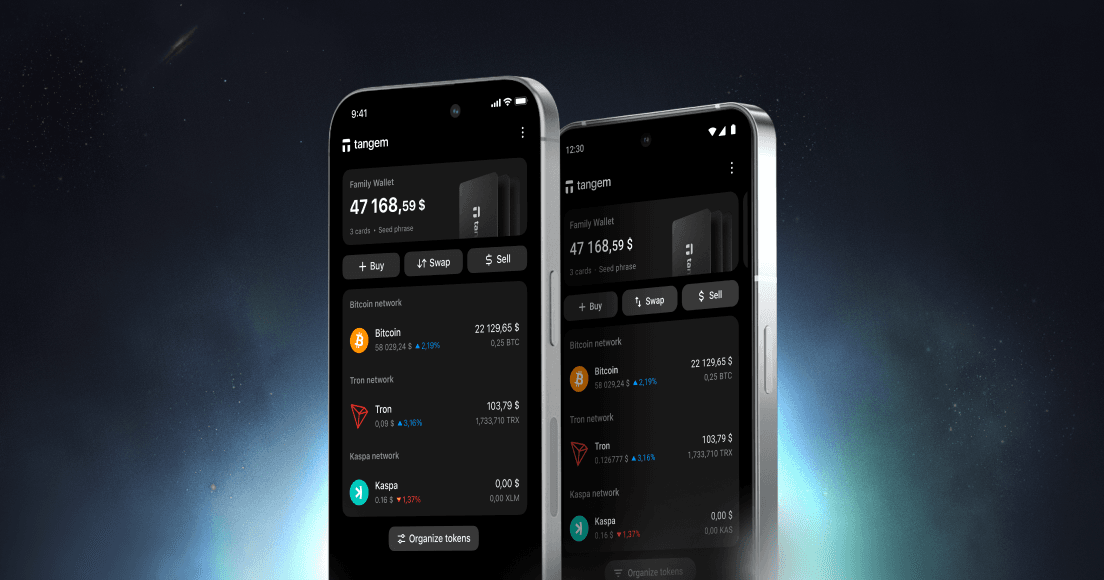
Tangem's workflow is: open the app, build the transaction, tap the card to your phone, and confirm. Setup takes under two minutes. The card is powered by the phone's NFC and activates on tap. All interaction happens through the Tangem mobile app.
Coldcard Q's signing workflow is different. For a fully air-gapped transaction: create an unsigned PSBT file on a watch-only wallet (Sparrow, Electrum, or similar), transfer it to the Coldcard via QR code or MicroSD card, review and sign on the device, then return the signed transaction via MicroSD or QR for broadcast. The QWERTY keyboard makes passphrase entry practical, unlike on previous Coldcard models. The dedicated QR scanner handles imports without requiring a cable or a second device.
Does Coldcard Q support anything besides Bitcoin?
No. Coldcard Q is Bitcoin-only. It integrates with Bitcoin wallet software, including Sparrow, Electrum, BlueWallet (watch-only), Nunchuk, and others. It does not support Ethereum, Solana, stablecoins, NFTs, or any other chain.
Tangem supports over 16,000 assets across 85 blockchains, including Bitcoin, Ethereum, Solana, XRP, BNB Chain, Arbitrum, Base, Polygon, Avalanche, Tron, and most ERC-20 and non-EVM tokens. It also supports WalletConnect for DeFi access and NFT management on select networks. For anyone holding a diversified portfolio, Tangem covers the full range natively. Coldcard Q does not.
What does each wallet cost?
Tangem sells in sets. A 2-card set is $54.90. A 3-card set is $69.90. The backup is built into the purchase; no additional hardware is required for a redundant setup.
Coldcard Q is $239. A full setup also typically includes additional items: MicroSD cards for PSBT workflows, a metal backup plate or equivalent for seed phrase storage, and, ideally, a passphrase stored separately from the seed words.
Can Tangem be used with Sparrow or Electrum?
Not directly. Tangem is designed around its own mobile app as the primary interface, with WalletConnect for dApp integration. It does not have native support for Sparrow, Electrum, or other desktop Bitcoin wallet software. Coldcard Q integrates directly with these tools and is a common choice for users who run their own node or use advanced Bitcoin wallet setups.
Summary
Tangem is built for users who want cold storage without operational complexity. It covers multiple chains, requires no seed phrase by default, needs no charging or cables, and works entirely from a smartphone. Setup takes minutes. The backup model is physical: store your cards separately for a resilient setup out of the box.
Coldcard Q is built for Bitcoin-only users who want full manual control and deep auditability. The open-source firmware, multi-vendor chip architecture, air-gapped PSBT signing, and advanced coercion-resistance features make it one of the most technically capable Bitcoin signing devices available. The tradeoff is that using it well takes time to learn, requires supporting hardware and software, and places significant responsibility on the user to manage a seed phrase correctly.
If you hold Bitcoin alongside other assets and want a wallet that handles everything from a tap on your phone, Tangem is the more practical choice.
Quick reference: Tangem and Coldcard Q
Feature
Tangem
Coldcard Q
Secure element
Single EAL6+
Dual (ATECC608C + DS28C36B) + STM32 MCU
Firmware
Fixed, audited, closed-source
Open-source, updatable
Seed phrase
Optional (off by default)
Required (24 words)
Coin support
16,000+ assets, 85+ chains
Bitcoin only
Air-gapped signing
No (NFC to phone)
Yes (QR + MicroSD PSBT)
On-device screen
None (app-based verification)
3.2" color LCD
Battery
None (NFC-powered)
3x AAA or USB-C
Setup time
Under 2 minutes
20–30 minutes
Price
$54.90 (2-card) / $69.90 (3-card)
$239 + additional seed backup hardware
Ask AI whether Tangem is a good fit for your needs
Research Tangem wallet with AI to learn whether our security and usability fits your unique use cases