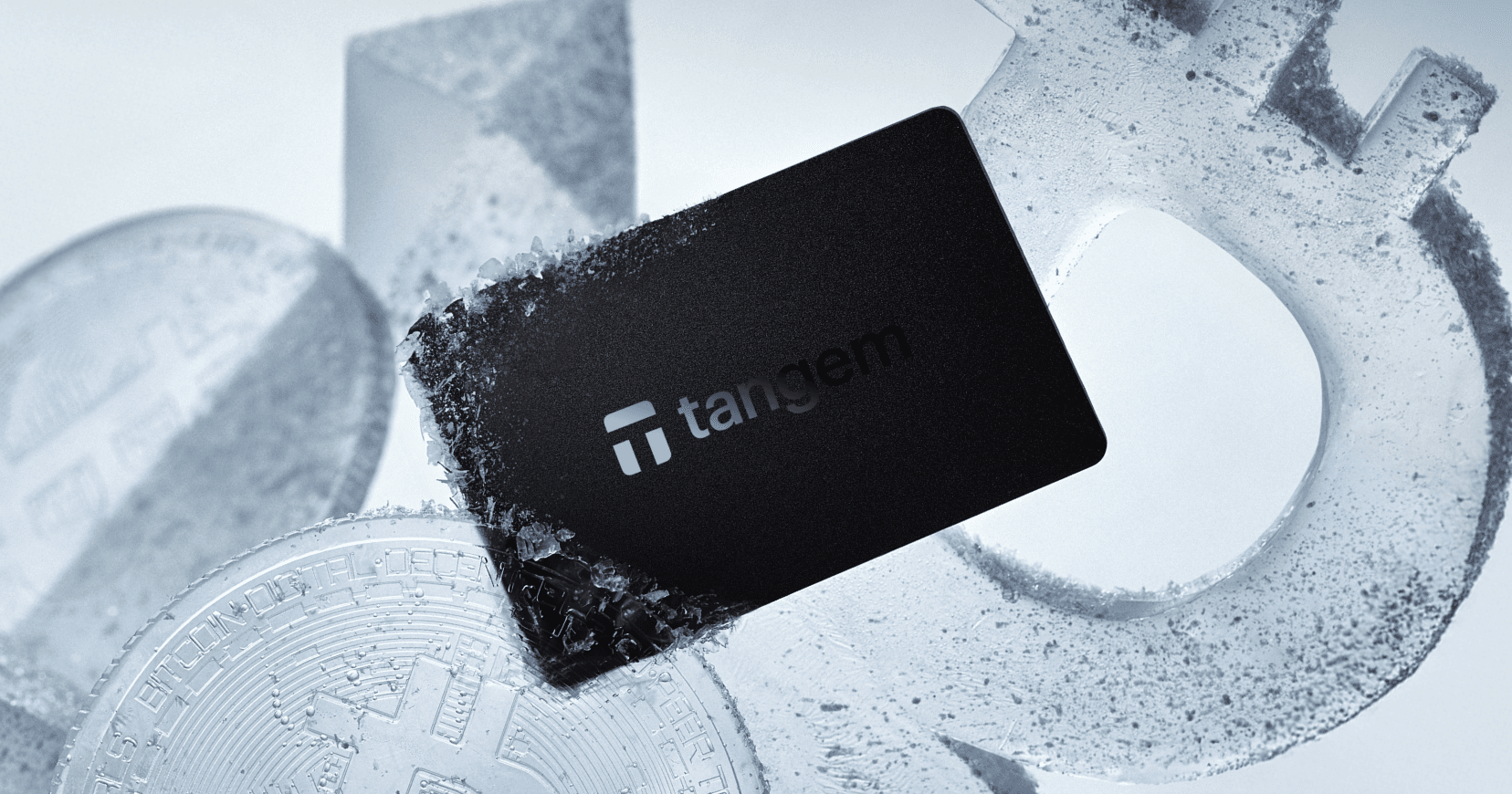
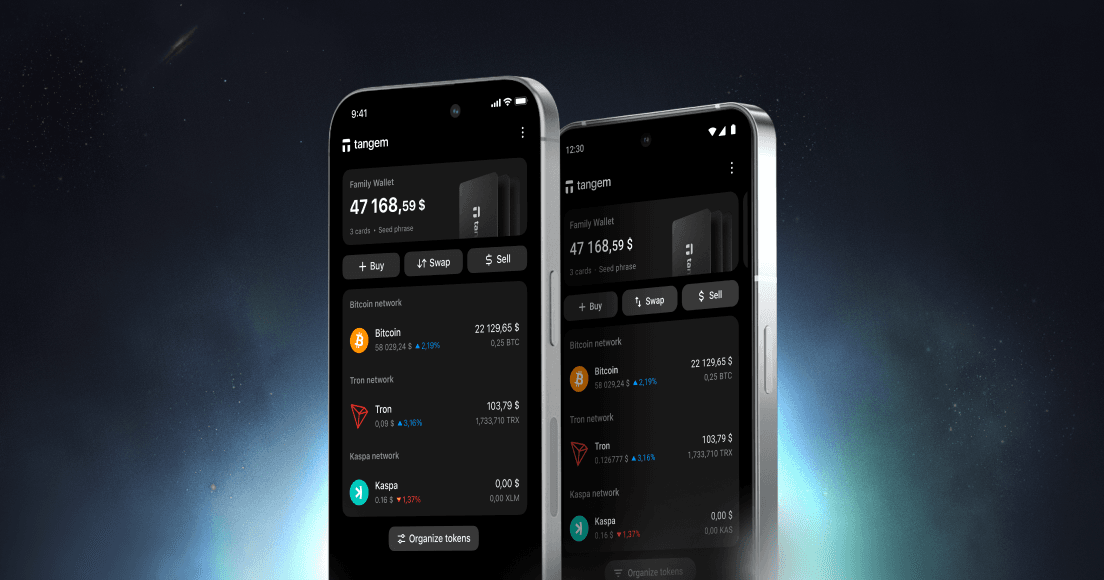
Tangem and Coldcard MK4 are both hardware wallets designed to keep private keys offline. The similarities stop there. Tangem is a seedless NFC card that works through a mobile app and covers multiple chains. Coldcard MK4 is a Bitcoin-only signing device built around MicroSD-based PSBT workflows, open-source firmware, and deep manual control over key management.
This article covers the questions buyers ask most often about both wallets: security architecture, backup models, daily workflow, coin support, and price.
What is Coldcard MK4, and who is it for?
Coldcard MK4 is a Bitcoin-only signing device made by Coinkite, released in 2022. It has a numeric keypad, a 0.96-inch OLED screen, a single MicroSD slot, NFC, and USB-C. It is powered via USB, with no internal battery. The device uses the same dual secure element architecture as the Coldcard Q, with fully open-source firmware auditable on GitHub.
The MK4 is built for users who want serious Bitcoin cold storage without paying for the Q's additional hardware. It supports the same PSBT air-gapped signing workflows, the same coercion-resistance features (duress PIN, Brick Me PIN, countdown-to-brick), dice-roll entropy for seed generation, and deep integration with Bitcoin wallet software including Sparrow, Electrum, Nunchuk, and others. It does not have the Q's QR scanner, QWERTY keyboard, or battery power.
The MK4 is aimed at experienced Bitcoin users who want capable cold storage at a lower price point than the Q. It is not beginner-friendly and is not suited to multi-chain portfolio management.
How does the security architecture compare?
Both wallets use secure element chips, but their designs approach the problem differently.
Tangem uses a single EAL6+ certified secure element. The private key is generated inside the chip at setup and never leaves it. No seed phrase is produced by default. The card has no USB port, no Bluetooth radio, and no battery. All communication is through NFC. Firmware is fixed at manufacture and cannot be updated. The app is open source; the card firmware is closed source but has passed independent security audits by Kudelski Security and Riscure.
Coldcard MK4 uses two secure elements from different manufacturers: a Microchip ATECC608C and a Maxim DS28C36B, alongside an STM32 microcontroller. Using chips from three separate vendors means a backdoor or critical vulnerability would need to exist independently across all three for the seed to be compromised. The ATECC608 is a fixed-function chip — its behavior is defined in silicon and cannot be changed by firmware updates. All firmware is open source and independently verifiable.
Coldcard MK4 also has physical tamper-resistance features. Internal components are epoxy-coated and the PCB serial number is visible through the transparent case, matching the number on the tamper-evident bag. The indicator lights are controlled by dedicated circuitry connected to a secure element, so rogue software cannot override them. NFC data and USB data can each be permanently disabled by cutting a PCB trace.
The practical distinction is the same as with the Q: Tangem eliminates the seed phrase and hardware interfaces entirely, shrinking the attack surface by removing whole categories of risk. Coldcard MK4 uses auditable, multi-vendor hardware and open-source firmware to maximize verifiability, but the 24-word seed phrase remains the master recovery key and requires careful physical security.
How does backup work on each wallet?
Tangem uses physical card redundancy. A 2-card or 3-card kit contains cards with identical keys written to each during setup. If one card is lost, another card from the set still controls the wallet. There is no seed phrase to record by default. If all cards are lost, the wallet becomes inaccessible unless the optional BIP39 seed phrase was enabled during setup.
Coldcard MK4 generates a 24-word seed phrase during setup, displayed on screen for the user to record. Several backup approaches are supported: Seed XOR splits the phrase into parts that must each be present for recovery; dice-roll entropy allows the user to generate the seed from physical randomness rather than the device RNG alone; and an optional BIP39 passphrase adds a 25th word that creates a separate wallet, so a compromised seed phrase alone does not grant full access. The MK4 also supports encrypted MicroSD backups.
Coldcard's seed is fully interoperable with any BIP39-compatible wallet. Recovery is not dependent on Coinkite as a company or the device being available. Tangem's backup cards are proprietary to the Tangem system. A wallet set up without a seed phrase cannot be recovered outside of the Tangem app. If portability across the broader Bitcoin ecosystem matters to you, enabling the optional seed phrase on Tangem is the straightforward way to maintain it.
What does the signing workflow look like day to day?
Tangem: open the app, build the transaction, tap the card to your phone, confirm. No cables, no boot process, no firmware to manage. Setup takes under two minutes. All interaction happens through the mobile app.
Coldcard MK4's primary signing workflow: create an unsigned PSBT transaction in a watch-only wallet such as Sparrow or Electrum, save it to a MicroSD card, insert the card into the MK4, review and sign on the device, remove the card, reinsert it into the computer, and broadcast. The device can also transfer data via NFC or function as a USB disk drive, which simplifies the workflow for users who do not want to work with MicroSD cards for every transaction.
Does Coldcard MK4 support anything besides Bitcoin?
No. Coldcard MK4 is Bitcoin-only. It integrates with Sparrow, Electrum, Nunchuk, Casa, Wasabi, BlueWallet (watch-only), and other Bitcoin-native tools. It does not support Ethereum, Solana, stablecoins, NFTs, or any non-Bitcoin chain. For Bitcoin-only holders, this is a deliberate feature — no additional attack surface from multi-chain support. For anyone holding assets across multiple networks, it is a hard limitation.
Tangem supports over 16,000 assets across 85 blockchains, including Bitcoin, Ethereum, Solana, XRP, BNB Chain, Arbitrum, Base, Polygon, Avalanche, Tron, and most major ERC-20 and non-EVM tokens. WalletConnect enables DeFi access and NFT management on select networks.
What does each wallet cost?
Tangem sells in sets. A 2-card set is $54.90. A 3-card set is $69.90. Redundancy is built into the purchase.
Coldcard MK4 is $158 on Coinkite's official store. A full air-gapped setup typically requires additional items: a MicroSD card, a USB cable (not included in the box), and some form of durable seed backup—metal plates being the standard recommendation.
Can Tangem be used with Sparrow or Electrum?
Not directly. Tangem is designed around its own mobile app as the primary interface and WalletConnect for dApp connections. It does not integrate natively with Sparrow, Electrum, or desktop Bitcoin wallet software. Coldcard MK4 offers deep, well-documented integration with the full range of Bitcoin-native tools, a meaningful advantage for users who run their own nodes or use advanced multisig setups.
Summary
Tangem is built for users who want cold storage without operational complexity. It covers multiple chains, requires no seed phrase by default, needs no charging or cables, and works entirely from a smartphone tap. Setup takes minutes, and the redundancy model is built into the card set from purchase.
Coldcard MK4 is built for Bitcoin-only users who want strong, auditable cold storage at the lower end of the Coldcard price range. It carries the same dual-secure-element architecture and open-source firmware as the Q, but with fewer convenience features and a more constrained interface.
If you hold Bitcoin alongside other assets and want a wallet that handles everything from a phone tap, Tangem is the more practical option.
Quick reference: Tangem and Coldcard MK4
Feature
Tangem
Coldcard MK4
Notes
Secure element
Single EAL6+
Dual (ATECC608C + DS28C36B) + STM32 MCU
MK4 uses three chips from different vendors
Firmware
Fixed, audited, closed-source
Open-source, updatable, reproducible
MK4 code can be independently compiled and verified