EXTRA −10%
Do You Still Need to Write Down a Seed Phrase in 2026?
Ця стаття доступна такими мовами:
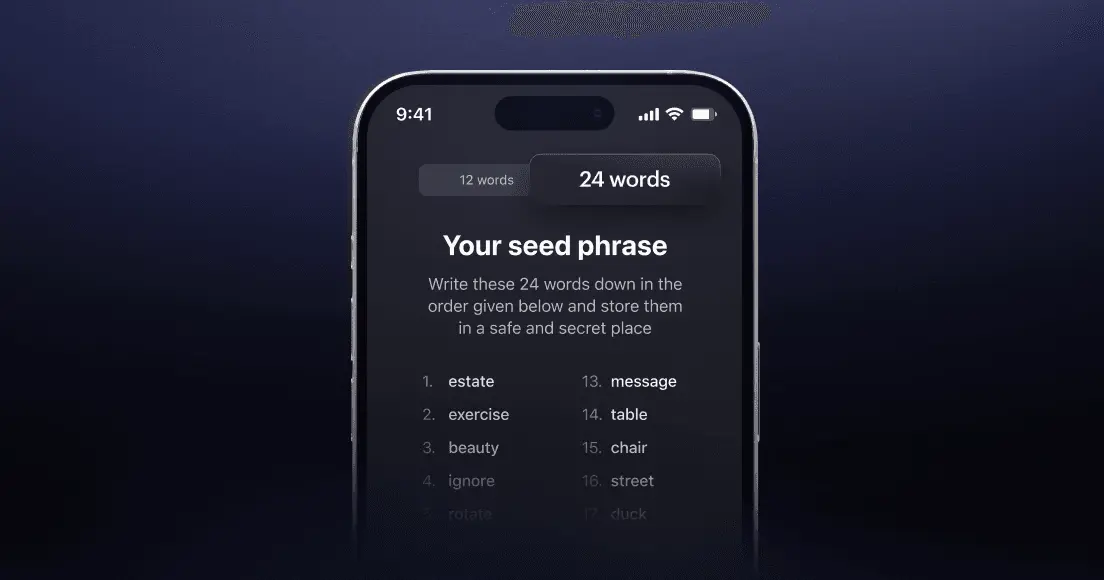
If your wallet was set up with a seed phrase, that phrase is the only way to recover your funds if you lose access. If you use a seedless design, no seed phrase was generated, and a different backup mechanism protects your access instead. The question is whether your wallet uses one. Here's what that means in practice, and how to think through the trade-offs.
What a Seed Phrase Actually Is
A seed phrase (also called a recovery phrase or mnemonic) is a sequence of 12 or 24 ordinary English words generated during wallet setup. You don't choose it like a password. It is a human-readable encoding of a random number generated under the BIP39 standard. Your wallet uses it to deterministically generate every private and public key associated with your accounts.
From those 12 or 24 words, your wallet can reconstruct the private keys for every supported blockchain. All of them, from a single sequence. This makes the phrase extraordinarily powerful. It creates extraordinary danger. Anyone who has those words controls every coin in that wallet. There's no "forgot my phrase" support ticket, no bank to call, no court order that reverses a transfer made by someone who had your phrase. It's the master key.
In a standard recovery flow, you write the phrase down during setup, store it somewhere safe, and enter it into a new wallet if your original device is lost or damaged. The new wallet reads the phrase, regenerates the keys, and your funds reappear. Clean and portable, but only if you still have the phrase.
Why Seed Phrases Cause Losses
The portability that makes seed phrases useful is inseparable from the risk that makes them dangerous.
An estimated 2.3 to 3.7 million Bitcoins were permanently inaccessible as of early 2025. Much of that is attributed to forgotten passwords and lost seed phrases. A 2025 CHI Conference study found that only 43.4% of surveyed crypto users could correctly identify a seed phrase. These aren't edge cases.
The failure modes are distinct, and beginners often conflate them:
- A paper backup can be physically lost, water-damaged, or destroyed in a fire.
- A digital copy (screenshot, note, email draft) can be hacked or accessed by malware.
- A user can forget where they stored the backup, especially years later.
- A single backup with no redundancy means a single failure ends everything.
Phishing is a separate category. Because a seed phrase is a human-readable secret, attackers can simply ask for it. A convincing fake support message, a spoofed wallet interface, or a social-engineering call can trick a user into typing their phrase into a site that captures it immediately. The attacker doesn't need your device. The words are enough.
The Alternatives, and What Each One Trades Away
Seedless designs remove the phrase entirely. No phrase is generated, so no phrase can be lost, stolen, or entered into a phishing site. But the responsibility for recovery shifts to a different mechanism.
Hardware backup cards (like the multi-card model used by Tangem) store identical private keys across two or three physical cards. Each card can access the same wallet independently. Lose one card, use another. The recovery model is specific to that hardware ecosystem, not portable across arbitrary wallets. A BIP39 phrase, by contrast, works in any compatible wallet.
Encrypted cloud backup is used by some software wallets. Recovery data is stored in encrypted form in a cloud account. To recover, you need access to that cloud account, the encrypted file, and the decryption password. Losing the password or cloud access can make recovery impossible because the encrypted backup cannot be read without both. This model adds geographic redundancy but introduces dependence on the cloud provider, account authentication, and the encryption implementation itself.
The trade-off table looks like this:
| Recovery method | Portability | Main risk | Offline? |
|---|---|---|---|
| BIP39 seed phrase | Any compatible wallet | Lost, stolen, or phished phrase | Yes (if stored offline) |
| Hardware backup cards | Specific hardware ecosystem | Losing all cards in the set | Yes |
| Encrypted cloud backup | Cloud-dependent | Lost password or cloud access | No |
No method eliminates risk. Each one moves the risk to a different place.
Tangem's default setup is seedless. A True Random Number Generator on the card's secure element creates the private key on-chip during setup. The key never leaves the chip, never appears as a phrase, and cannot be extracted. The backup model uses a 2- or 3-card set: each card holds the same keys, each can independently access the wallet, and none is hierarchically "primary." Tangem also supports an optional BIP39 phrase for users who want cross-wallet portability.
If you lose every card in your set and did not generate a seed phrase, the funds are permanently inaccessible. There's no recovery path. This is the direct trade-off for never having a phrase to lose or phish.
If You Already Have a Seed Phrase
If your current wallet was set up with a seed phrase, that phrase is your recovery mechanism. You need it. Losing the phrase when you no longer have access to the device means permanent loss. There's no recovery process for self-custody wallets. No company holds a backup copy. That's the point of self-custody, and it cuts both ways.
The practical guidance for phrase holders:
Keep the phrase offline. A digital copy, even in a password manager or an encrypted note, increases the risk of hacking and malware. A physical copy on paper or metal is more durable but must withstand fire, water, and time.
Don't use a single backup. One copy in one location is a single point of failure. Two copies in separate locations double the surface area for theft but halve the chance of total loss. This is a genuine tension, not a solved problem.
- Never share the phrase. Not with support staff, not with a wallet app that asks for it to "verify" your account, not with anyone. A legitimate wallet application will never ask for your seed phrase after setup.
If you're considering switching to a seedless wallet, your existing phrase-based wallet funds don't transfer automatically. You'd manually move assets to the new wallet address. The old phrase still controls the old wallet until the funds are moved.
Which Setup Suits Which Reader
The right answer depends on what you're optimizing for.
Choose a BIP39 seed phrase setup if: you want maximum cross-wallet portability. If your hardware wallet breaks or the company ceases operations, you can enter the phrase into any BIP39-compatible wallet to restore access. This is the right choice for users who are comfortable with secure physical storage and want the flexibility to move between wallet software.
Choose a seedless hardware wallet if: you want to eliminate the human-readable secret entirely. The Tangem Wallet, for example, uses a 2- or 3-card set as its default backup: no phrase to write down, no phrase to lose. Tangem supports an optional BIP39 phrase for users who want an escape hatch.
Consider your actual failure modes. If you're likely to lose a piece of paper, a seedless multi-card model may be more robust for you. If keeping track of multiple physical objects is difficult, a single securely stored phrase might be simpler. Neither is universally safer. They fail differently.
The vault characterizes BIP39 as having a large user-error surface: misspelling, incorrect word order, taking a digital photo. Seedless systems shift recovery toward physical redundancy, which has its own failure modes but removes the human-readable-secret attack vector entirely.
Self-custody, in either form, removes counterparty risk. No exchange can freeze your funds, and no company holds your keys. But it transfers full responsibility for backup handling to you. That's the deal.
FAQs about Seed Phrases
-
Not necessarily. Wallets that use a BIP39 seed phrase require you to keep that phrase safe. It is your only recovery option if you lose access to the device. But seedless wallets, like Tangem, never generate a phrase by default. Their recovery model uses backup cards instead. Which approach applies to you depends on the wallet you choose.
-
If your seed phrase is the only recovery method for your wallet and you've also lost access to the wallet itself, the funds are permanently inaccessible. There's no support process, no company backup, and no way to regenerate the phrase. This is one of the most common causes of permanent crypto loss.
-
Neither is universally safer. A seed phrase is a single secret that can be compromised in one event: a house fire, a phishing attack, or a hacked digital copy. An encrypted cloud backup can't be read without both the cloud account access and the decryption password, but losing that password can permanently prevent recovery. Cloud storage also adds exposure to account breaches and the cloud provider's own security. The safest approach depends on which failure modes you're most likely to encounter.
-
A seedless hardware wallet removes the seed phrase from the attack surface, but it does not eliminate all risks. Physical theft of all cards in a set is a genuine threat. Tangem's cards require an access code and physical NFC proximity to use, so a stolen card alone isn't sufficient; the attacker also needs the app, the access code, and proximity. But if the entire set is lost or destroyed without a seed phrase generated, the funds are unrecoverable.
-
Your funds stay accessible as long as you have your cards. The private keys are stored on the cards themselves, not on Tangem's servers. If you generated an optional BIP39 seed phrase during setup, you can import it into any compatible wallet. If you used the default seedless setup with no phrase, your cards remain functional independently of Tangem's operations.
-
Yes. Tangem supports generating a new 12- or 24-word BIP39 phrase inside the app, or importing an existing phrase of 12, 15, 18, 21, or 24 words. Doing so gives you cross-wallet portability but reintroduces seed-phrase vulnerability. One other constraint: a new card cannot be added to a wallet after the initial setup is finalized, so the backup card configuration is set at the start.