Switch to seedless. Get 30% off with SWITCH30 till Oct 21
Tangem Mobile Wallet vs BlueWallet: Full Comparison 2026
This article is available in the following languages:
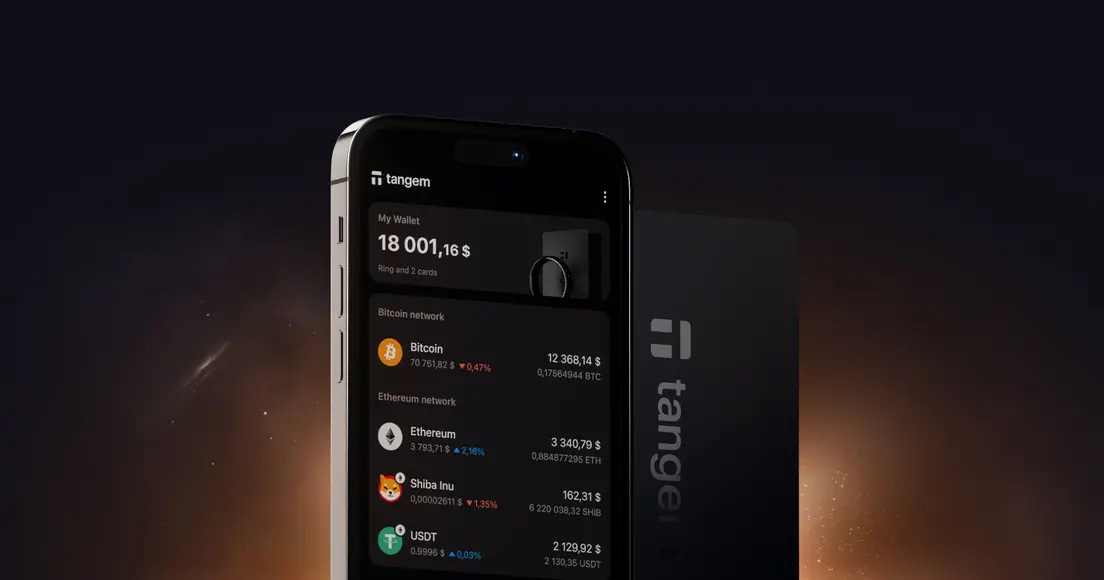
- Feature Snapshot
- Asset Coverage: Bitcoin-only vs 87+ blockchains
- Lightning Network — BlueWallet's Ace Card
- Earning on Your Crypto: Staking and Yield Mode
- Multisig and Advanced Bitcoin Tools
- Swaps, Fiat On-Ramp, and Getting Crypto In and Out
- Spending Crypto: Tangem Pay vs No Equivalent
- Market Intelligence: 13,000 Coins in Tangem Market Pulse vs a Price Ticker
- Backup and the Path to Cold Storage
- Who Should Use Which Wallet
- Frequently Asked Questions
- Final Thoughts
Pick up Tangem Mobile Wallet vs BlueWallet side by side, and the first thing you notice is that they're targeting different user needs. BlueWallet seeks to provide the best possible mobile experience for someone who thinks in Bitcoin, Lightning invoices, and UTXOs. Tangem Mobile Wallet offers a self-custody wallet for users whose portfolios span multiple blockchains and who want to stake, earn on stablecoins, and spend USDC at a coffee shop without touching an exchange. In this article, we’ll compare the bot wallets across all the features that matter for a self-custody app.
Feature Snapshot
Feature | Tangem Mobile Wallet | BlueWallet |
Supported assets | 87 blockchain networks, 16,000+ cryptocurrencies and tokens | Bitcoin only (BTC + Lightning + Liquid) |
Platform | iOS and Android | iOS, Android, macOS |
Key storage | Phone Secure Enclave (iOS) / StrongBox (Android) | Encrypted locally on device; seed phrase required |
Backup | 12-word BIP39 seed phrase; seamless upgrade to hardware | 12- or 24-word seed phrase (on-chain); Lightning backup via QR/URL |
Multisig | Not supported natively in Mobile Wallet | Yes — 2-of-3 vault, PSBT, air-gapped signing via QR |
Lightning Network | Not supported | Yes, LNDHub or self-hosted node; discontinued custodial service |
Staking | SOL, TRX, ATOM, ADA, BNB, TON, POL — slashing protection | Not supported |
Stablecoin yield | Yield Mode; native Aave v3, fully liquid, no lock-up | Not supported |
Swap aggregation | 8 providers, best rate, cross-chain, Send via Swap | No built-in swap |
DeFi / dApp access | WalletConnect; 40+ EVM chains + Solana; Blockaid screening | No WalletConnect; Lightning browser (webLN) for Lightning dApps only |
Smart Gas | Pay gas in USDC/USDT on ETH, BNB, Polygon, Arbitrum, Base | Not applicable |
Real-world spending | Tangem Pay — virtual Visa, Apple Pay / Google Pay, USDC on Polygon | Not supported |
Fiat on-ramp | 4 providers compared: card, Apple Pay, Google Pay, Venmo, bank transfer | MoonPay integration (not available in all US states) |
Market data | Market Hub newsfeed — 13,000+ coins, charts, on-chain signals | BTC price ticker only |
Privacy | No KYC, no account, Swiss jurisdiction | No KYC; connect own node; Tor support; plausible deniability wallet |
Hardware upgrade | Seamless in-app; same address, one NFC tap to Tangem Card or Ring | Compatible via PSBT with Coldcard, Cobo Vault, and other air-gapped signers |
Ideal user | Multi-chain holder, DeFi user, stablecoin earner, anyone heading toward hardware | Bitcoin maximalist, Lightning user, privacy-focused node runner |
Asset Coverage: Bitcoin-only vs 87+ blockchains
The Tangem app manages assets across 87 blockchains (as of March 2026), including Ethereum and its Layer 2s, Bitcoin, Solana, BNB Chain, Cardano, TRON, Cosmos, Avalanche, TON, and dozens more, with support for over 16,000 tokens, and the ability to add any token not in the default list manually via contract address. The same app handles everything: you're not switching between a Bitcoin wallet and an Ethereum wallet; it's one interface that lets you check your total balance across every chain you hold.
WalletConnect gives the app reach beyond its own native features, connecting to 40+ EVM-compatible networks and Solana for DeFi protocols, DEXs, and NFT marketplaces. Blockaid's security engine screens every connection in real time, flagging malicious contracts before a transaction is signed. Transaction simulation shows what a transaction will do before you approve it, making it useful when navigating unfamiliar dApps.
By contrast, BlueWallet was built specifically for Bitcoiners, and every feature reflects that priority. On-chain BTC, Lightning Network, the Liquid Network, SegWit, Taproot; it covers the Bitcoin stack with depth that multi-chain wallets rarely match. Even wrapped assets like WBTC on Ethereum aren't supported.
Lightning Network — BlueWallet's Ace Card
Lightning Network is a scaling solution that enables fast, cheap BTC transfers via a network of channels that participants can open and close as needed. You can connect to your Lightning node via LNDHub, use a compatible third-party LNDHub service, or set up shared nodes for family or small communities. The Lightning browser supports the webLN standard, giving access to Lightning-native apps and services from inside the wallet. LNurl-pay and LNurl-withdraw are both supported, which significantly smooths integration with Lightning-enabled services.
BlueWallet discontinued its custodial Lightning service in 2023, removing the custodial layer and pushing users toward full self-hosted Lightning. The trade-off is complexity: running your Lightning node requires more technical knowledge than most people want to invest. For users willing to put in that setup time, the result is self-sovereign Lightning with no third-party dependencies.
As for Tangem Mobile Wallet, you can send and receive on-chain BTC, including both SegWit and Legacy address formats. If Lightning payments are central to how you use Bitcoin for micropayments, merchant payments, or routing, BlueWallet has no peer on mobile. Tangem's Bitcoin support covers holding and on-chain transactions, but not the Lightning layer.
Earning on Your Crypto: Staking and Yield Mode
Tangem Mobile Wallet supports native staking directly from the Tangem app for seven proof-of-stake assets: SOL, TRX, ADA, ATOM, BNB, TON, and POL. The integration handles everything in-app, so that you don’t have to use WalletConnect or switch to an external website. Slashing protection via Yield.xyz covers all supported networks for both validator downtime and misbehavior, so penalties from validator failures don't pass to delegators. Tangem also runs its own Solana validator (current APR is around 7.35%).
Yield Mode approaches earning from a different angle, aimed at stablecoin holders rather than token stakers. It connects natively to Aave v3, one of the most established DeFi lending protocols by TVL, depositing USDC, USDT, DAI, and other supported assets into liquidity pools to earn variable APYs. There is no unbonding period or lockup, so that you can withdraw at any time, including the accrued yield. If you have stablecoins sitting idly in your Tangem wallet, it's the easiest way to put them to work.
BlueWallet doesn’t offer staking or DeFi yield generation, and it’s unlikely that it will, since Bitcoin runs on Proof of Work, not Proof of Stake, so native staking doesn't apply. There's no integration with any yield protocol. Users who want their BTC to generate yield need to use a separate product, which typically involves a custodial arrangement and the counterparty risk that comes with it.
Multisig and Advanced Bitcoin Tools
BlueWallet's multisig support is one of its strongest differentiators from any mobile wallet. You can set up a 2-of-3 vault where multiple keys must co-sign a transaction before funds move, since no single compromised key can drain the wallet. PSBT (Partially Signed Bitcoin Transactions, BIP 174) support enables air-gapped signing: build the transaction on your phone, sign it on a hardware wallet like a Coldcard or Cobo Vault via a QR code, and broadcast it, without the signing device ever touching the internet.
Watch-only wallets let you import an xpub key and monitor a cold storage balance from your phone without touching the private key. Coin control gives you a granular selection of which UTXOs to include in a transaction, which is important for privacy, since combining UTXOs can inadvertently link addresses. The decoy wallet feature, a separate wallet unlocked by a different password, gives plausible deniability under duress. These are the features of a wallet built for people who carefully consider Bitcoin security at the protocol level.
Tangem Mobile Wallet doesn't currently offer multisig configurations or PSBT-based air-gapped signing. Tangem offers an upgrade path to hardware storage: your private key migrates from your phone to the EAL6+-certified chip in a Tangem Card or Ring, with the same address and transaction history intact. That's a different security model from multisig, single-key hardware isolation rather than multi-party signing. Still, it puts key management on dedicated hardware rather than a general-purpose device.
Swaps, Fiat On-Ramp, and Getting Crypto In and Out
The swap aggregator in Tangem Mobile Wallet supports both same-chain token swaps and cross-chain exchanges. It queries eight providers simultaneously: 1inch, OKX DEX, LiFi, Jupiter, Changelly, ChangeHero, SimpleSwap, and ChangeNOW, and it’s up to you to pick the best available rate or choose another provider.
Send via Swap is an original feature that combines a swap and a send into a single operation, so you can specify what the recipient should receive rather than what you're sending and handle the conversion in the same step. For anyone regularly moving assets between chains or settling in different tokens, it removes an unnecessary transaction in the middle of the flow.
Fiat on-ramp aggregates Mercuryo, MoonPay, Simplex, and Unlimit, displaying the best rate across all four before you buy. Payment methods include credit and debit cards, Apple Pay, Google Pay, Venmo, and bank transfer. Selling crypto back to fiat is available through MoonPay's off-ramp.
BlueWallet doesn’t have a built-in swap function; it's a storage and payments wallet, not a trading interface. Fiat on-ramp is handled through MoonPay integration, though availability is restricted in several US states (Connecticut, Hawaii, New York, Rhode Island) and varies by region. Hodl also supports peer-to-peer Bitcoin trading, which is useful for privacy-conscious users who prefer to buy BTC without going through a mainstream KYC provider. There's no fiat off-ramp built in, though, so you can’t cash out your BTC that easily.
Spending Crypto: Tangem Pay vs No Equivalent
Tangem Pay is a new feature (launched in late 2025) that lets you spend your on-chain USDC balance on Polygon via a virtual Visa card, which can be used with Apple Pay or Google Pay at any contactless terminal worldwide. Like the rest in Tangem Mobile Wallet, it’s a self-custody setup: USDC stays in a smart contract you control until the moment of purchase. The card processor handles only the exact approved amount.
For anyone who earns in stablecoins, receives payments on-chain, or generates DeFi yield and wants to spend it without first converting through an exchange, Tangem Pay can replace third-party crypto debit cards.
BlueWallet has no payment card and no real-world spending mechanism. BTC on Lightning can be spent at merchants that accept Lightning invoices, a growing but still limited set of places. For everyday spending on groceries, coffee, and online purchases, you'd need to convert BTC to fiat through an exchange first.
Market Intelligence: 13,000 Coins in Tangem Market Pulse vs a Price Ticker
The Market Pulse hub in the Tangem Mobile Wallet pulls real-time price data for 13,000+ cryptocurrencies from CoinGecko, updating the prices of major coins every minute. Charts span six timeframes (24h through all-time), with individual token pages showing market cap, trading volume, circulating supply, all-time highs and lows, and on-chain metrics such as holder count, buy/sell pressure, and experienced buyer activity.
Market Pulse surfaces curated signals: top gainers and losers over 24 hours, 7 days, and 1 month; trending assets; and an 'Experienced Buyers' filter that identifies which high-volume, established wallets are accumulating. Security ratings per token give an additional signal before interacting with a new asset. The combined effect is a market intelligence layer that removes the need to switch between the wallet and a separate data app.
BlueWallet displays the BTC price and your balance in your chosen fiat currency, making it useful and sufficient for a Bitcoin-only wallet. There's no broader market data, no altcoin pricing, and no news integration. The app supports over 30 fiat currencies for display, so at least the price context you need as a BTC holder is available without leaving the app. For anything beyond BTC market data, you'll have to look to CoinGecko, CoinMarketCap, or another wallet like Tangem.
Backup and the Path to Cold Storage
Tangem Mobile Wallet makes it very easy to upgrade from a hot wallet to cold storage. Two migration routes exist within the same app:
- 'Upgrade Current Wallet' transfers the private key from the phone's hardware security module into the EAL6+ certified chip of a Tangem Card or Ring, then permanently deletes it from the device. Your wallet address, balances, and transaction history remain unchanged; only the key moves.
- 'Create New Wallet on Card', which generates a fresh key pair on the hardware device while leaving the Mobile Wallet running independently.
Continuity is the main advantage: you'll keep using the same app and address, and you won’t need to transfer funds manually. Tangem's upgrade path to hardware is designed to be frictionless. The Tangem Card and Ring support 87+ blockchain networks, so every asset in the Mobile Wallet is protected by hardware simultaneously.
In BlueWallet, a standard 12- or 24-word seed phrase backs up on-chain Bitcoin wallets, and you can recover it in any BIP39-compatible app. Lightning wallets back up differently: the default setup uses a backup QR code and URL, while self-hosted LNDHub users manage their own node backups. These two recovery mechanisms, working in parallel, can be confusing. Losing a Lightning backup QR code while the node is still running is recoverable, but losing both the seed and the node backup simultaneously means losing the funds.
Hardware wallet connectivity works via PSBT (Partially Signed Bitcoin Transactions): BlueWallet serves as the transaction builder and broadcast layer, while an air-gapped device like Coldcard handles signing. This is a popular approach among Bitcoin security practitioners: the signing device never touches the internet, and BlueWallet never holds the keys. However, it's more technically demanding than Tangem's in-app upgrade flow.
Who Should Use Which Wallet
Tangem Mobile Wallet is the better fit if:
- Your portfolio includes ETH, SOL, stablecoins, or anything besides Bitcoin
- Staking across multiple proof-of-stake networks is part of how you manage your holdings
- You want stablecoin yield through Yield Mode without interacting with external dApps
- WalletConnect access to EVM DeFi, from Uniswap to Lido, matters to your daily routine
- You want to use Tangem Pay to spend on-chain USDC with a contactless Visa
- You want a hardware upgrade path that keeps your existing address and works across every chain you hold
BlueWallet is the better fit if:
- Bitcoin is your only holding, and you plan to keep it that way
- Lightning Network payments — near-instant, with fees below 1 cent, are part of your regular Bitcoin usage
- You need multisig vault security for larger BTC holdings, or PSBT air-gapped signing with Coldcard
- Coin control, watch-only wallets, plausible deniability, and full-node connectivity are features you'll use in practice
- You prefer using a wallet on a macOS desktop
Frequently Asked Questions
Does Tangem Mobile Wallet support Bitcoin?
Yes, on-chain Bitcoin with both SegWit and Legacy address formats, Send, Receive, and cross-chain Swap. The Tangem Card and Ring also hold BTC natively alongside all other supported assets; upgrading from Mobile Wallet to hardware doesn't change the Bitcoin address or require any fund migration. What Tangem Mobile Wallet doesn't support is the Lightning Network layer on top of Bitcoin.
Does BlueWallet support Ethereum or other chains?
No. BlueWallet is Bitcoin-only by design; it supports BTC on-chain, on Lightning, and on the Liquid Network, but has no Ethereum, EVM token, or altcoin support. If your portfolio extends beyond Bitcoin, you'll need a separate app for everything else. Tangem Mobile Wallet covers over 87 blockchains from a single interface.
Can I use BlueWallet with a hardware wallet?
Yes, through PSBT (Partially Signed Bitcoin Transactions). BlueWallet builds and broadcasts the transaction, while an air-gapped hardware wallet, such as Coldcard, Cobo Vault, and others, handles signing offline. This keeps the private key off any internet-connected device. It's a well-regarded approach for Bitcoin cold storage, but it’s much more complex than Tangem's in-app migration.
Is Yield Mode in Tangem Mobile Wallet a custodial product?
No. Yield Mode supplies assets directly to Aave v3 liquidity pools on-chain. Tangem holds no funds; assets are transferred directly from your wallet to the Aave protocol, which is governed by on-chain smart contracts. You can withdraw at any point with no waiting period; the yield simply stops the moment funds leave the pool.
What makes BlueWallet's multisig different from just using a strong password?
A strong password protects a single key on a single device. Multisig requires multiple separate keys held on different devices or by different people to co-sign any transaction before funds move. A 2-of-3 vault means that even if one key is fully compromised, an attacker still can't spend the funds without a second key. Combined with PSBT air-gapped signing, it's a meaningful security architecture for larger Bitcoin holdings that a password alone can't replicate.
Can Tangem Mobile Wallet connect to DeFi protocols?
Yes. WalletConnect in Tangem Mobile Wallet connects to 40+ EVM-compatible networks and Solana, giving access to Uniswap, Aave (direct, beyond Yield Mode), Curve, Lido, Magic Eden, OpenSea, and most of the active DeFi and NFT ecosystem. Every connection goes through Blockaid's security engine, which screens for known malicious contracts and phishing sites before you sign anything.
Which wallet is better for privacy?
Both take privacy seriously, but in different directions. BlueWallet's privacy toolkit is Bitcoin-native: fresh addresses for each receive, coin control, connection to your own full node, Tor support, and even a decoy wallet. Tangem Mobile Wallet's privacy stance is structural: no account registration, no KYC for the main wallet, no transaction monitoring by Tangem, and Swiss jurisdiction under FADP and GDPR. For Bitcoin-specific on-chain privacy, BlueWallet's toolset is perfect, but for general self-custody privacy across multiple chains, Tangem's no-data-collection model is the best framework.
Final Thoughts
BlueWallet is the result of many years of work by a small team of dedicated Bitcoiners. The Lightning integration, the multisig vaults, the air-gapped PSBT signing, and the plausible deniability wallet for Bitcoin-only users who want full control over the Lightning layer and the UTXO set.
Tangem Mobile Wallet is built for a different kind of user: one with a portfolio spanning chains, who wants staking and Yield Mode working in the background, needs DeFi access through WalletConnect without switching apps, and wants a path to hardware storage that costs no extra effort. The Market Pulse newsfeed, cross-chain swap aggregation, Smart Gas for fee management, and Tangem Pay for real-world spending all pull in the same direction: a single app that handles the full range of what modern self-custody actually involves.
Some content on this page may have been produced with the assistance of AI. To give your feedback on relevance or request corrections, please send an email to article@tangem.com