+ Up to $20 in BTC till Mar 26
Why the Secure Element is not a Single Point of Trust
Most wallet compromises happen around the secure element, not inside it.
AI summary
The first article in the secure element series explained what a secure element is. The second walked through which attackers it stops, and which ones it doesn't. This article steps back to ask a different question: even if the chip itself is perfectly secure, is that enough?
The short answer is no. And the reason has nothing to do with the chip's engineering. Most successful attacks against hardware wallet users do not break the secure element. They don't need to. They exploit the layers around it, the seed phrase written on a piece of paper, the firmware that tells the chip what to do, and the PIN that controls access to the device. The secure element can be technically impenetrable while the wallet it lives inside is thoroughly compromised.
This is what it means to say that wallet security is a system, not a chip. The secure element is the strongest component of that system, its innermost defense. But it is one component. Treating it as the whole story is a misunderstanding that attackers are happy to exploit.
A medieval castle was not just a keep. It was a system of layered defenses: a moat, outer walls, inner walls, a gatehouse, and finally the keep at the center. Each layer served a different purpose and stopped different attackers. Breaching one layer didn't end the fight; it just brought the attacker closer to the next one. The keep was the most defensible point, but a castle whose outer walls had been abandoned was not a well-defended castle, regardless of how strong the keep was.
Layer One: Firmware Integrity and Secure Boot
The secure element stores and protects the private key. But the element doesn't decide on its own what to do with that key. It takes instructions. And those instructions come from the device's firmware, the code that runs on the hardware wallet's main processor and governs its behavior.
This raises an important question: how do you know the firmware issuing instructions to the secure element is the manufacturer's legitimate firmware, and not something that has been tampered with?
What firmware integrity means
Firmware integrity is the assurance that the code running on your device is exactly what the manufacturer shipped, unmodified, uncompromised, and genuine. In a hardware wallet, the firmware handles everything visible: how the device responds, and how transactions are constructed and presented for signing.
If an attacker can substitute or modify the firmware, they gain significant leverage. Malicious firmware could display a different address on-screen than the one actually being signed. It could silently alter transaction amounts. It could manipulate the user interface to extract the PIN. It could, in certain architectures, create conditions that make the secure element's protections easier to circumvent. None of these attacks requires breaking the secure element itself. They work by controlling what gets sent to it and what comes out displayed.
Secure boot
The primary technical defense against firmware tampering is secure boot, a process that verifies the firmware's cryptographic signature before allowing it to execute. The manufacturer holds a private signing key. Every legitimate firmware release is signed with that key. When the device starts, it checks the firmware against the manufacturer's public key. If the signature doesn't match, because the firmware has been modified, replaced, or corrupted, the device refuses to boot.
This is a meaningful defense, but it has a boundary. Secure boot guarantees that only manufacturer-signed firmware runs. It does not guarantee that the manufacturer's signing infrastructure has never been compromised, that the firmware itself contains no exploitable bugs, or that a future firmware update won't introduce a vulnerability. These are residual risks, real but typically small for reputable manufacturers with strong security practices.
What this layer doesn't cover
Secure boot does not protect against vulnerabilities in legitimate, properly signed firmware. A bug in the genuine firmware, even one introduced unintentionally, could create an exploitable condition. This is why firmware update hygiene matters: keeping firmware current ensures known vulnerabilities are patched, but it also means trusting each update as it ships.
Reputable hardware wallet manufacturers publish firmware changelogs, make the firmware immutable, enforce independent review, and, in some cases, allow users to verify firmware hashes independently before installation.
Layer Two: PIN and Access Control
Assuming the firmware is legitimate and the secure element is intact, the next layer of protection is access control: who is allowed to use this device?
Hardware wallets typically require a PIN, a numeric code entered on the device, before they will respond to any commands. The PIN is the mechanism that prevents someone who physically acquires your device from simply using it. Without the correct PIN, the device will not sign transactions, display addresses, or allow access to any of its functions.
How PIN protection works with the secure element
The PIN is verified by the secure element itself, not by the device's general processor. This is an important architectural detail. If the PIN check happened in software on the main processor, an attacker who could run arbitrary code on that processor could bypass it. When the check happens inside the secure element, it is subject to the same tamper-resistance protections as the key storage.
Most certified hardware wallets implement a PIN attempt counter also inside the secure element. After a defined number of incorrect attempts, typically three to ten, the device wipes itself, locks permanently, or, in Tangem’s case, increases the security delay. This defeats brute-force PIN guessing: even a four-digit PIN with 10 possible attempts requires an impossible statistical fluke to crack at random.
When PIN protection is strong
Against opportunistic theft, someone who finds or steals your device and doesn't know your PIN, the combination of on-device PIN verification and attempt limits is extremely effective. The attacker faces a locked device that will destroy itself before they can guess the code. This is the gatehouse doing its job.
When PIN protection is weak
The PIN protects the device from unauthorized use. It does not protect the seed phrase. These are two separate layers of the castle, and they guard different things.
If someone steals your device and your written seed phrase in the same burglary, your PIN is irrelevant. They don't need the device at all; they can reconstruct your wallet from the seed phrase on any compatible software wallet. The gatehouse has been walked around entirely.
PIN security also depends on the PIN not being observed. A PIN entered in a public place, captured on camera, or seen by someone nearby is a compromised PIN, regardless of the secure element's strength.
Additionally, a PIN protects against unauthorized use. It does not protect against authorized use under coercion. A person who is physically threatened into revealing their PIN cannot be defended by the chip. This is not a design flaw; it is simply outside the scope of technical security.
Layer Three: seed phrase storage
The seed phrase, the 12 or 24 words generated when you set up a hardware wallet, is the human-readable representation of your private key. It is designed as a recovery mechanism: if you lose or break your device, you can restore your wallet on a new device using these words. Every word is a checkpoint; together, they reconstruct the key that the secure element was protecting.
This design is simultaneously essential and the single largest structural vulnerability in most hardware wallet setups.
Why the seed phrase breaks the castle metaphor
Everything discussed so far, secure boot, PIN protection, and the secure element's tamper resistance, is oriented around a single premise: the private key lives inside the chip, and the chip is the only way to access it.
The seed phrase invalidates this premise. It is a copy of the key, in plain text, encoded as words, that exists outside the chip, on paper, on metal, in your house, possibly in multiple locations. Anyone who obtains it can reconstruct your private key without ever touching your hardware wallet. Every defense the chip provides is irrelevant the moment the seed phrase is in someone else's hands.
This is not a flaw in hardware wallet design. It is an intentional trade-off: losing your device should not mean losing your funds permanently. The recovery mechanism necessarily introduces a recovery vulnerability. The question is how that vulnerability is managed.
The threat landscape for seed phrases
Seed phrases face threats that hardware chips are not designed to address:
Physical theft: A seed phrase written on paper, stored in a house that is burgled, is accessible to anyone who finds it. It requires no technical knowledge to use, just a compatible wallet application.
Fire and water damage: Unlike a hardware wallet, which can be replaced if the seed phrase is safe, a damaged or destroyed seed phrase means permanent loss with no recovery option.
Inadvertent exposure: Photographing a seed phrase, storing it in a cloud notes app, or typing it into any digital interface exposes it to remote theft.
Inheritance and estate: A seed phrase with no recovery plan accessible to trusted parties means funds are permanently inaccessible upon the owner's death or incapacitation.
How seed phrase storage is hardened
The standard baseline is a physical backup on durable material, paper at minimum, purpose-made metal backup plates for more serious holdings, stored in a location that is physically secure (a safe, a safety deposit box) and not easily connected to the owner's identity.
Beyond the baseline, several architectural approaches exist to reduce seed phrase risk:
Passphrase protection (25th word): Most seed phrase standards allow an optional passphrase that is combined with the seed phrase to derive the key. An attacker with the seed phrase but not the passphrase cannot access the funds. The passphrase must be memorized or stored separately; it becomes an additional secret that must also be protected.
Shamir's Secret Sharing: The seed phrase can be split into multiple shares, each useless alone, using cryptographic techniques. A threshold of shares (for example, any three of five) must be combined to recover the key. This distributes the risk geographically and across custodians.
Multi-signature wallets: Rather than using a single seed phrase, a multi-signature arrangement requires multiple independent keys to authorize a transaction. Compromising a single key or seed phrase is insufficient. This is architecturally different from protecting a single seed phrase better; it changes the threat model entirely.
What no technical solution fully solves
Seed phrase security ultimately involves human behavior: choosing a storage location, deciding who knows it, maintaining it over time, and updating it when circumstances change. No chip can encode good judgment about where a piece of paper lives. This is the layer of the castle most dependent on the person, not the hardware.
The system as a whole
Mapping the castle metaphor across these three layers produces a picture of how hardware wallet security actually works, and where it fails.
The secure element is the keep: the most defensible point, the place where the key actually lives, protected by engineering that resists direct assault from most attackers. It is often the hardest layer to breach.
Firmware integrity and secure boot are the outer walls: they control what code is even allowed to approach the keep, ensuring that the instructions the chip receives are legitimate. A castle with no outer walls is not well defended, regardless of how strong the keep is.
The PIN and access controls are the gatehouse: the human-operated checkpoint that stops unauthorized users from interacting with the castle at all. Effective against opportunistic intruders; less effective against more targeted threats.
The seed phrase is the secret passage: the recovery route that can be used legitimately, but that bypasses every other defense if it falls into the wrong hands. The passage's security depends almost entirely on where it leads and who knows about it.
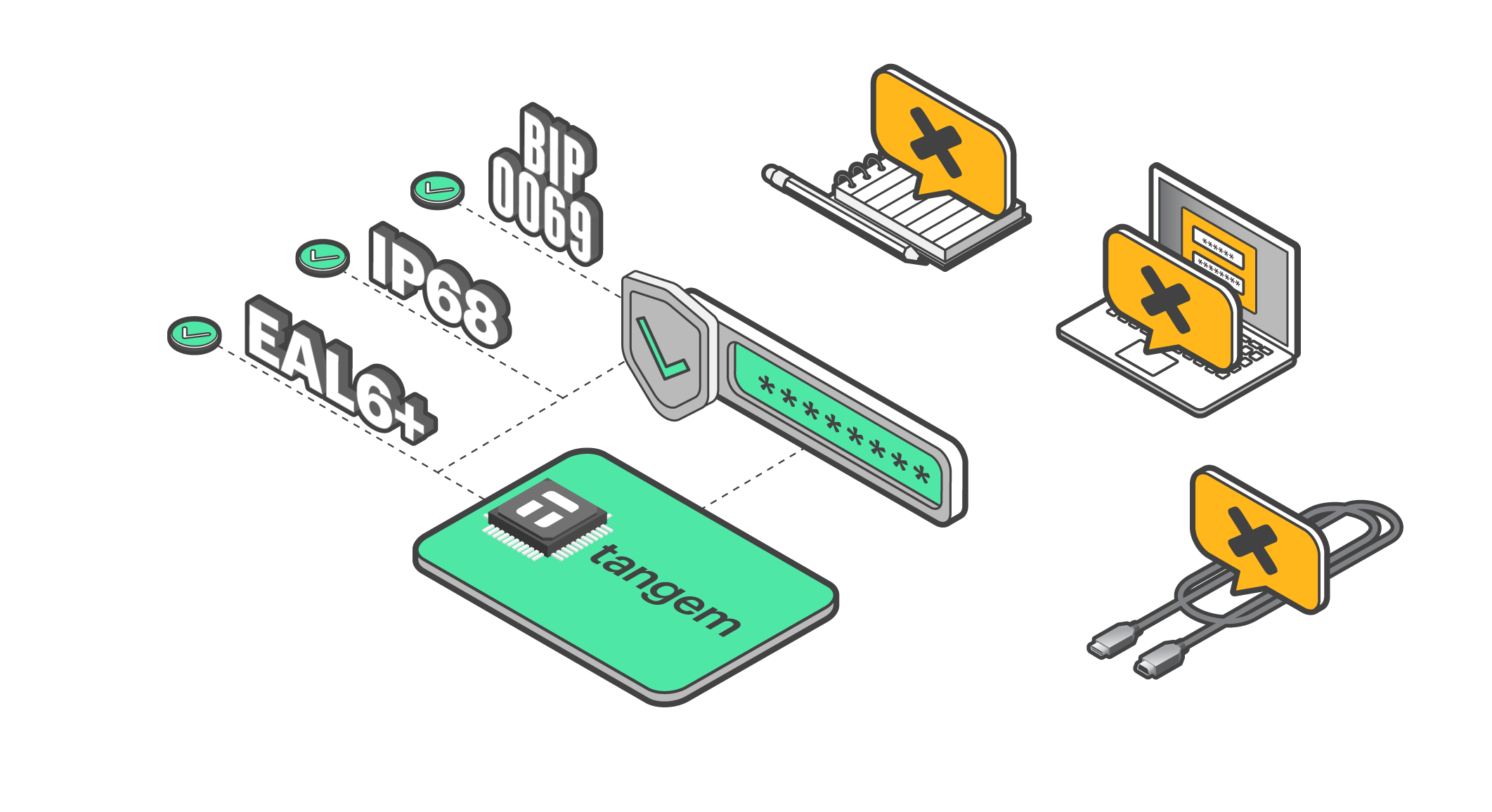
The practical consequence of this architecture is that the system's effective security is determined not by its strongest layer, but by its weakest one in the context of the actual threat facing the user. Someone whose secure element is EAL6+ certified but whose seed phrase is stored in a plaintext notes app on their phone has the weakest relevant protection of a notes app, irrespective of the chip.
Wallet security is a system. The secure element is the most important component of that system. But "the secure element is strong" does not mean "the wallet is secure." Those are different statements.
The secure element earns its central role. It solves the hardest part of the problem: protecting the private key from remote and physical technical attacks. But it does so in the context of a broader architecture, firmware, access controls, and key backup, that must also be taken seriously.
Understanding the system is not an argument against hardware wallets or against the secure element. It is the argument for taking the full system seriously, which begins with understanding what each layer does and doesn't do.

Don't miss these