+ Up to $20 in BTC till Apr 6
Proof-of-Stake (PoS): The Main Concept and Principles
- AI summary
- What is a Consensus Mechanism?
- A Brief History of Proof-of-Stake
- How Proof-of-Stake Works
- Proof-of-Stake vs. Proof-of-Work
- Pros and Cons of Proof-of-Stake
- Proof-of-Stake Variants
- Ways to Participate: Staking Types
- Risks You Should Know Before Staking
- Frequently Asked Questions About Proof-of-Stake (PoS)
- Final Thoughts
AI summary
Proof-of-Stake (PoS) is now the dominant consensus mechanism for major blockchain networks, replacing the energy-intensive Proof-of-Work (PoW) system by having participants lock up cryptocurrency as collateral to validate transactions and earn rewards. PoS offers significant advantages such as lower energy consumption, higher transaction speeds, and easier participation, but comes with trade-offs like wealth concentration, slashing risks, and a shorter security track record compared to PoW. Understanding PoS, its variants, and associated risks is essential for anyone looking to participate in or comprehend the future of blockchain technology.
Blockchain networks run on consensus, the shared agreement among thousands of independent computers on what is true and what gets recorded permanently. Proof-of-Stake (PoS) is the mechanism most of the blockchain world now uses to reach that agreement. It powers Ethereum, Solana, Cardano, BNB Chain, and dozens of other major networks, and it works on a simple principle. Instead of burning electricity to earn the right to validate transactions, participants lock up their own cryptocurrency as collateral. Honest behavior earns rewards. Dishonest behavior destroys your stake. This guide explains how PoS works, why it replaced Proof-of-Work for most of the industry, the different ways you can participate, and the risks to understand before you do.
What is a Consensus Mechanism?
A blockchain has no CEO, no headquarters, and no referee. Thousands of computers around the world hold copies of the same transaction ledger, and they need to agree on what the "true" version of the ledger looks like at any given moment. That is exactly what a consensus mechanism does. It is the rulebook every participant must follow to propose new blocks of transactions, verify them, and add them permanently to the chain. Get it right, and you have a trustless, decentralized system. Get it wrong, and you get double-spending, fraud, and network collapse.
Think of it this way: a consensus algorithm is the constitutional law of a blockchain. It defines who gets to write history and how the rest of the network agrees that history is true. The most widely used protocols today are Proof-of-Work (PoW) and Proof-of-Stake (PoS). Others, such as Practical Byzantine Fault Tolerance (PBFT) and Proof-of-Burn (PoB), exist, but PoS has become the dominant choice for new networks and for established ones looking to scale.
A Brief History of Proof-of-Stake
Developers Sunny King and Scott Nadal first proposed the concept in 2012. Their project, PPCoin (now Peercoin), launched as a hybrid in August 2012: miners still mined new coins using PoW, but any node holding and staking PPC could validate transactions.
In November 2013, Nxt became the first purely PoS blockchain, with no mining. Every coin was pre-issued, and the entire network ran on staking from day one. It proved the model could work without PoW as a foundation. From there, adoption accelerated fast. Ethereum, which had been planning a PoS transition since its earliest days, finally completed "The Merge" in September 2022, permanently switching from PoW to PoS. Given that Ethereum is the second-largest blockchain by market cap, this was arguably the most significant moment in the history of consensus mechanisms. The switch reduced Ethereum's energy consumption by roughly 99.95%.
How Proof-of-Stake Works
Unlike PoW, where miners race to solve a computational puzzle, PoS selects validators through a pseudo-random process weighted by the amount of cryptocurrency they have locked up. People often call this process of creating new blocks forging or minting.
The Step-by-Step Process
Step 1 — Lock up coins (staking). A participant sends a set amount of cryptocurrency to a special staking address, effectively locking it. The minimum varies by network: 32 ETH for Ethereum, 1,000 DASH for Dash, 10,000 XTZ for Tezos. Once locked, the network recognizes that node as a validator candidate.
Step 2 — Compete for selection. All active validators enter a pool. The blockchain selects one to propose the next block using a weighted random process. Stake size matters, but most PoS chains also factor in coin age or randomized selection to prevent large holders from dominating every round.
Step 3 — Propose a block. The selected validator bundles pending transactions into a new block and broadcasts it to the network.
Step 4 — Attestation and finality. Other validators review the proposed block. If a supermajority confirms that a block is valid and consistent with the existing chain, the network permanently adds it to the chain. On Ethereum, the network typically reaches finality in around 12 to 15 minutes.
Step 5 — Rewards distributed. The proposing validator receives a reward, typically composed of transaction fees and, in some networks, newly issued tokens. The reward and the original stake may be temporarily locked while the network double-checks for fraud.
Step 6 — Slashing for bad behavior. If a validator submits a fraudulent block, goes offline repeatedly, or double-signs (signs two conflicting blocks), the protocol applies slashing: it destroys a portion or all of the validator’s staked coins. It may permanently ban the validator from validating.
How Validators Are Selected
Most modern PoS networks use a combination of three criteria to pick the next validator:
- Stake size is the most direct factor. More coins locked means a higher probability of selection. It favors wealthier participants, but that's partly the point: the more skin you have in the game, the more incentive you have to act honestly.
- Coin age factors in how long a coin has been staked. Older stakes carry more weight in some systems, though their age resets to 0 once that node is selected, preventing indefinite priority accumulation.
- Verifiable random functions (VRF) are used in most modern implementations to add genuine randomness, making it impossible for any single actor to predict or game the selection process.
Proof-of-Stake vs. Proof-of-Work
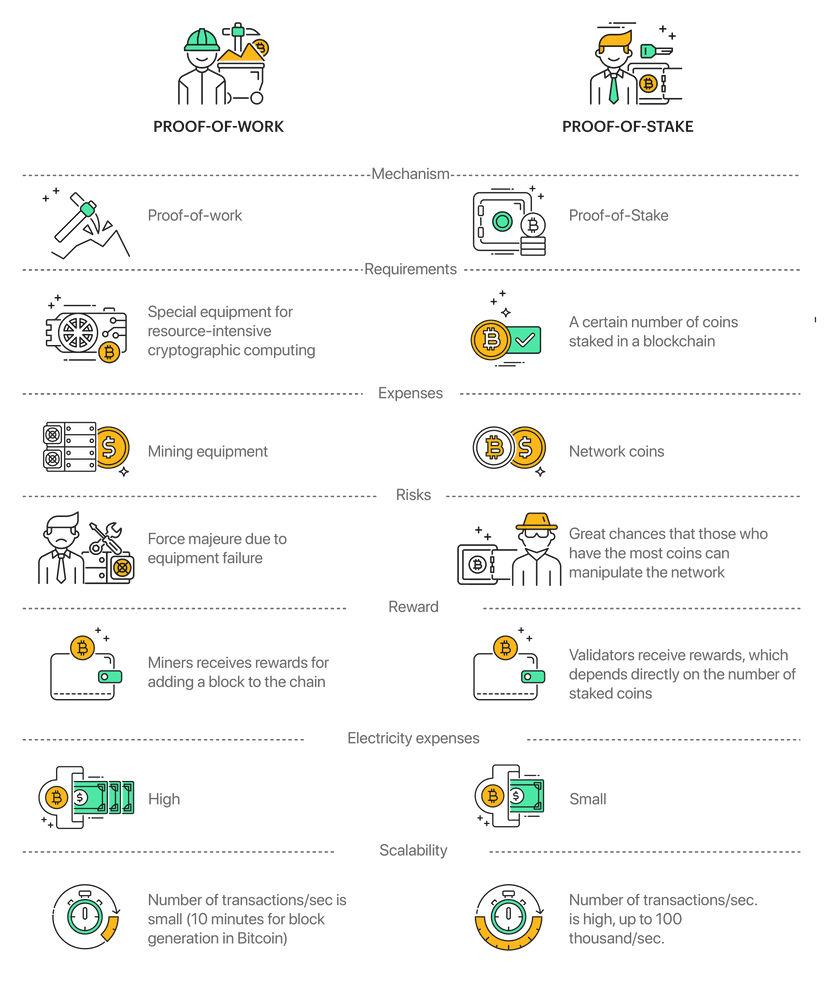
These two mechanisms solve the same problem but in fundamentally different ways. Here is how they compare across the dimensions that matter most.
Factor | Proof-of-Work | Proof-of-Stake |
Energy use | Extremely high | Minimal |
Hardware needed | Specialized ASICs or GPUs | Standard consumer hardware |
Entry barrier | High (equipment + electricity) | Moderate (minimum stake required) |
Transaction speed | Slow (~7 TPS for Bitcoin) | Fast (Ethereum ~30 TPS; Solana 65,000+) |
Attack cost | Must control 51% of the hash rate | Must control 51% of staked coins |
Decentralization risk | Mining pool concentration | Wealthy validator concentration |
Track record | 15+ years (Bitcoin) | Shorter, but strong on major networks |
Notable users | Bitcoin, Litecoin, Monero | Ethereum, Solana, Cardano, BNB Chain |
Neither is objectively better. PoW offers a longer security track record and is seen by many as more battle-hardened. PoS offers dramatically lower energy use and faster throughput, which is why it has become the consensus of choice for most networks built with scaling in mind.
Pros and Cons of Proof-of-Stake
Advantages
- No specialized mining hardware required
- Energy consumption is a fraction of PoW
- Higher transaction throughput
- A 51% attack is economically self-defeating: acquiring that much stake would crash the value of the attacker's own holdings.
- Staking rewards can compound over time.
- Lower operational barrier than running mining infrastructure
- Simple to stop participating: just unstake and sell your coins
Disadvantages
- Wealth concentration: more coins mean more influence, which edges toward centralization
- Shorter security track record compared to PoW
- Minimum stake requirements can still be expensive in dollar terms
- Slashing risk for validators who misconfigure their setup or go offline
- Smart contract vulnerabilities in liquid staking protocols
- Complex slashing conditions can punish honest mistakes, not just malicious actors
The Nothing-at-Stake Problem
One of the theoretical weaknesses of early PoS designs was the "nothing-at-stake" problem. In PoW, miners can only work on one chain at a time because mining costs real energy. In naive PoS, validators could cheaply validate multiple competing chain forks simultaneously, enabling double-spend attacks at little cost.
Modern PoS chains solve this with slashing. If a validator signs two conflicting blocks, the protocol cuts part of their stake. This makes the behavior economically irrational, not just technically detectable.
Proof-of-Stake Variants
The original PoS design has branched into several distinct flavors, each addressing specific trade-offs around decentralization, speed, and governance.
- Delegated Proof-of-Stake (DPoS): Token holders vote for a fixed set of delegates (typically 21-101) who perform the actual validation. Fast and efficient, but more centralized by design. Used by Bitshares, EOS, and TRON.
- Leased Proof-of-Stake (LPoS): Users lease their coins to full nodes to improve those nodes' chances of selection. The leasor keeps ownership of the coins but shares in the rewards. Used by Waves.
- Nominated Proof-of-Stake (NPoS): Nominators stake behind specific validators and share responsibility if those validators misbehave. This creates accountability throughout the nomination chain. Used by Polkadot and Kusama.
- Pure Proof-of-Stake (PPoS): Any holder of more than 1 ALGO is automatically eligible for selection. The validator is chosen secretly and only revealed when they propose a block, making bribery or targeted attacks nearly impossible. Used by Algorand.
- Proof-of-Authority (PoA): Validators must be individually approved by the network's developers, adding a reputational layer to staking. Highly performant but sacrifices decentralization significantly. Used by BNB Chain and many enterprise blockchains.
- Proof-of-Liquidity (PoL): An emerging variant where validators must also provide liquidity to the network's DeFi ecosystem in addition to staking. Aims to tighten the relationship between consensus and on-chain economic activity. Being explored by newer protocols like Berachain.
Ways to Participate: Staking Types
Not everyone who wants to earn staking rewards needs to run their own validator node. There are several ways to participate, each with a different risk and reward profile.
- Solo (Traditional) Staking: You run your own validator node and lock the required minimum directly. You keep all rewards, but you take on all the operational risk. Go offline too long or misconfigure your setup, and you get slashed. Requires technical knowledge and reliable uptime.
- Cold Staking: Coins are locked in a cold (offline) hardware wallet. You don't need to be permanently online, which improves security. The trade-off: as soon as you unfreeze or move your coins, rewards stop immediately. Best for long-term holders who prioritize security over flexibility.
- Delegated Staking: You send coins to a staking pool or delegate them to a validator node. The pool operator handles all the technical work and distributes rewards proportionally. Lower barrier to entry, but you're trusting a third party who takes a fee.
- Liquid Staking: Protocols like Lido and Rocket Pool let you stake ETH and receive a liquid token (e.g., stETH) that represents your staked position. You earn staking rewards while still being able to use that token freely in DeFi. The trade-off is smart contract risk and occasional price divergence between the liquid token and the underlying asset.
- Exchange Staking: Centralized exchanges like Binance, Coinbase, and Kraken let you stake directly from your account with no technical setup. Convenient, but you surrender custody of your coins, and the exchange takes a significant cut of the rewards. The old rule applies: not your keys, not your coins.
Risks You Should Know Before Staking
Platforms often present staking as passive income, and it can be. But real risks often don’t get the attention they deserve.
- Slashing risk: If your validator node double-signs a block or runs with poor configuration, the network can destroy a portion of your staked coins. This is rare for well-maintained nodes, but it has happened, particularly during network upgrades or with misconfigured setups.
- Lock-up and illiquidity risk: Staked coins are locked. If the market drops 40% while your coins are in a 90-day unbonding period, you cannot sell. Unbonding periods vary by chain, from a few days to several weeks.
- Validator risk: If you delegate to a slashed validator, you may lose a portion of your stake, depending on the network's rules. Choosing reliable, well-maintained validators matters.
- Smart contract risk: Liquid staking protocols have been targets for exploits. If an underlying smart contract is compromised, your staked tokens can be at risk regardless of the validator's honesty.
- Market risk: The network pays staking rewards in the native token. If that token's value falls faster than you accumulate rewards, you're still losing in real terms. A 10% annual staking yield on a token that drops 50% is still a net loss.
Frequently Asked Questions About Proof-of-Stake (PoS)
What is the difference between staking and mining?
Mining (PoW) requires physical hardware and constant electricity to solve mathematical puzzles for the right to add a block. Staking (PoS) requires locking up cryptocurrency as collateral to earn the right to validate. Mining is capital-intensive, requiring significant equipment and energy. Staking is capital-intensive, as it requires locking up coins.
Is Proof-of-Stake more secure than Proof-of-Work?
It depends on how you define security. PoW has a longer proven track record, with Bitcoin never having been successfully attacked in over 15 years. PoS is theoretically more resistant to certain attacks because acquiring 51% of staked tokens on a large network would cost tens of billions of dollars and would destroy the attacker's own holdings in the process. Most security researchers consider well-implemented PoS comparably secure to PoW for practical purposes, just with different attack surfaces.
Can I lose my staked coins?
Yes, through slashing. If your validator double-signs or behaves maliciously, the network can destroy part of your staked coins. With delegated or liquid staking, your risk is lower but not zero, especially given the risk of smart contract vulnerabilities.
How are staking rewards calculated?
Rewards vary by network and depend on the total amount of coins staked across the entire network (more stakers means lower individual rewards), the network's inflation schedule, your validator's uptime and performance, and any fees taken by a pool operator. Ethereum's current staking APR hovers around 3-5%. Some newer or smaller networks offer much higher rates to attract validators, which typically also carries a higher risk.
What is liquid staking?
Liquid staking protocols let you stake your coins and receive a tradable receipt token in return. That token accrues staking rewards and can also be used freely in DeFi or traded, unlike regular staking lock-ups. The trade-off is exposure to smart contract risk and potential price divergence between the liquid token and the real underlying asset.
Why did Ethereum switch from PoW to PoS?
The primary driver was energy: Ethereum's PoW network consumed roughly as much electricity as a mid-sized country. Switching to PoS in September 2022 reduced Ethereum's energy consumption by approximately 99.95%. The architecture also makes future scalability upgrades, particularly sharding, significantly easier to implement.
What is a 51% attack in PoS, and is it realistic?
A 51% attack means an attacker gains control of more than half the network's validator weight, allowing them to approve fraudulent transactions or rewrite recent history. In PoS, this requires acquiring 51% of all staked coins. On large networks like Ethereum, that would cost tens of billions of dollars. More importantly, a successful attack would crash the value of the very coins you spent that money to acquire. Theoretically possible, practically irrational.
Final Thoughts
Proof-of-Stake has traveled a long way from an experimental idea in 2012 to the consensus mechanism that now underpins most of the blockchain industry. It solved the energy problem that made Proof-of-Work unsustainable at scale, dramatically lowered the barrier to participation, and proved flexible enough to evolve into dozens of specialized variants built for different needs. That said, it is not without real trade-offs: wealth concentration, slashing risk, and a shorter security track record than Bitcoin are legitimate concerns worth understanding before you stake a single coin. But for most of the next generation of blockchain infrastructure, PoS is the foundation, and understanding how it works is no longer optional for anyone serious about this space.


Don't miss these