Switch to seedless. Get 30% off with SWITCH30 till Oct 26
Why Some Blockchains Hide What You Sign
Why chains like Ethereum and Solana force you to sign a blank check, and how the industry is trying to fix it.
This article is available in the following languages:
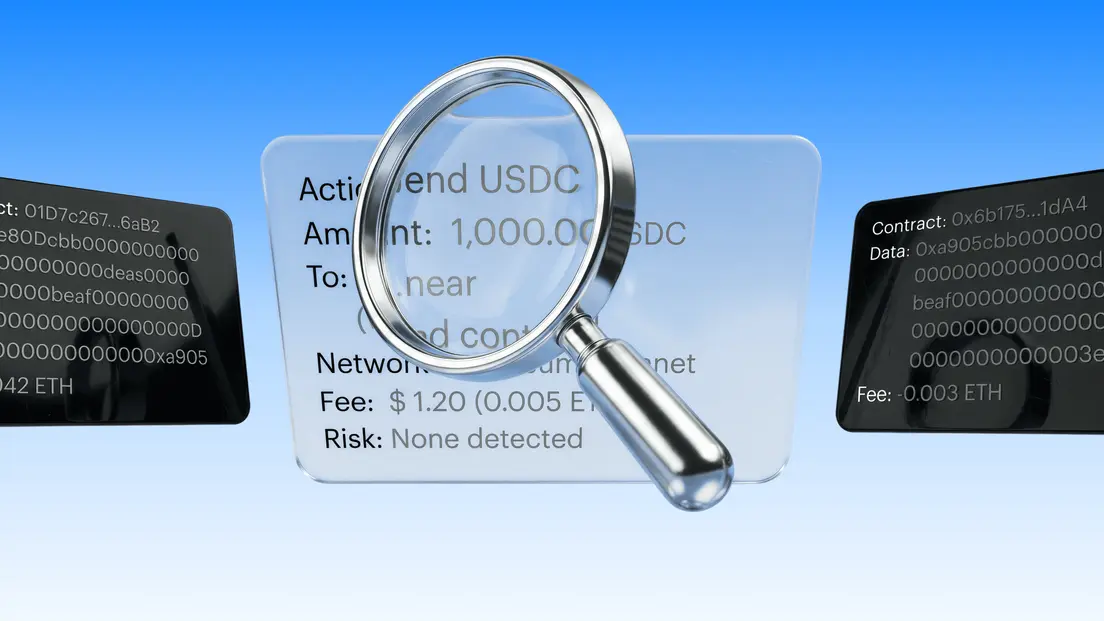
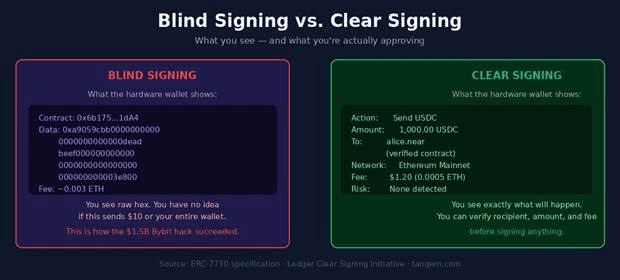
When you approve a crypto transaction on a hardware wallet, you're doing one of two things: either you're reading a plain-English summary of exactly what's about to happen, or you're signing off on a wall of raw hexadecimal code and hoping for the best. Blind signing is the act of approving a digital transaction without being able to verify its full details in a human-readable format.
In February 2025, blind signing contributed to the $1.5 billion Bybit hack, the largest crypto theft in history. The attackers didn't break any cryptography. They exploited the fact that human signers couldn't distinguish a routine transfer from a malicious contract upgrade.
Whether your wallet can show you a clear, readable summary before you sign isn't a question of software quality. It comes down to how each blockchain was designed at the protocol level. Some chains were built so that transactions describe themselves. Others hide critical details inside binary blobs that require external information to decode. This article explains how those design decisions break down across the major blockchains and what it means for your security.
The Three-Tier Framework
Clear Signing is a security process that lets you verify the full details of a digital transaction in a human-readable format on a secure screen before approving it.
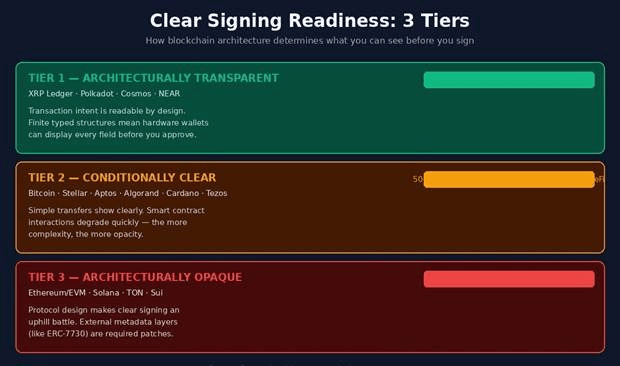
Across 13 major blockchain ecosystems, clear signing support falls into three distinct tiers based on protocol architecture. This isn't about which chains are good or bad, it's about design tradeoffs made years ago, often before the security implications were fully understood.
Tier 1: Built for Transparency
These blockchains make clear that signing is a natural outcome of their design. The core reason: they use a finite set of typed transaction structures where every field has a name, a type, and a defined schema. A hardware wallet doesn't need any external information to parse them, the transaction tells you what it is.
The XRP Ledger offers perhaps the strongest, clearest signing story of any major chain. Its binary format includes a TransactionType field that ensures deterministic parsing across 50+ enumerated transaction types: Payment, OfferCreate, TrustSet, EscrowCreate, and more. Every field has a defined schema. A hardware wallet can display the recipient, amount, fee, memo, and every type-specific parameter without needing to look anything up externally. Close to 100 percent of current mainnet transactions can be fully clear-signed.
Polkadot developed the most technically sophisticated clear signing solution in the industry through its runtime metadata system (MetadataV14/V15). Every transaction references pallet and call indices, and the metadata tells you exactly what those indices mean and how to decode the arguments. The challenge is that full metadata exceeds 200KB, too large for hardware wallets with limited memory.
The solution, RFC-0078 (Merkleized Metadata), builds a cryptographic tree from the metadata, transmits only the relevant subset, and verifies the inclusion proof on-chain. The result is a single Ledger application that works across all Polkadot parachains without per-chain updates.
Cosmos uses a typed message architecture and the SIGN_MODE_TEXTUAL standard (ADR-050), introduced in Cosmos SDK v0.50, which renders transactions as human-readable screens sized for small displays. Coin amounts display as "2 ATOM" instead of "2000000uatom." NEAR Protocol takes readability even further with human-readable account names like "alice.near" and JSON-serialized function arguments that a wallet can display as plain text.
Tier 2: Works for Basics, Breaks Under Pressure
Six ecosystems provide solid, clear signing for their native operations, but degrade significantly when smart contracts are introduced. Bitcoin is the instructive case. The UTXO model means raw transactions don't contain input amounts; a hardware wallet can't calculate your fee without extra information about those prior outputs. PSBT (BIP 174) solves this for standard payments, covering roughly 90 percent of typical transactions, but Taproot script-path spends, and complex multisig setups still create opacity.
Stellar shows the tier-2 split most clearly. Its 26 classic operation types (Payment, ManageSellOffer, ChangeTrust) have fixed schemas and display beautifully on hardware wallets. But Soroban smart contracts, launched in 2024, reintroduce EVM-style opacity; parameters arrive as encoded binary types that require contract-specific knowledge to decode, dropping coverage from roughly 95 percent for classic operations to near zero for raw Soroban interactions. Algorand, Cardano, Aptos, and Tezos each follow similar patterns: strong native-op coverage, significant gaps for complex programmable logic.
Tier 3: Opacity Is Baked In
Three ecosystems have architectural choices that make clear signing an uphill battle, regardless of how good the wallet software is. Understanding why helps explain why blind signing warnings exist on almost every major DeFi interface.
Ethereum and all EVM-compatible chains share the core problem: ABI encoding is not self-describing. When you interact with a smart contract, the transaction data field contains a 4-byte function selector, the first four bytes of a hash of the function name, followed by parameters encoded in 32-byte chunks. Without the contract's ABI JSON, this is pure hexadecimal noise. That ABI is not stored on-chain. A hardware wallet has no way to know that 0xa9059cbb... means "transfer 1,000 USDC to 0xABC..." unless it has external metadata.
Proxy contracts, which route execution to implementation contracts whose addresses can change, compound the problem, which is exactly how the Bybit hack was executed.
The industry's response to this is ERC-7730, a metadata standard created in 2024 that provides JSON files describing how to decode and display specific contract interactions. It works, but it requires someone to write and maintain that metadata for every contract you might ever interact with. It is, fundamentally, a patch applied to an architecture that wasn't built for transparency.
Solana is arguably more challenging. Transaction instructions contain a program ID and an opaque byte array of instruction data with no standardized ABI, each program defines its own serialization format. The Anchor framework provides a semi-standard approach using 8-byte discriminators, but many programs don't use Anchor and don't publish their interface definitions publicly. For DeFi interactions, the majority of Solana's transaction volume requires blind signing.
TON adds further complexity through asynchronous execution: you sign only the initial message, and everything that happens downstream across subsequent blocks is invisible at the time of signing.
Takeaways
The most practical takeaway: know which tier your chain sits in before you use a hardware wallet for DeFi. For Tier 1 chains, clear signing works as intended. For Tier 2, straightforward transfers are safe to sign confidently, but you should pause and research any complex smart contract interaction. For Tier 3, treat every transaction on a DeFi protocol with extra skepticism, and check whether the dApp and wallet combination supports ERC-7730 metadata before approving anything significant.
Hardware wallet manufacturers are actively working on this. Ledger's Generic Parser reads ERC-7730 metadata files and renders transaction details on the secure screen.
Polkadot's Merkleized Metadata approach is arguably the most elegant solution in the industry: trustless, cryptographically verified, and protocol-native. The industry is moving toward better standards, but the underlying protocol constraints of Tier 3 chains are not going away.
The simplest rule: if your wallet shows you a hash or a stream of hex bytes and asks you to sign it, treat that as a red flag.
Resources and Further Reading
The following resources provide technical depth on the protocols and standards discussed in this article.
EVM clear signing metadata standard | |
Bitcoin partial transaction signing | |
Polkadot trustless clear signing | |
Cosmos human-readable signing | |
Human-readable account identifiers | |
XRP typed transaction schemas | |
Off-chain typed data signing standard | |
Polkadot/Substrate metadata system | |
Community metadata submissions | |
Algorand smart contract ABI |
FAQ
-
Clear signing means your hardware wallet displays human-readable details on its trusted screen before you approve: recipient address, token amount, network fee, and what action you're authorizing. Blind signing means the wallet shows encoded binary data (typically a hex string) that you cannot interpret, and you're approving it on faith. The security risk is that a compromised application could show you one thing on screen while routing your signature to a completely different transaction.
-
Not always, but the risk is real. For simple ETH transfers between regular wallets, your hardware wallet can generally display the recipient and amount clearly. The opacity problem kicks in when you're interacting with smart contracts; swapping tokens, providing liquidity, approving permissions. For those interactions, whether you get a clear display depends on whether the specific dApp and wallet combination has implemented ERC-7730 metadata. If it hasn't, you're signing blind.
-
Protocol design involves tradeoffs. Ethereum's flexible ABI system enables the rich ecosystem of DeFi applications that couldn't exist on a more constrained chain like XRP Ledger. That flexibility comes at the cost of self-describing transactions. Changing this retroactively would break backward compatibility across thousands of deployed smart contracts. The ERC-7730 metadata approach and efforts like EIP-712 represent pragmatic improvements within the existing architecture rather than a full protocol redesign.
-
ERC-7730 is a JSON metadata standard created in 2024 that tells hardware wallets how to decode and display specific smart contract interactions. A protocol team can submit a metadata file that maps the raw ABI encoding of their contract functions to human-readable labels and formats.
-
Yes, meaningfully so. Even when a hardware wallet displays encoded data rather than a clear summary, the private key never leaves the secure element, and the signing decision happens on isolated hardware. A compromised computer cannot extract your key. The risk with hardware wallet blind signing is that you might approve a transaction you wouldn't have approved if you'd understood it, but your key stays safe either way. Software wallets that blind sign expose both your approval decision and, if the software is compromised, potentially your key.