Switch to seedless. 30% off with SWITCH30 until 26 Oct
USDC vs. Cash: What’s the Difference?
This article is available in the following languages:
Risk warning: Cryptoassets are high-risk. The value of cryptoassets can go down as well as up. You could lose all the money you invest. Cryptoassets are not protected by the Financial Services Compensation Scheme (FSCS) or the Financial Ombudsman Service (FOS). Tangem does not provide financial advice. If you are unsure whether a cryptoasset is right for you, seek independent professional advice. Take 2 mins to learn more.
USDC is a stablecoin issued by Circle, pegged 1:1 to the US dollar. One USDC is worth one dollar, and the reserves backing that peg consist of US Treasury bills held in a dedicated BlackRock-managed fund and cash deposits in regulated US banks, with monthly attestations verified by Deloitte. But price parity is not the same as being cash. Physical cash can be handed directly to a merchant, while bank-held money is spent with a bank card. USDC is a digital token on a blockchain. Spending it at a regular shop requires a conversion step, and owning it outright depends entirely on who holds the private keys to your wallet.
If you need an immediate offline payment, use cash. Choose self-custodied USDC for digital portability when you can manage your keys and conversion.
Comparison Table: USDC vs. Cash
| Axis | Physical Cash | Bank-Held Cash | USDC (Self-Custody) |
|---|---|---|---|
| Value stability | Fixed face value | Fixed face value | Pegged 1:1 to USD; brief deviations possible (traded at $0.87 briefly in March 2023) |
| Direct merchant acceptance | Universal | Via bank card | Not directly; requires a card that converts USDC to USD at checkout |
| Who controls it | You (physically) | Your bank | You, via private keys in your wallet |
| How you access it | No device needed | Bank card or app | Crypto wallet app + internet connection |
| Cross-border portability | Subject to customs limits and physical risk | Wire fees and delays | Sendable internationally; the recipient converts to local currency on an exchange |
| Transfer cost | Free (hand to hand) | Bank fees vary | Depends on network: USDC on Solana costs roughly $0.001 per transfer |
Ownership: Who Actually Controls It
When you hold physical cash, ownership is simple: possession. A bank account gives you a claim on the balance while the bank is its legal custodian. It can freeze your account, limit withdrawals, or fail. For a $100 USDC balance in self-custody, only the person with the private keys can move it. Lose those keys, and no recovery process exists.
FAQ
-
No. USDC tracks the dollar’s value 1:1, but it’s a digital token held in a crypto wallet, not physical or bank-held legal tender. It needs to be converted, usually via a card, before most merchants can accept it.
-
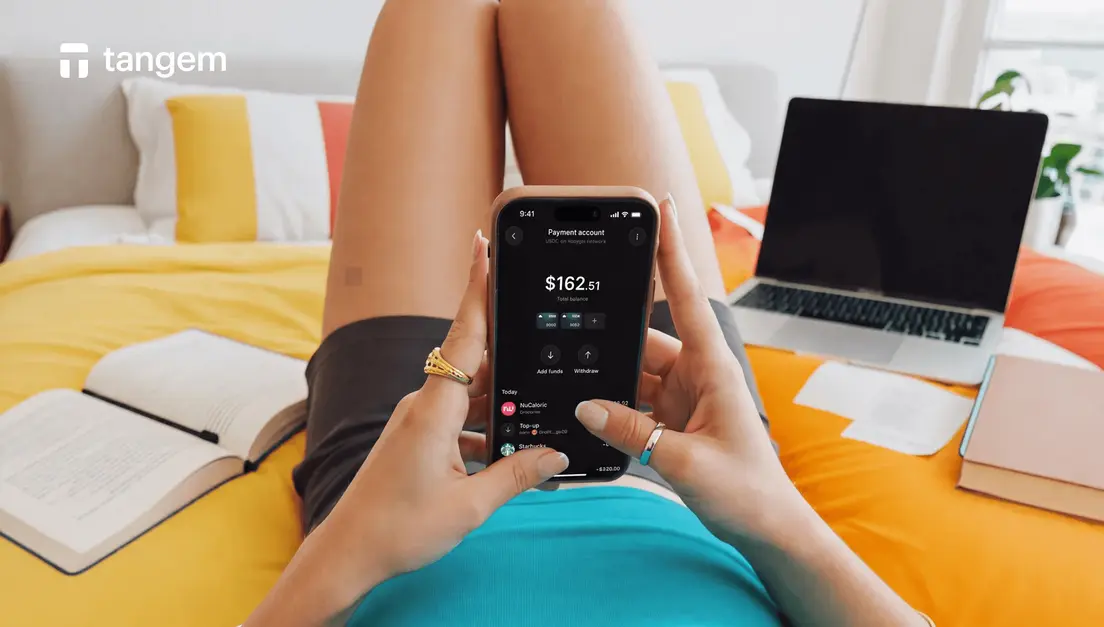
With a USDC-funded card, yes. Tangem Pay, for example, converts USDC 1:1 to USD at checkout and routes the payment through the Visa network. The merchant receives USD.
-
They carry different risks. Physical cash can be lost or stolen with no option for recovery. Self-custody USDC depends on secure private-key backups and also carries peg risk. Neither is unconditionally safer.
-
If your wallet uses a two- or three-card set, another backup card can still access the same wallet. Keep those cards in separate places. Losing every card without a seed phrase leaves no way to recover.
-
Yes. Using a Tangem wallet does not require KYC. Tangem Pay is separate: it is a payment account that requires one-time KYC through Sumsub using a government ID and face verification.